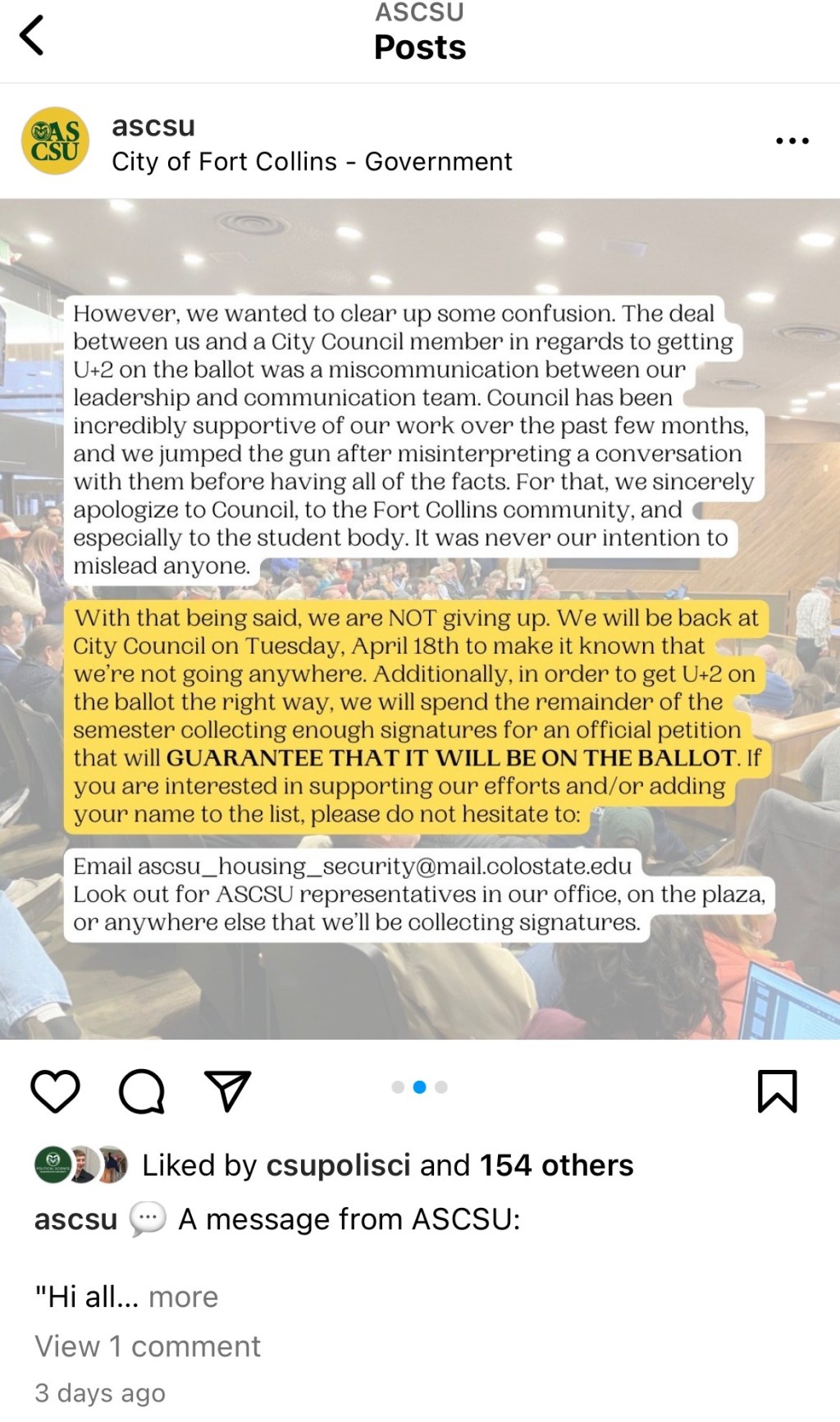
The Associated Students of Colorado State University held a student rally at City Hall on April 4 filling the council chamber so full the Fort Collins Fire Chief had to ask people to leave the building. The student rally was to put pressure on the council to make a motion to put a U+2 repeal on the ballot.
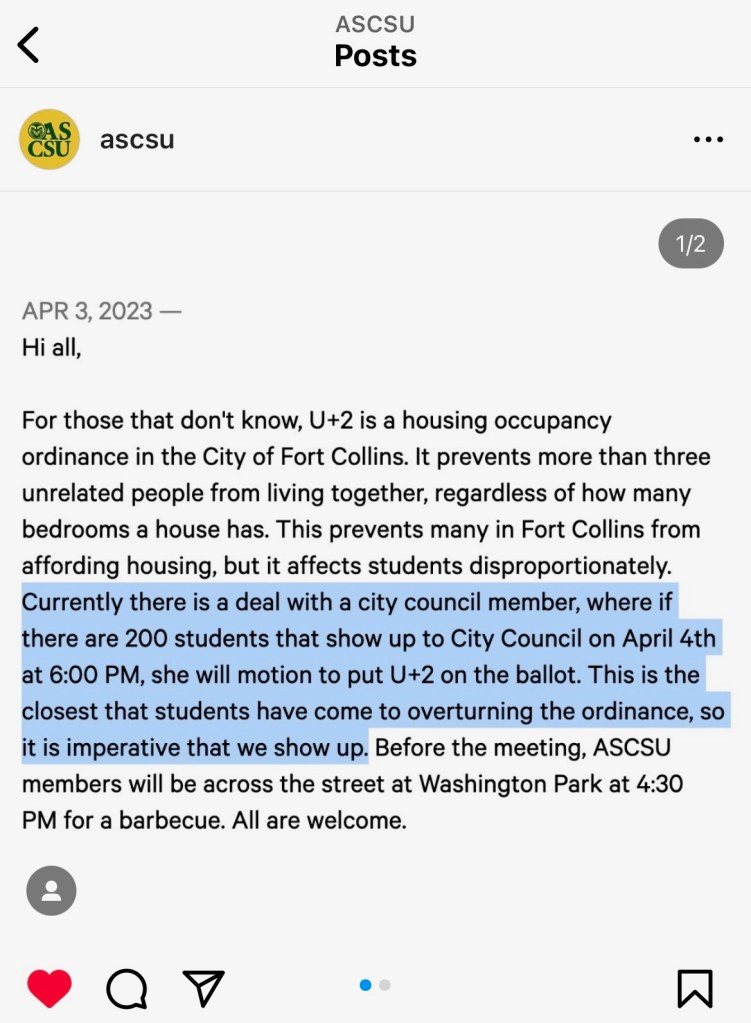
ASCSU posted to their Instagram that a member of City Council had promised that if 200 Colorado State University students showed up to the city council meeting, they would make a motion to put U+2 repeal “on the ballot,” presumably referring to the next city election, in November.
Evan Welch, Director of State Law and Policy for ASCSU, started the public testimony portion of the night with an explanation of why he thinks that U+2 should be overturned.
Public testimony on U+2 included ASCSU staff members, ASCSU Student Body President Rob Long and even the John Straayer Center for Public Service Leadership Director Sam Houghteling, testified in support of overturning U+2.
The city council meeting came at an interesting time in the housing debate in Fort Collins. The City has set dates for community engagement that the city has said will guide updates to their Land Use Code. Engagement will begin on the April 24 with an informational session.
It also comes as the Land Use Bill starts its journey through committees at the state capital. The Land Use Bill is extremely similar to Fort Collins proposed Land Development Code and would repeal U+2.
Despite a strong turnout from students that likely exceeded 200 no such motion was made.
ASCSU posted to their Instagram that there was an internal miscommunication between their leadership and communication team and there was in fact no deal like that on the table.
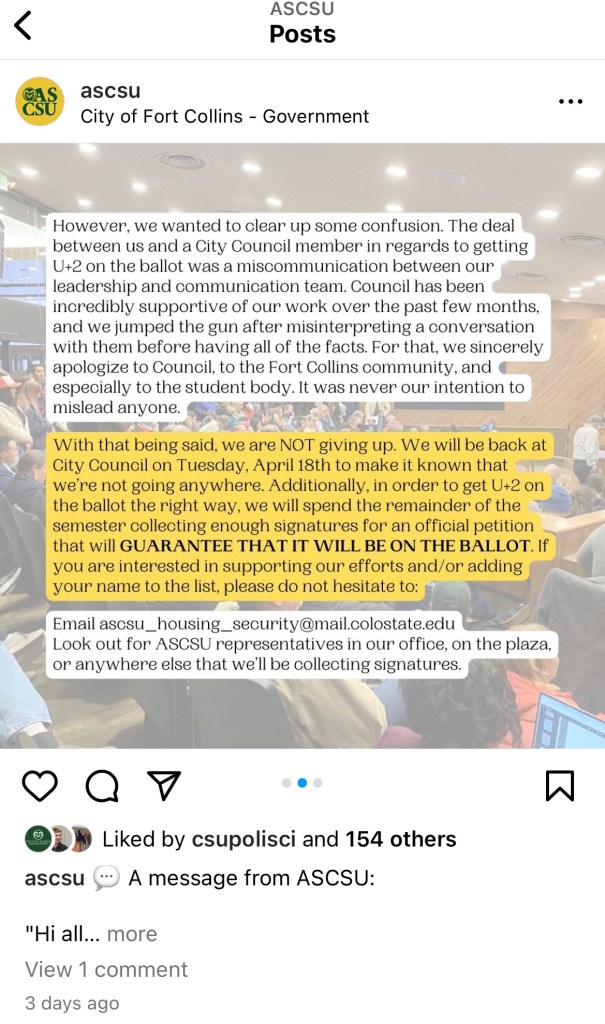
They are now calling for students to show up on May 9, for a city council work session on occupancy regulations.
It is important to note that May 9 is three days after the state legislature comes to an end and it is possible that the Land Use Bill will have passed both chambers by then and will just be awaiting Governor Polis’ signature.
Fort Collins would not be the only city affected by repealing occupancy limits at the state level. Cities such as Boulder and Greeley would be affected by the repeal of occupancy regulations as they also have occupancy limits in place.
There are different rules about how long a governor can take to sign a bill into law after it passes, dependent on when it passes during the session. Governor Polis may delay signing the bill into law until later in the summer in order to have a bill signing ceremony of one of his signature bills.
Nonetheless, it is likely to still be the law before Fort Collins does anything significant with U+2.
The Land Use Bill went through an extensive committee hearing on April 6. The committee hearing was only for testimony, meaning that no amendments to the bill could be given.
During the committee hearing, opponents of the bill said that taking away control from local municipalities was not the answer. Many proponents argued that the state would not have to take control if local municipalities had done a better job with housing.
As always, feel free to reach me at michael.stella@colostate.edu or @Michaelstella_.
 NoCo Convos
Leave a comment