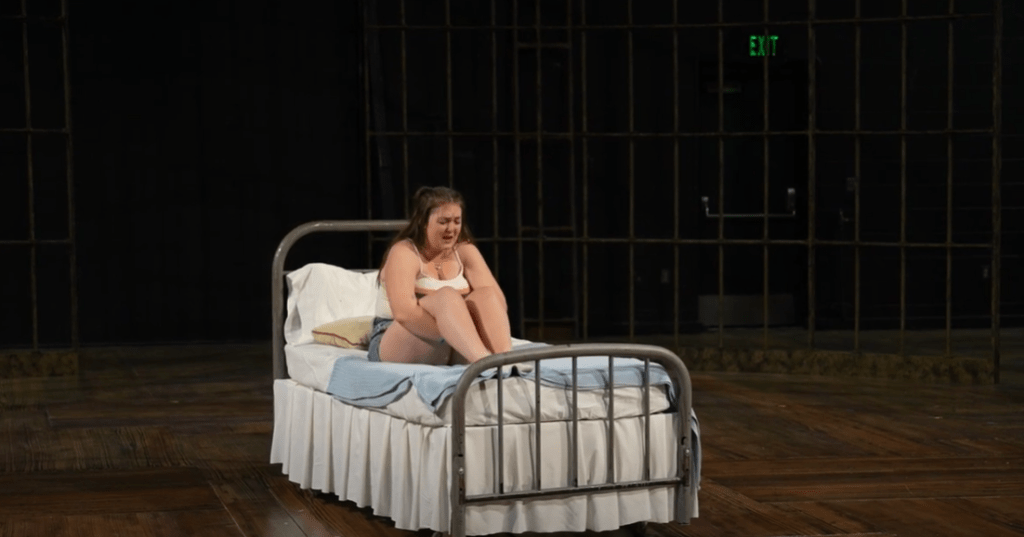
Sending a shockwave through audiences, Colorado State University’s production of Sophie Treadwell’s, “Machinal,” revealed the lengths that one woman will take when she is forced to conform to society’s machine.
Set in the American 1920s, “Machinal” is based on the true story of Ruth Snyder, the first woman in New York to be taken to the electric chair after murdering her husband.
While Snyder’s fate intrigued the Theater Department’s creative team, they were primarily focused on highlighting what drove Snyder to commit the crime in the first place.
“When understanding ‘Machinal’ what’s really important is that we are not advocating for what our heroine does,” said the show’s director, Debbie Swann. “What we’re trying to do is understand why a woman in a progressive time, both then and now, feels like she can’t be heard.”
Even though this progressive period provided women with a world of opportunities, it simultaneously forced them to conform to an unwritten standard – be happy, work, get married, have kids. Simply put, just submit.
As a result, CSU’s production of “Machinal” possessed a feminist outlook that allowed audience members to understand what it is like to feel trapped by the machine that is society.
“The feminist message is definitely there, but I think it resonates with audiences beyond feminism,” said Swann. “This message is about [the audience] feeling that [they] are in a world that [they] can’t understand.”
The ability for the audience to feel the world of the play is enhanced by how “Machinal” is written in an expressionistic style, an art form that showcases emotional experiences.
By harnessing the play’s expressionism, the creative team designed “Machinal” to specifically reflect the emotions and sensations that the heroine, Young Woman, experiences as the play unfolds.
“If ticking of clocks and typewriters are overwhelming to her, we’re going to amplify it and fill the space to make a soundscape that will mimic how she sees the world,” said Swann.
While the audio, light and sound departments achieved this objective through their technological designs, Swann accomplished this through how she directed the cast.
To do this, Swann instructed cast members to turn, look or deliver lines away from Young Woman.
For Courtney LaFontano, the actor playing Young Woman, this staging further revealed her character’s emotional and mental struggles.
“I think that it adds a layer of intensity to the show just because it shows the audience what my character is feeling in the sense that she’s never seen or never heard,” said LaFontano.
With this in mind, one of LaFontano’s primary goals was to let the audience discover not only how Young Woman was driven to commit the crime that she did, but why she went insane.
“I’m worried that people are going to sit in the audience and be like ‘oh, so she’s just crazy, she’s just a murderer, she’s just wack,’ I don’t want that,” said LaFontano. “I want people to sit there and be like ‘wow, women are human beings.’ Everyone has their limit.”
Indeed “Machinal” showcases a woman who goes to the extremes and murders her husband. But the heart of the play urges audiences to realize the danger that people face when they are continually pushed to the limit.
“There’s no greater honor, in my opinion, than to play someone who’s so emotionally complex but also stands for such power and has such a symbolism,” said LaFontano. “I’ve put so much of my own emotion, my own franticness into her and I’m not really ready to let her go yet.”
 NoCo Convos
Leave a comment