When we talk about Land Development in Fort Collins, we have to talk about the Growth Management Area. It determines how geographically large the city can become. When anyone mentions that Fort Collins only has so much land left to develop, they are in part talking about the Growth Management Area.
To learn more about the GMA, I reached out to the folks at the City of Fort Collins and I was directed to Planning Manager Rebecca Everette.
A quick journalistic note here: This interview was conducted over email. In person interviews are the standard for interviews and are always preferable to email interviews. However, this is the nature of journalism: I am a busy college student who is on a deadline and I had to make due with an email interview.
Nonetheless, Rebecca was really helpful in getting a better understanding of the GMA and the role it plays in our bigger discussion about the Land Development Code.
- What is the Growth Management Area? Can you provide a brief synopsis of what it is and what it does?
“The GMA provides a fixed boundary for urban growth and development,” Everett said.
This is a great way to start our understanding of what the GMA is. Fort Collins has drawn a line in the sand in how far out they will develop.
Everett went on to say, “ The GMA has been an effective tool for intentional, orderly, and responsible growth over time. It also establishes the boundary for City Plan and other long-range plans.”

- When was the GMA created? Who was involved in creating it?
“The GMA was originally established in 1980 as “The Urban Growth Area,” following a Service Area analysis that evaluated where the city could reasonably provide urban level services as the community grows over time,” Everett said.
The city has to be able to provide services to its residents and that is what the Service Analysis does. In case you were looking for the original resolution that created the Urban Growth Area, Everett provided it here.
- What factors were decided when the GMA was formed?
“My understanding is that there were growing concerns in the community, and with planning staff and elected officials, that the community was growing and expanding quickly, and a desire to ensure that growth happened in an intentional and responsible way,” Everett explained.
From 1960 to 1980, Fort Collins experienced a large influx of residents, especially students at the University.
Fort Collins’ population has grown considerably since before the Urban Growth Area was first developed. In my research I came across this great article by the Fort Collins Museum of Discovery. One statistic stood out to me in particular. During the 1962-1963 academic year, student enrollment at CSU was 7,304 students. During the 1968-1969 school year the student population had grown to 15,361.
The population of students at CSU basically doubled in 6 years. By 1970, the University set out to build accommodations for 25,000 students which included the Morgan Library, Moby Gym and Hughes stadium.
CSU had 7,304 students in 1963-64 and during the 1970’s, the University was making infrastructure plans for 25,000 students. If there is a housing shortage now, it seems likely there could have been one during this time of immense growth.
This student population growth led me down another rabbit hole and I found another great resource for Northern Colorado history. In the article, written by Meg Dunn, she points to “a row of quonset huts” that had been built to accommodate the growing number of GI bill students.
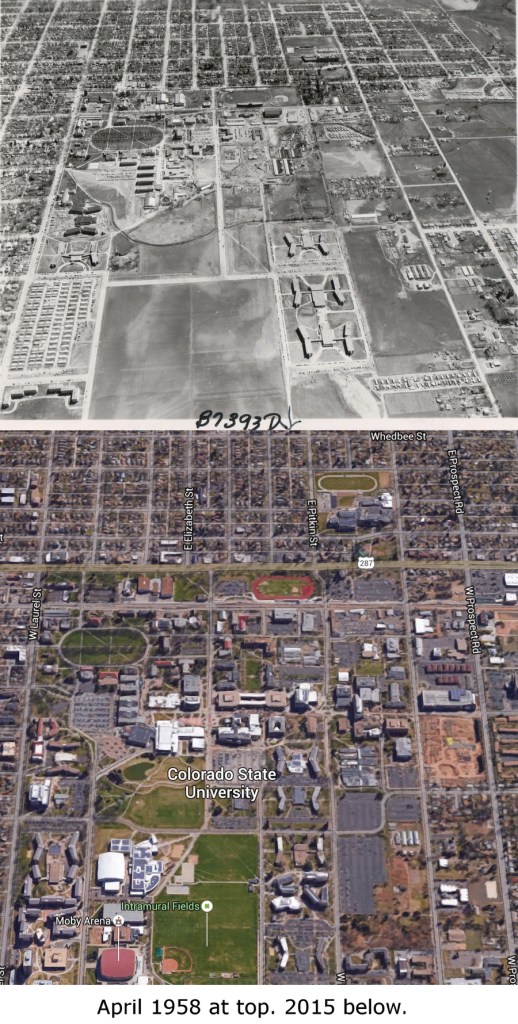
The City grew so fast that in 1970 an organization called “Planning Development for Quality” later changed to “Design tomorrow Today” to help Fort Collins residents cope with the rapid changes.
In 1980, the City of Fort Collins would go on to adopt their Urban Growth Area plan.
- Often we see GMA’s expanded once infill is no longer an option or even before it reaches that point. Will the Fort Collins GMA be expanded at some point?
As someone who grew up in a city where the boundary to development was constantly expanded and kicked down the road, I had a particular interest in this.
“It is highly unlikely that the GMA will be expanded in the future,” Everett said. “The growth area has remained relatively fixed over the past 40 years, and at times Councilmembers and community members have expressed more interest in reducing the size of the GMA in certain areas, rather than expanding it.”
If you are someone who prefers to see land stay the way it is and not be developed, this is great to hear. However, there is a constant push and pull between conserving land and housing. Inherently, if we conserve more land we will have less land to develop for housing, which means we will have less housing unless we can develop policies that allow for denser housing infrastructure. In essence, we have to do more with less.
“ Our GMA also shares boundaries with the GMA’s of other communities in certain areas-including Timanth, Loveland and Windsor- which limits any expansion in those directions.”
- Was this a type of policy that was influenced by public input? Or was it strictly governmental?
This question felt particularly pertinent because of the situation revolving around the Land Development code. Some in the Land Development Code discussion felt that there was not enough public input while others thought that there was a sufficient amount.
Everett said that, “Yes, growth and development have long been major topics of public discussion in Fort Collins. How a community grows over time is critically important, and it feels like a very personal issue to many community members.”
I also asked Everett about the GMA map. If you look at the map, you’ll notice parts of city limits extend past the GMA. The bottom Southwest corner is a good example of this. This area is the Coyote Ridge Natural Area. The other area is the City’s water treatment area along Laporte Avenue. Everett provided this interactive map which is easier to digest.
Final Thoughts
The Growth Management Area is crucial to the land development conversation in Fort Collins. With an understanding of what it is and what it does, we are able to get a clearer idea of the Land Development Code.
If you’ve stuck with me this far, I appreciate it. Also, something to keep an eye from the Coloradoan: The Land Use Code outreach by the City is going to start soon.
Feel free to reach out to me at michael.stella@colostate.edu or @Michaelstella_.

 NoCo Convos
Leave a comment