-
Bridging the Gap: Student Perspectives on Financial Disconnection and Rising Costs
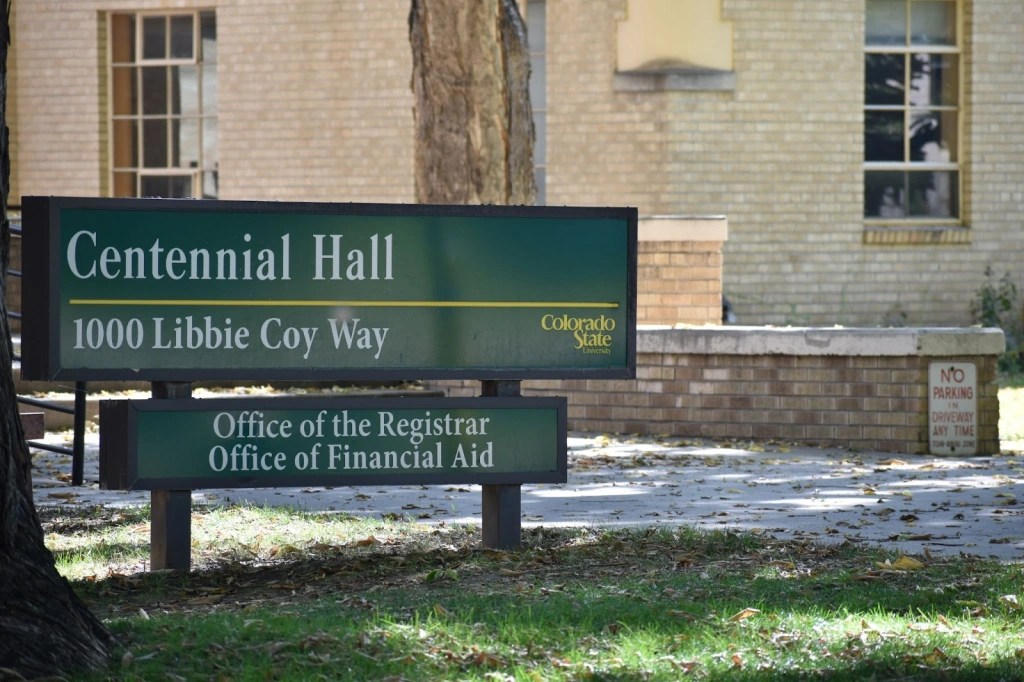
The Office of Financial Aid on a fall Monday, located on the Colorado State University Campus. Photo taken by Nick Alhadeff. By Nick Alhadeff and Nick Edwards
The rising cost of living is a top concern for young people across Colorado, as shown by responses to the Voter Voices survey, a collaborative effort involving over 60 Colorado news rooms including Colorado State University’s JTC 420 Deliberative Journalism class.
Among the more than 7,000 responses, participants aged 18-28 identified economic pressures like housing, healthcare, and climate change as key issues, with the cost of education standing out for students.
For the 2024-25 academic year at CSU, tuition costs for Colorado residents average around $12,500, while out-of-state students pay nearly $32,500. When adding housing and meal plans—which can cost between $13,000 and $15,000—annual expenses often exceed $27,000.
While tuition has increased by an average of 1.6% per year, adjustments in financial aid have not consistently kept pace. This gap has left many students struggling to cover both educational and living expenses, placing additional financial stress on them and their families.
With rising tuition rates, students at CSU are facing mounting financial challenges, requiring families to carefully navigate financial aid, scholarships, and employment options to fund college
For many students at CSU, the increasing expense of tuition, combined with general living costs, has become a significant financial burden. While the university offers scholarships, financial aid, and work-study opportunities, students are left to pay for additional expenses such as personal products and transportation.
While the school does offer 11 scholarships to instate freshman as well as financial aid programs, these are based on parental income, as well as merit. This can be difficult for students who cannot qualify based on either parameter.
For those in situations such as this there are options such as work study programs or scholarships from external sources, however both of these often come drawbacks whether it be GPA requirements or time commitments.
For many students who are already in financial need, dedicating time to either of those may not be possible due to jobs or work; they must continue to support themselves through school.
One option to combat the rising costs is to apply for external scholarships, but students need to be wary of potential scams or low-value offers. Researching scholarships may not always be worth the effort to significantly reduce tuition, aside from the CSUSA (Colorado State University Scholarship Application), which students apply for once a year.
This puts all applicants in a pool for any scholarships they may qualify for, greatly reducing the time from individually applying for scholarships. These include a large number of academic scholarships as well as aid based on criteria such as first generation students, liberal arts talents such as music and dance, and adult learners.
However, any scholarship money earned is subtracted from your financial aid package, so it is not received directly in cash—it just reduces the financial aid award received.
According to the CSU Financial Aid Office, federal aid is determined by financial need, but there are limits on how much each student can receive; scholarships are applied first, and any remaining financial aid is used afterward. The full award is disbursed each semester, and any leftover funds are refunded to the student.
But, as Jenn Dawson, a current CSU student and teaching assistant for JTC 420, points out, “scholarships can impact living expenses, and that can be frustrating when you’re already on a tight budget.”
Colorado State University offers its students 3 different dining hall options, the 15 per week, 19, and the 19+ add ons. The cost per meal still equates to around $12 per meal even with the higher plans. This is comparable to the costs of local restaurants and far more expensive than grocery shopping and meal planning.
The federal government allocates financial aid based on need, and there is a set limit that varies per student. When students earn scholarships, they are applied first, and any remaining aid is used afterward.
“You get the full award per semester, and any unused funds return to you as a refund, but scholarships often impact living expenses, which can be frustrating for many students,” Dawson said.
Another aspect is that financial aid is often considered on the basis of parental income. For students whose parents earn above financial aid qualifications, but do not receive full support through school, financial aid may not be the best option.
Work-study programs can also be a valuable way for students to earn money without affecting their financial aid package.
“Work-study is a good option at CSU because you keep 100% of what you earn, and it doesn’t reduce your aid,” Dawson said.
This can help with managing expenses, but students are rarely awarded enough financial aid to cover living costs. The maximum amount is around $5,000, but for many students, it may only amount to a few hundred dollars.
The SLICE Office (Student Leadership, Involvement, and Community Engagement) is a key resource for students seeking information about affordable education, housing, and food programs.
One helpful program that SLICE can help students access is Rams Against Hunger, which provides emergency food assistance to students in need. While these programs offer some relief, students still find work and income on and around campus.
A good place to find work is the Career Center located in the basement of Lory Student Center. At the Career Center, students can find help finding available campus jobs that can involve anything from cooking to study-related research.
The Career Center also offers resume revision assistance that can help students receive more positive responses and potential interviews when applying for jobs. All of the resources at the Career Center are available for free to students at CSU.
CSU’s tuition cost rises almost every year, with an average increase of 1.6% per year between 2018 and 2023. These changes are reflected in the financial aid packages, but not always at the same pace as rising living costs. The financial outlook of the school can be analyzed through publicly available financial statements, which provide insights into potential future increases.
This data is available on RamWeb to determine cost-of-living adjustments, but for students, the rising expenses often feel like a moving target, with financial aid struggling to keep up.
It’s important to understand why tuition keeps rising and where the extra money goes. Each year, students see an increase in tuition and fees, but it’s not always clear how these funds are used.
For the 2024-2025 year, the university board approved a 3% increase in tuition for resident students, and a 4% increase for nonresidents. While 25% of this is to be allocated towards student financial aid, where the other 75% of additional income is going can only be seen online through their financial statements.
While the university does provide these online reports that show how funds are allocated, students often feel disconnected from these decisions.
“I feel like I’m not involved at all with financial decisions made by CSU,” said David Roseberry, a junior studying Marketing at CSU “Considering that CSU is using our money to pay for new projects, they should be more transparent on how they spend it.”
Writing letters is another option, but there isn’t a clear or accessible process for students to have their voices heard in decisions about tuition or financial aid changes.
By staying informed and involved, students can better understand the factors driving tuition increases and advocate for a more transparent and equitable financial aid system.
The current financial aid system doesn’t always feel fair to students, especially those who need to work full-time to cover tuition and living expenses.
Lara Kuchen, is a student who had to leave CSU in 2024 for financial reasons.“Financial aid doesn’t help every situation,” Kuchen said. “Without qualifying for scholarships or any other help I wasn’t able to afford to stay in school.”
Much of the financial aid system is shaped by federal and state government involvement, leaving individual universities like CSU limited in how much they can do to support students.
Creating a more equitable system would require significant changes in how financial aid is structured, whether through federal programs or changes at the university level.
For now, students must navigate the existing system, balancing work, school, and living expenses while hoping for a future where higher education is more accessible and affordable for all.
While the cost of attending the university is likely to continue to rise, and scholarships only become more competitive for students, campus jobs, financial aid, and work study programs all provide viable options for combatting rising costs.
-
Philosophical Differences Color Education Debates in Colorado

A new day begins at Manitou Springs High School in Manitou Springs, Colorado. Manitou Springs School District was one of only two districts in El Paso County to meet or exceed test scores prior to the pandemic in 2023. By Gideon Aigner
It is often said that your perspective on life changes as you live it.
For Lauren Thorpe, a third-year history major at Colorado State University studying to become a teacher, the change from high school to college was quite drastic.
“It was a culture shock for sure,” Thorpe, a 2022 graduate of Colorado Springs Christian School in Colorado Springs, Colorado, said. “I wasn’t expecting it to be as big of a transition as it was, because it’s still Colorado. ‘It’s not that big a deal.’ But it was, and I think that was just a big culture shock, and it definitely was a bit difficult at first.”
“The academics were really good [at CSCS],” Thorpe said. “I will give them kudos for their academics and their college prep… In terms of culture and the students, it was sheltered. It was a small private Christian school. Obviously, things happen, but compared to what I’ve heard other people have dealt with, it was fairly sheltered.”
Thorpe’s experience in high school was quite different from most, as she was able to attend a private school because one of her parents worked on campus. According to the Pew Research Center, 83% of all students in the United States attended traditional public schools in 2022, compared to 10% of students in private schools, and 7% in public charter schools.
A large debate is between the prevalence of traditional and charter public schools. All public schools are funded with tax funds, largely based on property taxes. According to the Colorado Department of Education, the main difference with charter schools is that they have “more flexibility than traditional public schools as regards curriculum, fiscal management, and overall school operations.”
A charter school, unlike a private school, is free of charge to the student, but a student’s family must apply for the child to be able to attend. These differences in operation have created discussions around which approach to education should be more prominent in modern America.
Regardless, educators and students alike agree that the Covid-19 pandemic changed the conversation around education in America.
“To me, the pandemic was the biggest shift in mindset,” Daryl Solomon, the director of the Career Tech Center for Poudre School District in Fort Collins, Colorado said. “Parents are out of
control right now. When I was a dean of students, it wasn’t kids who threatened me. It was parents threatening to harm me physically because of something that their student did.”
Solomon says that she feels a lot of additional friction from parents because of what parents believe her job is, contrasted with what her actual responsibilities are. This has been exacerbated by claims from President-Elect Donald Trump that educators are performing surgeries on students in schools and making children transgender or gay.
“I cannot believe the misinformation that parents and the community have about teachers and educators and what our job is and what we do,” Solomon said. “People think ‘you’re indoctrinating my kids.’ That is actually illegal. When you learn how to become a teacher, you learn it has nothing to do with your own opinion and what you think; it’s about how to teach kids to think critically.”
While this is the stated intention of all schools in the U.S., Liberty Common Schools Headmaster, former Congressman Bob Schaffer, believes that charter schools are more efficiently able to meet the educational needs of their customers. Liberty Common High School was the best high school in Colorado for SAT preparedness in 2024, and has been one of the top academic schools in the state for years. Shaffer thinks that the customers, being parents and their children, should have control of the curriculum and how pupils are taught.
“The customers get to drive,” Schaffer said. “They get to decide they’re not having their children’s lives defined for them by politicians or government bureaucrats.”
Further, Schaffer believes that charter schools, like businesses, are more driven by competition, supply and demand than regular public schools. In Fort Collins, there are currently 8 traditional public high schools compared to 4 charter high schools and 3 private high schools.
“Schools are not monolithic. There’s good ones, and there’s bad ones,” Schaffer said. “The beauty is, if there’s a charter school that’s established and it’s not attracting customers, is not generating the cash flow from the business standpoint, it shuts down.”
“We don’t have that benefit with governmental monopoly schools,” Schaffer said. “If [a public school] is doing poorly, then the government tends to appropriate money to just keep them open. Even though they’re not serving their customers efficiently or serving them particularly well… The addition of a charter school is great for those families who choose it, and usually great for those families who don’t.”
“Once competition exists, then everybody starts trying to compete with one another,” Schaffer said. “Everybody in the education marketplace tries to outdo one another in appealing to families
and in quality. In doing so, you drive up the quality, which for children and families, is the thing that matters the most. Efficiency with their tax dollars matters to charters, who tend to be more efficient. For example, [Liberty Common] spends fewer dollars per pupil in this school, than public schools do generally, yet our results are consistently high.”
According to the PEW Research Center, while half of the U.S. believes that there are problems with the current state of education in America, the source of that problem is argued. Thorpe says that she thinks a lot of it comes down to the parents.
“Education is never just on the teachers,” Thorpe said. “It also is really big on the families. I never want to put anyone down to parenting styles, but I think also a lot of problems that we’re seeing right now is helplessness and complacency in a lot of parents in their child’s behaviors that end up showing up in classrooms.”
It has been demonstrated that parents don’t actually know what happens or is expected of their children in school, with one study demonstrating that, since the Pandemic, 90% of parents believe that their kids have caught up to where they should be, while many of them simply are have not. The reality is that most students in 2023 are behind where their peers were in 2019, and Thorpe says that this hasn’t been adequately addressed.
“I think it’s if we address the damage that has been done to children’s development in education from the pandemic and everything that’s been happening, then we can right the ship,” Thorpe said. “If we just keep going about the way things have been going and say, ‘The kids have gotten worse now,’ and that’s all we do about it, then we can’t fix this.”
Since 2019, K-8 students have been on average half a year behind where they should be in math. Similar to Solomon’s sentiments, since the Covid-19 pandemic, there has been a demonstrable disconnect in children’s educational perception by the parents, and what the reality of their situation is. Solomon believes that one way that schools can adapt to the modern educational environment is by teaching kids more about the trades if college is not the right path for them, something that charter and private schools don’t emphasize.
“One thing I’m really proud of in my current position is that we just started an auto program,” Solomon said. “We have kids that didn’t go to school who are getting straight A’s in the Auto Program.”
While career technical skills may sound simple to the average person, any trade requires certifications and real world practice to work, something that can be provided before a student becomes an adult.
“Yesterday I did a class observation,” Solomon said. “[The instructor] was teaching about changing brake fluid. These kids were doing equations, they were testing voltage, and talking about condensation. Kids were demonstrating high level critical thinking skills and problem solving while earning college credit. All of our teachers are certified to teach at either AIMS [Community College] or Front Range [Community College], and then they test to get industry certification. We’re giving kids an opportunity to start earning.”
Further, Solomon says that this approach has helped students who struggle in more traditional classroom environments. She says that this is a boon for public schools with less of a focus on test scores, and more of a focus on opportunity. Some surveys have even found that 45% of students believe that “getting a college degree is not worth the investment,” so this provides a path for that demographic.
“The kids I worked with in the Dean’s office, they would say ‘Solomon, I don’t want to sit in a Shakespeare class. I need to start making money because we don’t have food,’” Solomon said.
“Now they’re going to start making more money than I do by the time they graduate high school,” Solomon said. “They’re getting educated, they’re earning money, they’re going to school, and they’re passing, so I’m really proud [of them]. I think Career Tech Education is really the way to go… Having opportunities and options for whether you want to go to Harvard, or you want to work in an auto shop; You can come to my school and we’re going to meet your needs.”
Further, Solomon wonders if an increased emphasis on post-secondary education may be starting to dissuade students who don’t have as much economic opportunity.
“I just wonder, [if emphasizing] ‘college, college, college,’ where does that leave all of the other students who are just as bright and intelligent and have just as much potential,” Solomon said. “I think a lot of people have no idea what kids go through. I did a ton of home visits during COVID, and I’m going into trailer parks, and these kids are starving, and I’m trying to meet all of their needs… if you’re not exposed to it, you just don’t even know that that side exists. [There’s] nothing wrong with college. I loved college, but I had a family in a financial situation that we could afford it.”
And while charter, private, and traditional public schools all aim to get pupils ready for the next step, the disagreement largely lies with whether the state is the right body to determine a child’s path.
“The whole theory of charter schools goes back to the natural law,” Schaffer said. “[It’s] a universal premise about education, that it is the right and responsibility of parents to direct the
education and upbringing of their children. To oppose charter schools is to discard that premise, and to replace parents with the government.”
“If you favor governments and unions and the bureaucracy of education, you might not have a high opinion of charters,” Schaffer said. “If you favor the power and importance of the individual, the idea that families are the most central and essential unit in American society, the idea that parents have the right responsibility to direct the education and upbringing of their children, then charter schools satisfy those values.”
Regardless of philosophical differences, for someone like Thorpe looking to enter the education field, the focus should remain on the children and their teachers.
“I don’t blame administrators for focusing on test scores, because that’s currently what decides funding,” Thorpe said. “I will say though, if it is obvious that is all you focus on, that will discourage students. It will discourage them from doing anything, not just in pursuing higher education, but in pursuing their current education… You need to have it balanced with other things like social-emotional learning relationships and generally teaching you how to be a human.”
“I think you also just need to have an overall support system for the adults in the school,” Thorpe said. “They’re the ones who make the environment, and if they’re not feeling it, then the students aren’t going to feel it. So I think conversations need to gear towards how can we support our educators, [in order] to support our kids?”
And regardless of views on how best to educate our future leaders, everyone agreed that we need to support them better than we are now. The only question is how?
-
Concern for the future after election results

By Audrey Donow
After this election, Colorado State Students are experiencing a whirlwind of emotion, whether left distraught or satisfied with the results. The presidential election was important for many new and returning voters as so many promises and consequences were left on the table for voters to evaluate.
For CSU student Raigyn Moran, the results of this election took her by surprise and ended with a result that made her fearful for the next four years.
“I think my biggest concerns were women’s rights like reproductive health…and also environmental concerns,” Moran said.
This was Moran’s first time voting in the presidential election. She exercised her freedom to vote for a candidate that aligned with the policies she was most concerned about such as reproductive health and climate change.
Specifically in Colorado, these policy concerns included Amendment 79 which adds the right to have an abortion to the Colorado constitution and prevents state or local governments from restricting access to it.
After the results were announced of the next president of the United States of America, Moran felt a sense of dread due to the loss of her preferred candidate and a potential future lack of protection over reproductive health and environmental issues.
Another policy on the ballot in Colorado that was important to Moran was Amendment J which removes the ban on same-sex marriage from the Colorado constitution. This marriage ban was put into place in 2006 stating that only a union of man and woman would be valid and recognized as a marriage in the state. After the Supreme Court ruling in 2015 in the case of Obergefell v. Hodges, the justices extended the right of same-sex couples to be married but in Colorado, the language banning the union would still be in the books unless voters chose to remove it.
“It’s been a little better seeing people be uplifting but it’s still very concerning and hopeless,” she said.
Moran expressed that after the results, in relation to reproductive health, she is concerned nationwide. Even with her feeling of doom that came along with the results of the election, she celebrates the wins Colorado experienced removing the ban on same-sex marriage from the constitution by passing Amendment J as well as implementing protections for abortion in the Colorado state constitution by passing Amendment 79.
Photo Credit: Tim Hurst, CC BY-SA 2.0, Wikimedia Commons
-
Gen Z CSU student reflects on Trump’s win, as concerns rise over environmental and social policies
By Cole Cardona
At Colorado State University, Trump’s recent election win has left many students, including student Ryan Durbin, feeling a mix of worry and determination.
“I wasn’t totally shocked, but it’s still disappointing to see so many of my own generation moving toward far-right values,” Durbin said.
Like many of his peers, he had hoped for a shift that prioritized climate action, and he’s now concerned about the potential impact on environmental policies and social progress.
Durbin said he’d noticed a conservative trend among some classmates, but the scale of support for Trump among Gen Z came as a wake-up call.
“I don’t think we fully realize how divided our generation is, or how serious people are about these issues,” Durbin said. “It’s concerning because it’s not just about political leanings; it’s about values like environmental protection that affect all of us.”
For Durbin, the most immediate worry is the potential rollback of environmental protections.
“We’ve seen a lot of progress in Colorado with renewable energy, and people here are serious about tackling climate change,” he said. “But with Trump in office, there’s a risk of federal pushback on policies that are crucial to our state’s future.”
Colorado has long been a leader in progressive climate initiatives, with policies aimed at reducing emissions and increasing renewable energy use.
In Fort Collins, for example, the Our Climate Future guide, produced by the city, sets ambitious targets for 2030: an 80% reduction in greenhouse gas emissions, 100% renewable electricity, and achieving zero waste. Federal resistance to such goals could severely limit funding and state support for these sustainability projects.
Durbin and other environmentally minded students worry that federal shifts could impede local efforts, impacting future job prospects in environmental sectors and stalling essential climate work. He hopes that his peers, even those with differing political views, can unite around issues like climate action.
“At the end of the day, we’re all going to feel the impact of these policies,” he said. “I just hope more people can see that this isn’t about parties; it’s about our future.”
Photo Credit: Decumanus at English Wikipedia., CC BY-SA 3.0
-
Post-election concerns about economy, reproductive rights
By Gideon Aigner
When Kai Nguyen woke up on November 6, 2024, he was shocked.
“I was upset,” said Nguyen, a third-year mechanical engineering major at Colorado State University from Howard County, Maryland. “[Democrats] lost the majority vote for the first time in 20 years. I was really disappointed.”
The last time that a Republican candidate for the land’s highest office won the popular vote was in 2004, when George W. Bush claimed the seat. Now, President elect Donald Trump has broken that streak for the party, and the circumstances around this election are much different than those when Nguyen was just an infant.
The campaign for Kamala Harris spent a lot of time focusing on reproductive rights and healthcare, an issue that Nguyen cares a lot about.
“My number one issue is reproductive rights,” said Nguyen. “That’s always been my main concern.”
However, for the Harris campaign, that seems to have backfired, partially due to the Trump campaign’s focus on one issue: the economy. Nguyen says that while Trump campaigned on the economy, policies like tariffs may backfire for the President elect.
“I’m interested in how it pans out for the economy overall,” said Nguyen. “That’s something I’ll be taking note of as the presidency continues.”
Nguyen also thinks that Harris was a bit uninspired as a candidate, who was harder for the Democratic party to rally around than past party-heads.
“Well, I think they kind of pushed her into it, and I feel like a lot of people weren’t very excited about Harris as a candidate,” said Nguyen. “I feel like if we had a stronger candidate that would come in elsewhere, with stronger ideas, or more… I don’t want to say more progressive ideas, but, you know, something that would stand out in the voters’ minds is this is something that I can really support and really get behind.”
Nguyen also thinks that the campaign misused Tim Walz, the Vice-Presidential candidate with the higher approval rating between himself and JD Vance.
“Pushing Walz. I think they did an alright job,” said Nguyen. “I think they could have pushed him a little bit more as someone that people could relate to… I think they could have leaned a little bit farther left.”
And looking towards the future, the Democratic party is going to have to start swinging. Nothing succeeds like success, and Trump is often credited with saving the Republican party, making it his party. Nguyen says that the Democrats need to target their base like Trump did and find someone who can contest with his personality.
“I think they shot a little wide with who they were trying to target,” said Nguyen. “I think if [the Democratic party] drilled down harder on specific groups, they could have done a little bit better… I really hope they find a stronger candidate, someone that the people can relate with, and that they feel could be like, a strong leader. Not to say that Harris couldn’t have been a strong leader, but she didn’t really stand out in the minds of voters.
“This is someone I really want to spearhead us into a new era of America,” said Nguyen. “Somebody that, when faced against someone like Donald Trump, can really like butt heads with their aggressive tactics.”
Ultimately, much like most of the Democratic party, Nguyen is stunned, especially by people in his age bracket.
“The youth vote was honestly kind of shocking to me,” said Nguyen. “I was looking at some stats for college educated individuals, and it was very surprising to see how far red it was leaning, and as of right now. I still don’t know why.”
And on that, both Nguyen and the Democratic party can agree.
Photo credit: Spilly816, CC BY-SA 3.0, Wikimedia Commons
-
CSU Students shocked post-election
By Katherine Borsting
College marks the time of self-discovery for many students as they experience their first years of adulthood and begin to develop and gain exposure to new ideas, cultures, and opinions. For many students at Colorado State University this was the first presidential election they were eligible to vote in.
Prior to the election the general feeling of anxiety about who would be the 47th President-Elect was present on both sides amongst students concerned for what is right for their future and our country.
Olivia Roberts, a senior and first-time voter felt that media played a big part in how she consumed and evaluated the candidates prior to the election.
“A majority of the media I consume is left-focused and honestly instilled a lot of fear in me prior to the election,” Roberts said. “I felt that issues I care about were at risk if Trump were elected.”
Now that President Donald Trump has been elected as the 47th President-Elect, Roberts expresses real fear along with disappointment based on the results.
“It is not what I was hoping for, I can say that and [it’s] honestly disappointing, scary, and hurtful that people have such horrific priorities when it comes to politics,” Roberts said.
Other students on CSU’s campus seemed to be somewhat disappointed but unsure and optimistic of what the future holds. Owen Marinkovich, a senior who voted for Kamala Harris disclosed how he felt uneducated the entire election season.
“I voted for Kamala because my mom told me to,” Marinkovich said. “But honestly, I don’t know what’s really going on with what she wants or what he [Trump] wants.”
Marinkovich revealed he felt disappointed with the results due to the expression of concern amongst those in his friend group.
“When it comes to policy, I don’t know what she [Kamala Harris] wanted,” Marinkovich said. “However, my friends who are gay said they are scared and I trust them. I should probably read up because maybe I would agree with some Trump stuff.”
Overall, students seem disappointed and uncertain based on the recent election results. Many are worried about what Trump will do once he is in office, and are disheartened that he has made a return.
Photo credit: Spilly816, CC BY-SA 3.0, Wikimedia Commons
-
Fort Collins Post Election: How the Outcome Affects Residents
By Brady Vrana
With the 2024 election in the rear view, Colorado looks to come together to create change.
According to Voter Voices surveying, among the many problems for young voters, cost of living and abortion are two of the most concerning factors.
Extra efforts have been made to ensure protection for women’s reproductive rights as Colorado is one of seven states to vote for these rights during this year’s election.
On election night it was speculated by CBS News that, “Amendment 79 has passed and a section of Colorado’s state constitution is recognizing the right to abortion.” Amendment 79 was passed on November 5th by Colorado voters.
In response to this news, a couple of students at CSU have given their thoughts on the matter.
“I think the results of this election were eye-opening to students because of potential conflict with abortion rights. This has been a strong issue especially based on the displays already made on campus,” James Frederick, a current CSU junior said.
“It’s so disheartening as a woman knowing that the new leader of the US is pursuing a nationwide abortion ban. My faith in Colorado is strong though knowing we’re trying to push back,” Shannon Ross, another CSU junior said.
Since the recent presidential election, inflation has been a top concern for Colorado residents.
Though under the Biden administration the creation of more jobs has increased, Donald Trump has claimed that, “government spending in Biden’s first two years in office is to blame,” according to a Denver Post article focusing on the local economy before the election.
Young voters at CSU have weighed in on this topic as well.
“Inflation has hurt me in my daily and weekly spending in the past couple years, but I wouldn’t say it’s as detrimental to me personally as others,” Armailey King, CSU sophomore said.
“Cost of living because of inflation has wrecked shops around Fort Collins, but I hope with the change in leadership we can cut down on this kind of government spending,” CSU freshman Ali Devish said.
CSU students and Fort Collins residents will have to look forward after this election to truly see if this shift in power helps or hurts them in the long run.
-
Colorado State University Students Left on Edge After the Results of the 2024 Presidential Election are Announced
By Elyse Gerke
It is the day after election day on the Colorado State University campus. There is no sign of the sun, a gray blanket of clouds coats the sky as far as one can see. The wind blusters through the skeleton of the once-full-of-life trees.
The campus seems more abandoned than a typical Wednesday afternoon at Colorado State University. In the plaza stands a shorter woman wearing a large jacket that almost consumes her entire body. When approached, she emulates a warm presence but expresses a fearful attitude.
Jo Holley is a graphic design major transfer student from San Gabriel, Calif. Before the presidential election Holley was worried about “women’s rights and how things might look different if Kamala lost the presidential election,” she says while walking through the CSU Oval. “I’m worried about women’s rights and how things might look different after Kamala lost the presidential election,” she says.
The results made her feel “kind of numb and really scared for what the future might hold.” Holley avoided eye contact while saying, “I am upset and angry but not entirely surprised. It’s sad to see so many of the people around me, mostly men, hold values that diminish who I am as a person.”
The 2024 presidential election results were announced at 2:34 a.m. MT in favor of former president Donald J. Trump.
“Waking up felt surreal. It is insane to me that he won the popular vote because what I was seeing online and around my community, I thought a lot of people were in agreement that it would go the other way,” Holley said. “I know that the people closest to me voted the way I did. I like to surround myself with people who support and value women’s issues. I went to bed knowing that it was a very close race, but not truly believing Donald Trump was going to be the next president.”
While tension lingers across America, communities reflect on what this means for their town. Across CSU, there is a jumble of emotions as the community digests the results. Holley expressed a mix of shock and fear of women’s rights and is uncertain of what the future holds.
-
Where to find the cost of living on your ballot
Our Voter Voices survey identified the economy and cost of living as a top issue among nearly all groups, especially voters 18 to 29 and conservatives across Colorado. If you’re a voter who’s concerned about the cost of living, here’s where your vote has the most impact.
By Jennifer Brown, The Colorado Sun
One of the top issues on the minds of Colorado voters this election is the cost of living, with about 15% in our Voter Voices survey saying they intend to focus first on the economy as they mark their ballots.
Coloradans are concerned about the price of housing, groceries, gas, utility bills and everything else it takes to keep households running. That’s not shocking considering that the average household has spent $34,194 more since 2020 due to inflation, according to research from the Common Sense Institute.
“That’s the cost of higher education tuition,” said Kelly Caufield, the institute’s executive director. “All Coloradans should care about the economy and the cost of living here.”
While economists say inflation is “cooling,” Coloradans are still feeling the economic crush of the past few years. The average rent for a one-bedroom apartment is about $1,500 in Fort Collins. The average price of a home in Fort Collins is now above $557,000. Food prices in Colorado and across the country rose 25% from 2019 to 2023.
Carter Gilbertson, a Fort Collins resident and sophomore at Front Range Community College said his primary concern with cost of living is pay rates not being raised comparatively.
“Unless pay rates rise, or costs go down, my generation simply won’t be able to purchase homes” Gilbertson said.
From 2020 – 2024 Gilbertson saw a 13% increase in his utility bill.
“Rising costs have affected how much take home pay I have, more of my money goes to rent, gas, and utilities each month with less leftover to save” he said.
So if your top concern is the high price of living in Colorado, how should you vote? A large part of that answer depends on which economic policies you believe will work and how those policies match up with your other priorities. Here’s what to watch for on your ballot.
State ballot measures to collect more tax dollars
The top tax measures on the November ballot are regional and local, including some so-called “de-Brucing” measures that would remove entities from the tax limits set under the Taxpayer Bill of Rights. TABOR was authored by former state representative Douglas Bruce.
They all put less money in people’s pockets, but, and this is the key question for voters, propose to do so for the greater good.
One measure, 7A, would allow RTD — the Regional Transportation District — to keep spending about $50 million to $60 million a year above the TABOR cap instead of refunding that amount to millions of people who made retail purchases in the eight-county RTD taxing district. If it passes, RTD could keep all of its sales tax revenue permanently.
TABOR exemptions for RTD that were passed in the 1990s are scheduled to expire this year, and the transportation authority has seen its ridership drop since the pandemic while its operating budget is increasing. RTD had an operating budget in 2014 of $477 million, an amount that has grown to more than $1 billion.
Sales tax increases
Since 1989, the city of Fort Collins has employed a street maintenance tax of 0.25%. Just under 50% of all of the city’s spending on street maintenance is covered by this tax.
Previously the tax has been renewed over 10 year cycles, with the large majority of local residents voting in favor. The tax is now set to renew, for a 20 year term.
If the extension is voted in, it will simply stay in place and no taxes will be increased.
Other ballot measures that could lead to increased spending
Even ballot measures that don’t seem to be about cost of living are related. Two statewide measures force voters to consider whether it’s worth potentially paying more in taxes for public safety and ed\ucational choice.
Amendment 80 would enshrine school choice in the state constitution, opening the door, critics say, to taking money from public education to fund private school. The proposal comes after school-choice groups have failed in the past to pass voucher programs that would allow parents to get tax refunds to help pay for private school, and after a voucher program in Douglas County School District was struck down by the courts. It’s supported by Advance Colorado, a conservative action committee.
Proposition 130 would spend a one-time $350 million in state funds on law enforcement, including for recruiting, training, salaries and death benefits for officers’ families. Proponents are hoping that the cost of the “Back the Blue” measure will be overshadowed by people’s concerns about crime.
Unlike most ballot questions proposing to spend money, it doesn’t authorize any new taxes or borrowing. That means state lawmakers would have to decide how to find the $350 million.
Presidential race
Both presidential candidates are touting economic proposals intended to decrease the burden on taxpayers.
Former President Donald Trump is proposing to end taxes on Social Security benefits and on tips for hospitality workers. He’s also vowed to offer incentives to foreign companies that relocate manufacturing to the United States and hire American workers. And he wants to impose tariffs on other countries that trade with the United States, including a tariff as high as 200% on vehicles imported from Mexico.
Vice President Kamala Harris said she also supports ending taxes on tips for restaurant workers. She has called for expanding the child tax credit to $6,000 from $2,000 for parents, and raising the minimum wage. Colorado’s minimum wage is $14.42 per hour and will rise to $14.81 on Jan. 1, but the federal minimum wage has been $7.25 per hour since 2009. Harris also is pitching tax breaks for small business owners and first-time homebuyers.
Congressional races
Candidates running to represent Colorado in Congress all say the economy is a top issue, but have different ideas about how to rein in the cost of living.
Congress can affect the cost of living with policies on taxes, industry regulations that decrease jobs and social services programs that provide food and housing assistance.
Fort Collins falls within the 2nd Congressional District of Colorado.
The incumbent seat, held by democrat Joe Neguse, is currently being challenged by republican candidate, Marshall Dawson.
Joe Neguse’s economic policy centers around equal opportunity, pushing for affordable health and child care, paid leave, and a fifteen dollar minimum wage.
This is the second time Dawson has challenged Neguse, with the first being during the 2022 midterm elections. He offers a different approach to economic policy, focusing on security within our country over social programs.
State candidates/legislators
During a special session this summer, Colorado lawmakers headed off ballot measures that legislative analysts said would have cut taxes by $2.4 billion, throttled their future growth and risked the state’s ability to fund K-12 schools and other public services.
Lawmakers instead agreed to cut taxes in 2025 by $769 million — the fourth round of tax cuts in less than a year. Colorado now has a $900 million budget hole.
To close the budget gap, the state will either have to cut spending or dip into its reserves, which under state law are required to set aside 15% of general fund spending.
Lawmakers in the next few years will have to make key decisions on how to fund K-12 education, which will receive less local funding because of property tax cuts. They also have to deal with unexpected Medicaid costs, after the state Department of Health Care Policy and Financing overspent on the low-income health care program by as much as $154 million last budget year.
In terms of housing costs, lawmakers have power to pass wide-ranging legislation that can affect the availability of housing. Recent examples involve the state government expanding tax credits for affordable housing projects and overriding local policies.
A new law passed this year, for example, requires 31 local governments to change their zoning laws to allow more housing units along major bus and rail corridors. It requires local governments to zone for at least 40 units per acre within a quarter mile of bus stops and a half mile of rail stations. Another new law allows people who live in metropolitan planning organizations to build accessory dwelling units or “granny flats” on their properties. The law blocked many existing local regulations that prohibit ADUs.
Nick Alhadeff, journalism student at Colorado State University, contributed to this story.
-
Where to find the environment on your ballot
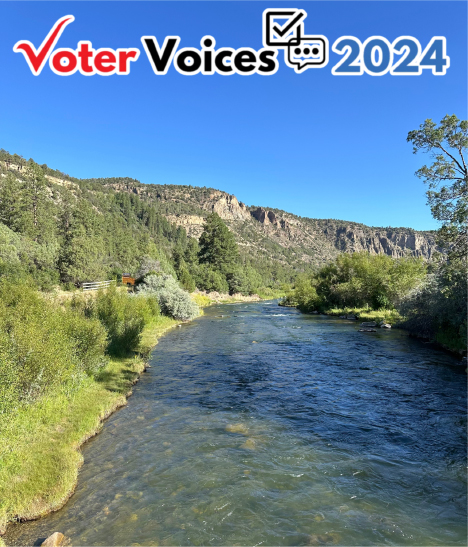
The Uncompahgre River flows through Pa-Co-Chu-Puk Campground in Ouray County in 2024. A megadrought in the Colorado river basin has led to major stress on water supplies relied on by Western Slope towns and agricultural producers, as well as higher risks of catastrophic wildfires. (Gideon Aigner) By Chase Woodruff, Colorado Newsline
The devastating and deadly impacts of Hurricanes Helene and Milton in the final weeks of the 2024 election have once again put the climate crisis top of mind for voters across the country. For many Coloradans, who’ve been impacted by severe droughts and unprecedented wildfires in recent years, climate issues have long been a priority. These natural disasters, in combination with human activities like fracking have been found to contaminate the natural habitats and water of native plants and animals that Coloradans are used to.
Climate change, the environment and natural resources were among the top five concerns identified by more than 7,000 Coloradans who have responded to the Voter Voices survey.
“[What] I would like to hear is transparency. We need avenues of data and conservation and also funding for that. Conservation isn’t just about animals. Humans are animals, and we’ve been living in environments for thousands of years, helping to manage and co-evolve with environments,” said Gabriella Lam, an environmental sociology student at Colorado State University. “How can we move forward, connect human and animal relationships, and work together to coexist?”
Self-described liberal and moderate respondents were far more likely to say climate and the environment were a top issue than conservatives — a trend that’s consistent with the results of the Colorado Health Foundation’s 2024 Pulse poll, which found that while 80% of Democrats believe climate change is an “extremely” or “very” serious problem, fewer than 1 in 10 Republicans say the same.
Thousands of scientists who contribute to periodic reports published by the U.N.’s Intergovernmental Panel on Climate Change wrote in 2021 that the science of human-caused global warming is “unequivocal”: Greenhouse gasses emitted into the atmosphere by human activity, mostly through the combustion of fossil fuels, are responsible for virtually all of the warming observed since the mid-18th century. Average global temperatures have risen by about 1.2 degrees Celsius since then.
What may sound like a small increase has already had profound impacts on the Earth’s climate. The extreme rainfall in the southeastern U.S. during Hurricane Helene, which caused an estimated 232 deaths and nearly $40 billion in damage, was made “up to 20 times more likely” by current levels of global warming, climatologists with the Berkeley National Laboratory estimated. Over the last two decades, higher temperatures in the Colorado River Basin have been the main driver of a “megadrought” that hydrologists have found is worse than any dry spell the region has experienced in at least 1,200 years.
In a special report released six years ago this month, IPCC scientists made a last-ditch appeal to governments around the world, urging policymakers to take steps to limit average global temperature rise to 1.5 degrees Celsius and avert the catastrophic risks of further warming. The IPCC warned that doing so would require “rapid, far-reaching and unprecedented changes in all aspects of society.”
That hasn’t happened.
Instead, Colorado, the federal government and many foreign countries have taken steps towards a gradual transition from fossil fuels to clean energy over the next several decades. They’ve made important, incremental progress in lowering projected future emissions, making the
worst-case scenarios for the climate by the end of the 21st century less likely. But efforts to date have fallen well short of science-based goals, and we’re still on track to roughly double the planet’s current level of warming.
For young voters like Lam and Mila Garelle-Essam, president of CSU’s mycology club and Voter Voices respondent, environmental policy is an underrepresented aspect of policy, and needs to be more prominently discussed in this election cycle.
“Nature is in all these issues, like in the housing crisis thing or food are some of the biggest ones connected to nature,” said Garelle-Essam. “When we farm in a really detrimental way, we get bad food, which connects to the healthcare. … Young people are kind of realizing, like, oh, food is where it’s at for me recently… it’s all connected.”
If climate change, the environment and natural resources are top concerns for you, here is where your vote has the most impact.
The presidential race
President Joe Biden’s signature climate policy, the Inflation Reduction Act of 2022, included about $370 billion in new federal funding and tax incentives for clean energy technologies like wind and solar generation, electric vehicles, more efficient home appliances and much more.
The Biden administration has paired the IRA’s incentives with major new Environmental Protection Agency rules aimed at limiting emissions from cars, power plants and oil and gas infrastructure. Altogether, these efforts add up to what is by far the most ambitious set of climate-action policies in U.S. history — but a recent analysis estimated they will only achieve about half of the emissions reductions recommended by scientists over the next decade.
Vice President Kamala Harris credits the IRA’s tax incentives with helping to create 800,000 new manufacturing jobs during Biden’s term, and promises to “build on (the administration’s) historic work” in confronting the climate crisis. At the same time, Harris has backed off her previous support for a ban on fracking, and instead boasts on the campaign trail that under Biden, domestic oil and gas production has reached its highest levels ever.
Former President Donald Trump has long called climate change a “hoax,” and during his first term he oversaw a sweeping rollback of Obama-era emissions regulations. The Washington Post reported in May that Trump asked a group of the country’s top oil executives to contribute $1 billion to his campaign during a meeting at his Mar-a-Lago Club, pledging once again to reverse dozens of climate and environmental rules enacted by Biden’s EPA and other federal agencies.
In June, 2024 multiple justices appointed by Trump voted to repeal the 1984 Supreme Court decision, Chevron v. Natural Resources Defense Council. Experts say that this decision keeps arms of the government like the Environmental Protection Agency from enforcing legislation important to environmental conservation, which shows the power that presidential appointments have on environmental regulations and enforcement.
“It’s kind of taken away EPA’s ability to really regulate and track and monitor the pollution of U.S. waterways,” said Lam. “I believe the federal government has, has been doing a lot to try to tackle these really overarching policy decisions, but there’s a lot of disconnects with the federal government and everyday people.”
Congressional races
Neither of Colorado’s two most competitive congressional districts is a stranger to heated conversations about climate and energy.
Voters in the 3rd District — where Democrat Adam Frisch hopes to pull off an upset victory over Republican Jeff Hurd for the seat being vacated by U.S. Rep. Lauren Boebert — are more directly impacted by climate change than in any other district in the state, and perhaps the country. The Colorado River megadrought has led to major stress on the water supplies relied on by Western Slope towns and agricultural producers, higher risks of catastrophic wildfires and growing threats to the region’s natural landscapes and outdoor recreation industries.
But the 3rd District also illustrates the political challenges of the energy transition. While Pueblo, its largest city, is home to a fast-growing clean energy sector, communities in Garfield County and other parts of the Western Slope face a more uncertain future amid sagging demand for the coal and natural gas resources they’ve prospered from in the past. Both Frisch and Hurd say they support “all-of-the-above” energy policies and have had harsh words for Biden’s efforts to respond to the climate crisis.
Meanwhile, Democratic U.S. Rep. Yadira Caraveo faces a challenge from Republican state Rep. Gabe Evans in Colorado’s battleground 8th District, another region on the front lines of climate and energy policy. Residents of Denver’s northern suburbs and southern Weld County have benefited from jobs, growth and tax revenues spurred by the northern Front Range’s booming oil and gas sector, but they’ve also borne the costs of harmful air pollution from fracking pads and industrial polluters like the Suncor refinery.
Caraveo has often cited her work as a pediatrician, witnessing firsthand the negative health impacts of air pollution on hundreds of young patients, as her motivation to run for office, and while serving in the state Legislature she co-sponsored a landmark 2019 bill to strengthen health and safety rules in the oil and gas industry. Evans, a first-term state lawmaker and former police officer, has repeatedly voted against Democratic-backed clean energy legislation, and his campaign website blames “climate alarmism” and “draconian Leftist climate regulations” for increases in the cost of living.
With the battle for control of the U.S. House of Representatives expected to come down to just a handful of congressional races across the country, voters in the 3rd and 8th districts could play a pivotal role in determining whether the IRA and other Biden-era climate policies are preserved and expanded, or weakened and repealed.
Lam believes that races like the ones happening in these two districts are emblematic of wider societal trends, both in more rural communities like the 3rd District, and in more urban districts like the 8th.
“Folks who are in vulnerable populations, whether it be super urban environments or really, really rural environments, are becoming increasingly separated from what causes environmental changes, despite them facing most of the consequences of them,” said Lam.
Lam says that inaction from legislators is keeping the corporations who are causing environmental changes from being held accountable when those changes lead to negative effects on people in urban and rural communities.
“We’re being very reactive when climate events happen, that’s when we respond and try to put things into place to stop things from happening again,” said Lam. “But can we be more preventative in our policy making now?”
State legislative races
With few exceptions, Republicans in the Colorado General Assembly have continued in recent years to bluntly deny the scientific consensus on human-caused climate change. Democrats, who won total control of state government in 2019 and have expanded their legislative majorities since then, broadly recognize the need to sharply reduce emissions, but haven’t always agreed on how to get there.
The emissions-cutting strategies pursued by Gov. Jared Polis’ administration have largely mirrored the Biden administration’s approach, pairing incentives for clean energy with modest regulations on polluters. Polis has publicly — and successfully — opposed efforts by Democratic lawmakers to impose more aggressive measures like a cap-and-trade scheme or legally-binding emissions limits, and his administration has shown no appetite for fighting climate change by curbing oil and gas extraction, which remains at near-record highs.
The results of this approach, too, have been broadly similar to results at the federal level: Despite meaningful progress, Colorado appears virtually certain to fall short next year of the very first science-based emissions target set by its 2019 climate-action law, which called for a 26% statewide cut by 2025. Without major improvements, the state’s next statutory goal, a 50% cut by 2030, could also be in jeopardy.
Colorado’s biggest climate victories over the last five years have come in the electricity sector, where state officials — with a big helping hand from the falling costs of wind and solar generation — have been able to coax and prod utilities into a series of agreements that will see all of the state’s remaining coal-fired power plants close by 2031.
But progress has been far slower in other sectors, especially transportation. Though EV sales are poised for continued growth, millions of gas-guzzling cars and trucks are likely to remain on Colorado’s roads for years to come. Under Polis, the state has opted against policies pursued in other states, like California’s ban on new gas-powered car sales by 2035 or a mandate on large employers to encourage multimodal commuting, and there are few signs that Coloradans are on the verge of voluntarily ditching their cars for the bus or an e-bike any time soon — at least not on a scale large enough to make a difference.
Lam says that a large part of why she thinks Coloradans are reluctant to voluntarily switch to more environmentally friendly transportation options is a lack of infrastructure.
“I think that would be a really good push in regards to helping to fight and create resilience in the face of climate change,” said Lam. “Having people depend less on cars and whatnot, making cities more walkable and eco friendly, so that people can bike.”
Faced with these challenges, Polis and top officials in his administration have opened up a new front in the state’s battle to reduce emissions from transportation and other sectors. Adopting the mantra that “housing policy is climate policy,” they want Colorado municipalities to “upzone” more of their neighborhoods for higher-density housing developments that create less dependency on car travel.
State legislators have approved parts of that agenda in piecemeal fashion, with new laws requiring more density in transit corridors, legalizing the construction of accessory dwelling units in most circumstances and prohibiting local minimum parking requirements that advocates say hinder the construction of multifamily housing. At the same time, they’ve enacted a new fee on oil and gas production to fund expanded public transit services and are moving forward with projects like Front Range Passenger Rail.
But even in a Legislature where Democrats hold large majorities, the most ambitious land-use proposals backed by Polis and his allies have hit a stone wall of opposition from lobbying groups representing local governments and a bloc of Democratic lawmakers from Front Range suburbs and affluent mountain towns. In some cases, opponents stripped reform legislation of enforcement mechanisms, and experts say the implementation of these new laws will need to be watched closely.
Garelle-Essam says that she wants policy makers to focus more on environmental education, so that the average voter is more knowledgeable as to what needs to be done in their community, and in the state as a whole.
“People in cities are pretty disconnected from nature,” said Garelle-Essam. “It’s hard for them to make nature based decisions… it keeps coming back to storytelling, and how we connect with people. [It] could be like documentaries made by politicians or by the state, or something telling stories of specific people.”
Further, Garelle-Essam says that as part of education, policy makers should look at making real education as entertaining as misinformation.
“How can we make the real solutions catchy,” Garelle-Essam asked. “Stories? That’s probably my only answer right now; stories.”
As climate-action advocates continue to pursue a vision for cleaner air, expanded transit and more walkable and bikeable neighborhoods in communities across the state, every vote at the Capitol will count.
Gideon Aigner, a journalism student at Colorado State University, contributed to this story.
-
Subscribe
Subscribed
Already have a WordPress.com account? Log in now.
 NoCo Convos