-
Podcast: Let’s Talk

-
Where to find housing on your ballot
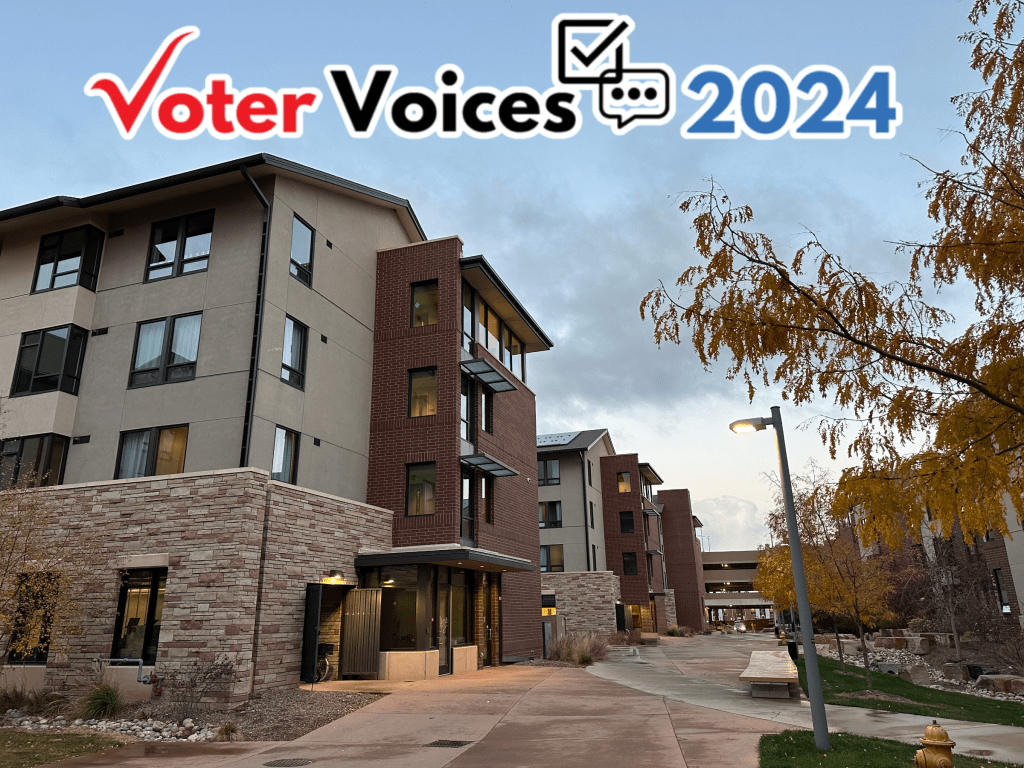
A cool fall day goes by in the Aggie Village apartments at Colorado State University. The buildings at Aggie Village, Lodgepole, Cottonwood, and Walnut, serve as housing for current CSU students, as well as containing classrooms and office space. The apartments at Aggie Village are the only housing in Fort Collins that can be paid for with scholarship funds, making it one of the most affordable options in town. Photo: Gideon Aigner More than 7,100 Coloradans have responded to our Voter Voices survey and across the political spectrum, many of them said the cost of housing is a top concern. If you’re a voter who’s concerned about housing costs, here’s where your vote has the most impact.
By Megan Verlee, CPR News
Living in Colorado, for many, means spending a lot of time worrying about how to make the rent or the mortgage, or whether they’ll ever be able to buy a home.
Housing costs have been on a long and sometimes sharp climb throughout the state. In Colorado Springs, home prices have risen 119% since 2015, according to the Common Sense Institute. In the Denver area, the average sale price for homes this year is $617,000, up from $304,000 a decade ago.
That shift has been driven by a long-running mismatch in supply and demand. Between 2013 and 2020, more than 40,000 new people a year were moving to the state. And while Colorado has built a lot of new housing, it hasn’t been enough to keep prices from climbing ever higher.
“My family moved to Colorado from Arkansas, where the cost of living is extremely low,” said Luke Spencer, a Residential Assistant and student at Colorado State University in Fort Collins. Spencer has been living in Fort Collins with his family since he was 4 years old. “My parents bought a house in 2008 or like 2009, and it’s doubled in property value. So I think that just kind of says what it does about just the cost of living, and how we’ve done no improvements to the house. It’s just the market going up.”
In many ways, what’s happening here is just an extreme version of what people are experiencing across the country. Since the Great Recession, America has seen an ever widening housing gap, with more and more middle-income families priced out of home ownership.
Five-year Fort Collins city councilperson Julie Pignataro says that even in a smaller city like Fort Collins, the cost of housing has increased dramatically since she arrived in the 1990s.
“Throughout college and afterward, I moved around quite a bit, and I never really had too much of a problem finding a place,” said Pignataro. “Fast forward to my current home, which I’ve lived in the longest. My husband and I bought it in 2012 but it was the third house that we put a bid on, and we had to provide $10,000 over their asking price, just to be competitive. And I have heard that we have data to show that it has only gotten worse since then.”
Those trends have hit renters hard, too. Denver’s median monthly rent increased an eye-watering 82% between 2009 and 2021, climbing from $856 a month to $1,554, one of the steepest increases in the country in that period. Recent U.S. Census data found that a quarter of Denver tenants spend more than half their paycheck on rent. Today, the average rent in Pueblo stands at close to $1,000 a month for a one bedroom. In Grand Junction, it’s $1,100.
Brendan Mahoney, owner of At Home Realty in Fort Collins, says that renting prices have changed drastically since he first entered the housing market back in the late 1990s.
“When I rented my first apartment out of high school, I want to say the rent was somewhere between four and $600 for a two bedroom little basement apartment,” said Mahoney. “I had friends that were renting rather nice two bedroom apartments, newer places in the $600 range. Those are probably going for close to the $1,600-$2,000 range today.”
While both the inflow of new people and the spike in housing costs have leveled off in the last year or so, households across Colorado still feel the strain.
For Spencer, this increase in cost of living is a large obstacle for young people just trying to survive in the modern world. Both Spencer and his older sister became Residential Assistants at CSU partially because the university provides housing as part of compensation for the position.
“Paying for college and housing, and food is just unsustainable for me,” said Spencer. “For me, the practicality of having food and housing paid for was essential. There’s no way I could afford [college] otherwise… I love being able to serve people, but a huge reason and push for it was just financial security.”
Spencer wants to see Colorado focus on developing less traditionally desirable areas to help maintain affordability without long legal battles about building homes in open spaces. While he thinks Fort Collins is moving in the right direction, he thinks that the current state of housing is going to force people out of the city with the influx of people moving to Colorado in recent years.
“It’s not sustainable, what we have right now for college students or people just trying to live in Fort Collins,” said Spencer. “The demographic will definitely start to shift a lot more and bring up some uncomfortable situations, all about people being able to stay or move.”
If housing costs and development are top concerns for you, here is where your vote has the most impact.
Presidential race
Both candidates have offered ideas to lower housing costs.
The centerpiece of Vice President Kamala Harris’ housing plan is a proposal to help first-time homebuyers with $25,000 in downpayment assistance, although critics note that wouldn’t address the shortage of starter homes on the market.
She’s also pitching new tax incentives for builders who focus on affordable housing, with the goal of 3 million new housing units built nationwide over the next four years. And she wants to double an existing program that supports local governments to pursue “innovative” approaches to affordable housing, bringing funding to $40 billion.
Harris also wants Congress to crack down on two elements of the housing market that have increasingly been a focus for Colorado lawmakers — the trend of large companies buying up single-family homes as investment properties, and landlords’ use of rent-setting apps that aggregate market data.
Former President Donald Trump’s housing plan contains fewer specifics.
During his first term, he convened experts to examine regulatory hurdles to affordable housing, and could potentially draw from their recommendations, should he win a second term.
In this campaign, Trump has blamed the recent surge in immigration for housing costs and said that his plans for mass deportations will also help bring down rents around the country. However, construction industry groups and economists warn that large-scale removal of undocumented immigrants would likely also cut significantly into the labor pool needed to build new housing.
He has attacked the Biden administration for encouraging communities to drop single-family zoning. And Trump has proposed building 10 “Freedom Cities”, each the size of the District of Columbia, from the ground up on federal land. While the proposal is light on details, most undeveloped federal land is concentrated in Western states, like Colorado.
Congressional races
Many of the housing proposals from the presidential candidates will actually depend on getting Congress to go along. Two of the bills Harris specifically mentions in her plan, the Stop Predatory Investing Act and the Preventing the Algorithmic Facilitation of Rental Housing Cartels Act are Democratic bills without any Republican sponsors.
Colorado’s Republican and Democratic congressional candidates blame different causes — and propose different solutions — to the housing crisis.
Like many of his fellow Republican candidates, Gabe Evans, who’s trying to flip the Eighth District, blames federal spending for contributing to higher housing costs and says he’d work to dial back federal dollars.
Evans argues that government spending sparked the recent jump in inflation, which led the Federal Reserve to raise interest rates in recent years. Those higher rates have meant higher mortgage payments for homebuyers, and encouraged homeowners to stay put, rather than lose their favorable rates. The trend is shifting, though; in September, the Federal Reserve lowered interest rates for the first time in four years, with analysts expecting more cuts in the future.
Rep. Yadira Caraveo, the Democrat whom Evans is trying to unseat, touts her support for boosting the low-income housing tax credit (and renaming it the affordable housing tax credit). She’s also a co-sponsor on a bill that would prod local governments to allow denser housing, which tends to be more affordable.
Many of the Republican candidates also criticize federal energy-efficiency and other construction mandates they argue drive up the cost of new homes. For their part, Democratic candidates lean into federal funding and tax incentives to support affordable housing construction.
Two of Colorado’s members of Congress have thrown their bipartisan support behind an effort to build new housing for mountain towns on nearby national forest land. Rep. Joe Neguse is sponsoring a bill to make those projects easier, with Rep. Lauren Boebert signed on as a co-sponsor.
State lawmakers
Housing has become a top issue for Colorado’s legislature in recent sessions.
For Gov. Jared Polis and many Democratic lawmakers, the solution lies in getting local governments to allow denser development in areas that are currently zoned for single family houses. The idea is that condos, townhomes and apartment buildings are more attainable for many households, while also being easier to serve with public transit.
The most ambitious effort in this area, a land-use bill that would have required cities to allow multi-family development and accessory dwelling units in more areas, failed last year amid strong local government opposition. Since then, lawmakers have taken a more piecemeal approach. They’ve struck down local growth caps. They’ve also forced dozens of cities to allow accessory dwelling units; create denser zoning near transit corridors; and eliminated minimum parking requirements in some areas, among other changes.
These are all areas where Fort Collins city council has tried to stay ahead in recent years, but have had to adapt to local problems and proposed solutions.
“I know when we made a lot of changes to our land use code in the last few years, we looked at certain policies, like allowing accessory dwelling units citywide,” said Pignataro. “[We looked at] how that affected housing prices and availability in Minneapolis, Minn., which had a great response by doing something like that. But also looking at Loveland in that same case, who has allowed accessory dwelling units, but hasn’t really had any built, and weren’t trying to solve the same problem we are.”
State law, particularly the Construction Defect Reform Act, also makes building townhomes, which are generally cheaper than single family homes, more difficult for developers. This raises costs all-around.
“Because of this law, it has made it uneconomical for developers to build town homes, which is why we don’t have that many townhomes anymore,” said Pignataro. “The state is working on that, because [townhomes] are a great way to get into the market… A great way to build equity is to start in between an apartment and a single family home, so need to build more of those.”
While the issue doesn’t break down entirely on party lines, most of the support for the state getting involved in local development decisions comes from Democratic lawmakers. Republicans have tended to support voluntary incentives for more density but characterized anything stricter as threatening the character of existing communities.
Progressive statehouse Democrats have also turned their attention to policies for renters. In recent years, they’ve unsuccessfully pushed for rent control, made it harder for landlords to push out tenants when their lease ends, forced cities to lift their caps on group housing and made it easier for local governments to buy affordable apartment buildings.
Opponents to those policies argue they put more burdens on landlords, with the risk of pushing smaller landlords in particular into selling, further reducing the supply of affordable rentals.
Republican lawmakers have also focused a lot over recent years on construction defects laws, arguing that the state makes it too easy for condo owners to sue builders over problems, which put a drag on new condo construction. However, efforts to change the liability law have proven hard to get through the statehouse.
Both parties have also worked together over the past year to approve a series of property tax cuts, after soaring values led to big spikes in valuations. While those cuts will keep homeowners’ tax bills from growing quite so quickly, they are also contributing to a looming budget shortfall for the state.
Local Governments
Housing development policy is largely determined at the local level, and it’s an eternally hot topic for local elected officials. That makes your local votes some of the most consequential you take, when it comes to the future of housing in your immediate area.
Through zoning, your local officials control things like minimum lot sizes for homes and determine where developers can construct multi-family buildings, and where they must stick with single-family units. Their voices also carry significant weight when the state considers changes to housing policy.
For residents, zoning policy can often go hand-in-hand with the character of their communities, and large new developments often meet with stiff opposition, slowing down construction time and raising costs. In Steamboat Springs, residents recently rejected a plan for 2,300 new, income-controlled units in the town.
In some of Colorado’s larger, more liberal cities like Denver, local governments have raised funding for affordable housing and been able to increase allowable development densities. But other places, like Fort Collins, have faced fierce strong pushback from residents to upzoning proposals.
Notably, the proposed “Sanctuary on the Green” development has been in the process of trying to build more affordable housing for young families in Fort Collins since 2018, but it has been delayed multiple times since appeals in 2022. This is also seen with how new businesses are built in communities, and what kind of businesses are built near different kinds of housing.
“Costco almost always has a gas station associated with it,” said Pignataro in response to a question about the Costco that was built just a couple hundred feet outside of Fort Collins city limits in 2014. “We have all these laws about where gas stations can be. The most logical place is that Costco would be along Harmony Road, and there are rules that you cannot have gas stations along Harmony or something.”
This kind of zoning law can leave a community with denier’s remorse.
“I would say this council and the last are trying to be a little more business friendly,” said Pignataro. “We understand that, yes, we definitely lost out on some major tax revenue from a big box store like that.”
Missing out on these tax dollars leaves less potential money for infrastructure, education, and subsidized affordable housing.
Ultimately, Mahoney believes that this, combined with the lack of affordability in housing, can lead to a city potentially being less accessible of a place to live compared to its surrounding communities.
“People that want to live in Fort Collins, want to live in Fort Collins. People that want to live in Northern Colorado will often settle in Timnath, Wellington, Windsor, or Loveland,” said Mahoney. “It’s always a little bothersome to me when I see all the cars saying ‘Fort Collins Police’ parked in Wellington and Windsor and Timnath. It’s unfortunate that our tax dollars are paying them to buy homes in different cities.”
Ballot Measures
Voters in a number of Colorado communities will decide on housing-related ballot measures in this election.
For example, Denver will vote on proposals to increase funding for affordable housing.
Voters in Montrose, Avon and Mt. Crested Butte will consider increasing taxes on lodging to pay for housing projects and other causes. In Dillon and Snowmass Village, voters will consider whether to approve new workforce housing developments.
In Fort Collins, there aren’t any local ballot measures that are housing specific in 2024, but there are many that would increase the cost of living through taxes. These include Ballot Measure 4A, Measure 6A, and Measure 6B.
The city of Fort Collins added 11 metro districts for property tax purposes in 2021, and voters decided against a measure in 2023 that would have allotted $16 million annually to help fund affordable housing.
Mahoney was against the metro tax in 2021, thinking that it contributes further to higher costs to build and purchase a home, and increases the variability of what he believes is a historically stable market.
“Fort Collins has avoided having any Metro tax for new construction,” said Mahoney. “They’re doing it now, but I find that very unappealing for my buyers and myself. I don’t agree with [metro taxes].”
There is one statewide ballot measure related to housing, Amendment G, which would expand property tax breaks for veterans. Colorado voters did take a major step with affordable housing two years ago when they passed Prop. 123. That measure dedicates $300 million a year to affordable housing efforts around the state.
Ultimately, Spencer understands why some groups may oppose affordable housing policy, but thinks that affordability should be a goal in this state, and that the government may need to get creative to make that happen.
“A huge pull of Fort Collins is all the recreational and environmental things you can go do or see that increase your property value,” said Spencer. “Other housing would decrease your property value too… I think we should be trying to get less desirable locations and build affordable homes in those locations, so you can just get an influx of housing.”
Gideon Aigner, a journalism student at Colorado State University, contributed to this story.
-
Food Insecurity in Northern Colorado

Food insecurity among the Colorado population is an all too prominent issue that especially impacts college students. Here at Colorado State University, around 32% of students face some form of food insecurity after a #RealCollege survey was conducted amongst the student body.
Although some students struggle with food insecurity, that does not account for other residents of Fort Collins. The Food Bank for Larimer County stated that, “During the fiscal year end 2023, we provided over 8 million meals to just over 40,000 individuals in need.”
Although food insecurity runs high in the Fort Collins community, many organizations have made strides in counteracting food insecurity among the community. Here is a list of the organizations that will be focused on in this piece.
One resource for students on campus is Rams against Hunger – a resource for students to obtain free food and produce, no questions asked.
Another resource is FoCo cafe is a non-profit that provides food to people in need and runs especially off a donation basis. On their website, they state that “You can give more, please pay it forward. If you have a little less, pay what you can.”
The final resource is Vindeket Foods, a resource that teams up with restaurants and grocery stores to reduce food waste and to give back to the Fort Collins community.
-
Voter Voices 2024
A movement has been under way for some time now, one rooted in what can be a hard truth for some news organizations: Traditional election coverage hasn’t been serving communities well. It’s been too driven by the horse race, by polls and pundits, by the competition to be first and by listening too much to candidates and not enough to you, the voters.
We are breaking with that tradition. And here, we take another step. JTC420, the CSU class associated with the Deliberative Journalism Project, is joining newsrooms across the state in doing something that we all need to get better at: listening.
Voter Voices 2024 asks Colorado voters what their priorities are in this election cycle so that we can report and write more responsive, representative and fair stories. We want to capture not simply the odds, but the stakes.
The heart of Voter Voices is a short survey built around a key question: “What do you want candidates to talk about as they compete for your votes?”
As part of this project, student reporters in JTC420 took to campus to engage the CSU community, asking the same question. Those conversations were about food insecurity, concerns about cost of living ranging from tuition and fees to rental rates, and the security of our democracy.
In this section of NoCoConvos, you will find stories in which student reporters flesh out the top concerns of their peers, and offer resources and advice related to those concerns.
-
A brief history of sex education to what it looks like in Northern Colorado
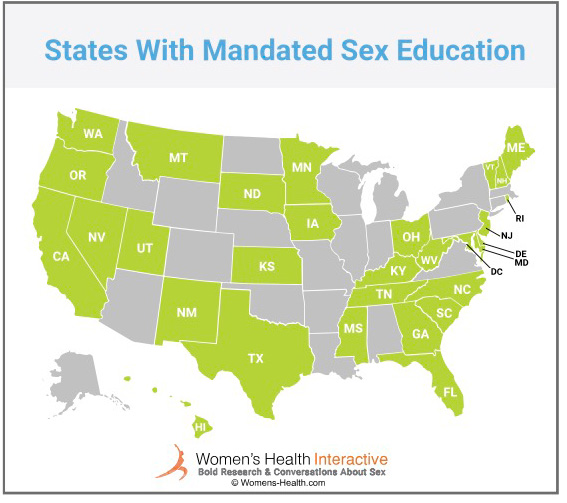
Photo from: Women’s Health Interactive A concept that sparked fear within the government as they began to question why anyone needed to learn about sex education in a formal setting then presented the opposing idea that by choosing to educate the young on sex, they would become wilder and therefore it would cause more issues than solutions. But as time has gone on the understanding has grown to accept that the best way to make sure people are having sex safely is through educating them within a classroom setting.
This is the trajectory that sex education has taken, especially as it continues to be changed and modified for those who are trying to gain a better understanding of what and how sex education will continue to shape the future of children. However, the challenges and fears that erupted in the early 1980s, after nearly 20 years of sex education trying to be a part of the general knowledge that people got, have continued to have major impacts to this day on what sex education looks like for those in high school and sooner.
But looking into the early aspects and challenges that overtook those who were trying to get information about sex out to people in a way that was not only accurate but also useful began in the 1990s thanks to the Sexuality Information and Education Council of the United States. With the support of the national guidelines task force they were able to come up with a curriculum design that would help understand what was already being taught and what needed to happen for sex to be taught in beneficial way. This original curriculum made sure that information provided was accurate for not only human sexuality but beyond that as they looked into all aspects that could or could not be a part of one’s sexual journey. They also wanted to make sure there was a healthy attitude about sexuality and communication so that they could make responsible decisions as their own human beings. But there was still a large push and try for the focus to be on abstinence only education.
Many of these aspects are still seen in today’s education, however, much of it has still shifted in that they don’t offer as complex of an understanding of what a sexual experience could look like for humans. The idea was that education would be focused on community-based abstinence, but in 2009 the Obama administration changed the funding so that it would focus more on a Teen Pregnancy Prevention Program and the Personal Responsibility Education Program. But this was just the beginning and the biggest forms of what most would like to see sex education look like now.
The funding that the Obama administration transferred was directly tied to noticing a declining trend in teen pregnancy after education had increased. Within a modern-day context something that has helped benefit this is the education on forms of contraception and birth control that help prevent pregnancy. There is also a lot of support that comes from proper condom demonstrations happening in schools that can not only encourage personal responsibility but reduce pregnancies and STDS.
Abstinence only education was still extremely prevalent in this era where the idea of sex education shifted. However, the passing of what is known as the “chastity law” in 1981, legal name the Adolescent Family Life Act. Helped make sure that there was funding dedicated specifically to abstinence only education that was developed by churches and religious conservatives. And since 1996 the act has continued to not only develop but also be something that helped other programs be funded to focus on abstinence only education.
Despite all efforts to enrich sexual education programs, not much of a difference has been made. Many schools still enforce that students learn a well-rounded education in sex however, according to the CDC more than 95% of teenagers in U.S schools, churches, community centers or other places, receive some “formal” sexuality education before they turn 18. And 89%-82% of that is saying no to sex. There is still a large understanding that sex education will come from parents more than it will come from schools.
But from my own research and survey done of college students in the front range area, 66.7% of the students said they receive a somewhat adequate sex education in high school, no one responded that they felt they received an adequate sex education. And even though 33.4% of these respondents are from Colorado many are from around the nation.
Narrowing the conversation specifically around sex education within Colorado first means taking a look at the law. State policy says that sex education is not required in schools meaning that school districts can decide whether or not they want to offer sex education and if their school does offer sex education students can decide whether or not to take the class.
In an interview with Jo Dixon who is the Health Curriculum Facilitator for Poudre School District “the state of Colorado leaves it up to each district to decide what curriculum they choose to teach in each district regarding health education or sexual health education” she said.
Which is exactly what the state law encourages however, it doesn’t make it clear in any of its writing that the education should be abstinence only.
Dixon mentioned this is often dependent on where the district is located because it can influence what the education will look like.
“Fort Collins is a pretty liberal community. So, it’s not going to be an abstinence only based program, which is technically a lie to kids. Because we want to show all of the options, but then let kids make their decisions for our students” Dixon said.
This is very accurate to what can be found within the Poudre School District curriculum as it is very thorough and informative in what is shared within their curriculum as they look into birth control options, what a safe and healthy relationship and sexual interaction looks like, discussions around HIV and AIDS, as well as look into gender and sexuality. But the largest caveat to this is that the education despite being extremely informative is not required for students to take, per Colorado state law.
This policy was almost changed in 2019 when Colorado House Bill 19-1031 was introduced with a focus on comprehensive human sexuality education. This would not only change the law that has already been created to make sure that everything was covered within human sexuality education but would also make it so that it will be required and something that would continuously be monitored, however, this didn’t pass and has not been reintroduced since.
“In my dream world every student is required to have human growth and development at the elementary level and human sexuality at the middle and high school level,” said Dixon.
Especially as we try to stay away from abstinence only education that is a method that is still stressed in 29 states within the United States. A comprehensive education is better than an education on how to best not have sex.
-
Colorado libraries criticize book bans amid national rise in challenged titles

2023 saw the most book challenges ever recorded in the United States at 4,240 unique titles — a 65% increase from 2022, according to the American Library Association’s Office for Intellectual Freedom. There were eight challenges of 136 titles in Colorado from January to August 2023.
The sharp increase in book bans aligns with a tense and polarized political landscape dating back to the 2020 presidential election. “Free speech” is a buzzword that has been brandished in social media debates and social justice movements — it’s enshrined in the U.S. Constitution, but what is the First Amendment doing for books in American libraries?
American Library Association Office for Intellectual Freedom Diane Lapierre, executive director of the Poudre River Public Library District, has never had to officially remove a book from their collection. Some individual titles are evaluated according to their criteria — such as whether there are updated editions available and what other libraries’ decisions have been — and emerge with a verdict to be re-shelved from the children’s section to the teen’s section, for example.
Lapierre said she’s seen no common thread between content, authors or genres that are challenged at Poudre Libraries but that she always gives it careful consideration. In her experience, removal requests have included a children’s book containing a cartoon gladiator battling a lion in ancient Rome; a biography of women in the Middle East that began with a map including Palestine but not Israel; Spanish photo novellas containing sexually violent scenes; or the movie “The Comedian” starring Robert De Niro because “it wasn’t very funny.”
Other states like Texas and Florida that ban the most books often challenge LGBTQ+ content or authors of color; some of the most nationally challenged titles include “All Boys Aren’t Blue” by George M. Johnson, “The Bluest Eye” by Toni Morrison, “This Book is Gay” by Juno Dawson and “Gender Queer: A Memoir” by Maia Kobabe. But beyond what the ALA reports, many book challenges take the form of informal requests on a local level.
“While I don’t get a lot of requests for reconsideration of LGBTQ titles, what we do find is that people — if we have a display — will go to the shelves where the books are and ‘hide the pride’: They will take books and remove them from the display or the shelves and put them in other parts of the library, tuck them down behind the shelves or put them with the pages forward, which makes it really easy for us to see which ones have been misshelved,” Lapierre said.
Colorado has seen multiple counts for book banning legislation to attempt to regulate the process, many without coming to fruition. In February, Colorado’s Senate Education Committee voted against Senate Bill 49 that would have made it more difficult to ban content from schools’ or public libraries. But in 2022, the Board of Trustees of Wellington, Colorado, passed a resolution effectively banning book bans at their local library.
In essence, the city prohibited the restriction of any content available by the Wellington Public Library: “The Board of Trustees hereby supports the freedom to read and opposes book banning and other attempts to patrons’ access to information. The Board of Trustees shall take no action to censor, suppress, remove, monitor or place age restrictions on ideas or information in our public library. The Board of Trustees stands firmly with the mission of the Wellington Public Library, which is a vital part of our democratic fabric and provides knowledge access for all.”
Wellington Deputy Town Administrator Kelly Houghteling drafted the resolution after one community member began rallying support on social media and questioning why certain titles were provided by Wellington Public Library. Houghteling said the passionate community response was unlike anything she’d seen, swiftly cutting the conversation short before it could constitute an official book ban — even making national headlines.
“It’s incredible how much impact that a local group of involved residents can have on the community,” Houghteling said. “People so often don’t know what’s going on at the local level. … We have council meetings every board meetings every Tuesday night. Respectfully, it’s the same five people: Those same five people, their voice is amplified more than others, and that could be — for some people — for better or for worse. So if people actually got involved, got engaged and made their voice heard, you would have the community that you’d like to see.”
Wellington’s recent city elections April 2 leave open the possibility for any preexisting legislation to change with new leadership. When the resolution was passed 5-2 in September 2022, Houghteling said Wellington’s city council meetings evolved into long nights of heated discussion from both sides of the spectrum: those against a ban in the community and those wanting to leave open the possibility to restrict some content.
“It gets complicated because you can end up restricting that very thing that you are about, which is free speech,” Lapierre said of Wellington’s resolution. “It’s a fine line and something that intellectually can be very challenging to consider: … how far you want to be on ideas of free speech versus protecting the community.”
The definition of each varies from person to person; what some call censorship is viewed by others as protection.
“Overwhelmingly in my library and my experience in libraries across the country, it has usually been a parent or a grandparent who has a concern about content not being appropriate for their children or their grandchildren — or even if it’s not a parent, again the concern is that this content is not appropriate for children,” Lapierre said. “It comes from this place of protecting.”
“I think it comes from fear, and everyone can understand that at its most basic level, but your fear shouldn’t allow you or motivate you to remove something that somebody else might not be afraid of and something that might be vital to them,” said Annaclaire Crumpton, digital communications specialist with Poudre Libraries.
National groups like Moms for Liberty have taken the issue of book bans and put it on steroids, Lapierre said. Beyond community members making requests for an individual title, such organizations have formed that introduce entire lists of books that, in their opinion, aren’t suitable for schools or public libraries.
“The common thread doesn’t lie with the books themselves,” said Louis Force Torres, founder of Polyverse Publishing Group. “It’s not the theme of the book that’s being banned, but rather it’s the people who ban.”
Groups who believe their word is the only word goes against the founding principle of Torres’ company: “poly,” meaning “many,” and “verse,” as in “universe.” Torres said the common denominator among those in favor of banning books is often being told to dislike a work without actually having read it, which makes the national book banning movement — driven by lists and group chapters across the country — dangerously imposing on local communities.
“We are a public forum, and there are going to be ideas and images and displays that may not be the thing that you would choose to experience, but that’s sort of the risk and the benefit of having a public library — where people from all walks of life can come in and hopefully see themselves reflected in what we carry and also see a different perspective reflected,” Lapierre said. “This is a place where you can come and experience a broad range of ideas, and some of them may make you feel uncomfortable or not align with your own personal values, and that’s OK.”
It can be a slippery slope when someone makes a claim about a certain type of content based on a personal or political stance that is neglected to be applied to similar content; it can be impossible to standardize.
“Who gets to decide what is and isn’t controversial, and what if there is value in having conversations about things that are controversial?” Lapierre said. “Do you set yourself up for not having the wide range of views and perspectives that the library should have? … What criteria do you use, and how many other things would fit that criteria?”
The book banning conversation comes down to whether every community member can agree on the content that should be removed, the likelihood of which is close to zero and an unreasonable expectation in a vastly diverse country founded on the notion of freedom.
The question is raised of whether silencing certain voices can be justified — and for whom.
“Book bans can come from the whole political spectrum and from any background of beliefs as well,” Crumpton said. “If you look at the data of what books have been challenged in the state, it doesn’t necessarily ascribe to one particular ideology always.”
Diversity of thought is the basis of literature, the basis of democracy and the basis of innovation. Productive discourse is not defined by agreement but by expansion of thought.
“That’s what democracy and what our country is based on: You’re able to read, think, explore and interact with each other in a way that preserves free thinking and new ideas coming forward,” Lapierre said.
Torres said bans rarely achieve what they’re meant to achieve.
“It’s almost like the unfortunate situation with abortions,” Torres said. “If something is vilified — even for health reasons — if something is being crushed and stomped down, then people will find a more dangerous and potentially life-threatening way to get that needed service.” Torres added that with the digitization of books and piracy in a global network of communication, it can be impossible to ban any one piece of media completely.
Libraries and bookstores are divided into sections for a reason. As keepers of knowledge, tomes of history and indicators of the future, different books serve and attract different readers. How is a public library meant to serve everyone if it is constantly being asked to remove content that has every chance of being essential to another? Even the darkest chapters of history are to be learned from, not erased.
“The books are written; they’re there. And you can learn from them and take from them what you will, but they’re not jumping off the shelf and screaming in your face their message,” Torres said. “To be assaulted by advertising is a more bannable thing in my mind than a book that sits there on the shelf waiting to give knowledge. Whether it’s considered good or bad to the reader, you can still learn from it.”
Poudre Libraries was one of many libraries that celebrated Banned Books Week in October, with events that included a challenge to read a banned book, public readings of banned books and writing postcards to various elected leaders advocating for the right of people to have access to a broad range of ideas.
“(Book bans are) an infringement of our First Amendment at its most basic form,” Crumpton said. “We don’t want more book bans, but it’s good that awareness of the issue is appropriately responding to the amount of books being challenged and banned.”
Poudre Libraries offers many services that Crumpton said she wishes residents knew more about. Beyond books, library card holders can check out gadgets ranging from ukuleles and record players to state park passes and GoPro cameras. Their free events include monthly book club meetings, adult crafting nights and language learning resources, “whether you’re learning English as a second language or you’re wanting to learn some conversational Italian before you go on a trip,” Crumpton said.
A Poudre Libraries card is free with a photo ID and proof of a Colorado address.
“Intellectual freedom is one of our core values, and that is closely connected to censorship and book banning and book challenges,” Crumpton said. “As stewards of democracy and intellectual freedom, we’re not going to bow in the face of any challenges or bans to defend that intellectual freedom.”
Lapierre quoted Jo Godwin to epitomize her mission after having worked in public libraries for 30-plus years so far: “A truly great library contains something in it to offend everyone.”
-
A War 7,000 Miles Away

A multimedia project by Kate Sherman, in which she tells the stories of Coloradans directly affected by the conflicts between Israel and Gaza and Russia and Ukraine.
-
Local Art in Fort Collins

Nestled in the heart of Colorado, Fort Collins might look like a standard college town upon first glance, but under the surface it has a vibrant hub for creativity and artistic expression. In the midst of these wild college students and lively atmosphere, a thriving community of local artists adds a unique and colorful vibe to the cultural tapestry of Fort Collins. From painters and sculptures to musicians and performers, many talented individuals contribute to the city’s artistic spirit in ways that captivate and inspire. Colorado State University, boasts a thriving art program that serves as a testing ground for honing artistic skills. Fort collins is extremely accepting to the diverse amount of creativity. However, many artists and art majors struggle with the stereotype of being poor or unsuccessful in the college world. Art Majors battle many passive aggressive remarks and questioning of their choices. People wonder what they are going to do with their major or why not choose something you could make more money off of? Most art majors have one goal and that is to express a message they think is worth hearing. Something that could make a difference and cause others to think or brainstorm the path of their own life choices.

Photo by Ian Schneider on Unsplash The faculty at CSU’s art program are not just educators but also practicing artists themselves, bringing a wealth of real-world experience and a passion for craft into the classroom. This ensures that students receive guidance that is only academically sound, but also deeply rooted in the practical aspects of the art industry. They have connections and are able to set up their students with success. One former art major that continues to support the art program at CSU is Matthew Longton, the current manager at Coopersmith’s Pub & Brewery. For 34 years Coopersmith’s has been showing local art within their restaurant to gain community and spread the artistic culture. Jane and Scott Smith, the original owners of Coopersmith’s started the art wall out of artistic interest and owners ever since have continued this tradition and kept their brewery’s interior alive.

Photo by Alexa Touchard Longton’s intention with the Art wall is to continue to keep this going. He finds artists that give a very similar aesthetic to the brewery to showcase their work. Sometimes artists come in to be shown and other times he finds them himself. As a former art major he is aware that some art students need to show their art work in a gallery in order to pass certain classes. He will occasionally reach out to the CSU Art Department and ask if Art Majors are interested in showcasing their work at Coopersmith’s. The current art at Coopersmith’s is done by the Artist, Frith Ann Jones, who has brought a very unique and descriptive art style to the Coppersmith’s atmosphere.

Photo by Alexa Touchard The opportunities for showcasing local artwork in Fort Collins are endless. Whether you are someone who wants their artwork shown or are someone who just wants to see the hidden talents of this town. Petrichor Collective puts together many shows and accepts applications of any talented artist willing to showcase their work. You can apply through their website or a they also have a studio downtown where they host other events and people within the community are able to reserve the space to teach classes or do what they please.

Photo by Alexa Touchard So far the collective consists of almost 200 artists and their whole goal is to strengthen the art community and make the process easier for artists to display their work and get noticed. It’s family owned and operated and they’re constantly adding new events to their schedule and open to new ideas as well, “Petrichor Collective is a comfortable, inclusive space for everyone to collaborate on projects and accomplish our Collective goals. By cultivating our different skill sets and fostering creativity, we support our community through Art!” quoted on their website.
After an art show they host an after party for all artists, and every Wednesday they do an artist potluck at their studio so you can bring food and something to work on and get to know other artists in the area or all within the show.

Photo by Alexa Touchard On December 1st, 2023 Grace Payne, an abstract acrylic an gold leaf artist, influenced by nature, had her first art show through Petrichor Collective. She mentions how the art community in Fort Collins is strong and continues to grow. The local businesses that are willing to be apart of the art community are inspiring more and more upcoming artists as time continues. Petrichor Collective is a great example of a local business that has created such an amazing space for creative souls to come together and learn from one another.
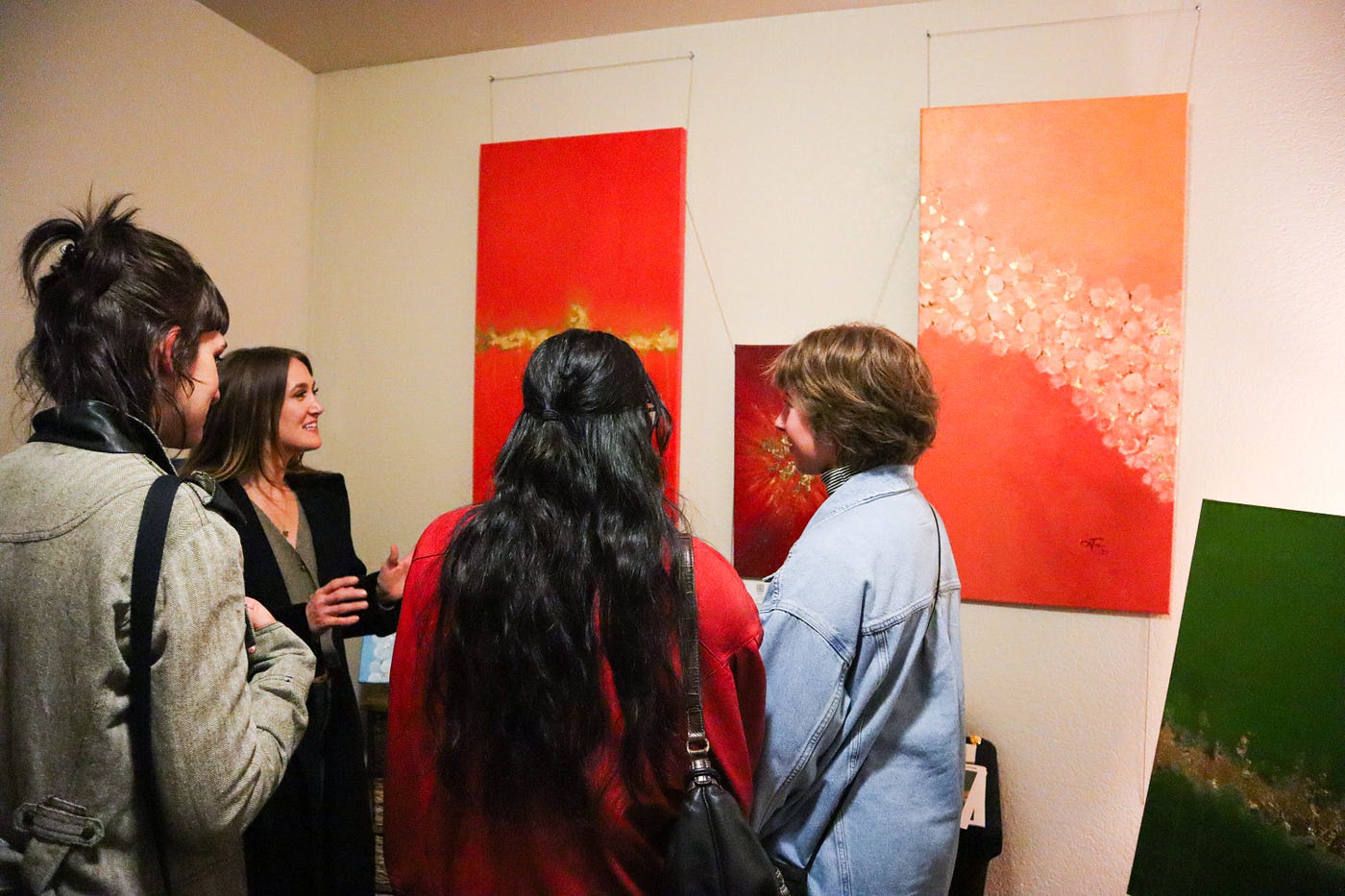
Photo by Alexa Touchard Payne describes her first art show as nerve-racking, but an overall success! She mentions that the transition from showcasing her artwork on social media, to an in-person showing was a big change yet a thrilling one. Payne said, “It was truly inspiring to see all the joy and intrigue people had while participating in the Art Walk. I am very thankful for the opportunity to be able to connect with other artists and people within the community who value the arts as much as I do,” she mentions how being able to share the process with the public and answer questions was very enjoyable.

Photo by Alexa Touchard Experiencing an ice breaking event such as a first art show gives an artist the ability to learn more about themselves and incorporate more ideas into future events. Payne mentions that she dove into artwork as soon as she could hold a pencil, where most credits go to her artistic bloodline. Although sharing her art publicly was not her overarching goal, she eventually felt like sharing that part of herself was something that would not only bring her joy but hopefully others. She feels that showcasing her artwork allows her to be her authentic self in a vulnerable way, “I hope that when people view my work, they can fall into it for a moment and absorb the beauty and passion put into each piece. I hope that they find comfort, warmth, love, vulnerability, connection, whatever it is they need in that moment,” said Payne.

Photo by Alexa Touchard Art can be described in many ways, and what makes it so cherished by many is that art is all up to interpretation and it is up to the artist, and the viewer for what it could mean. For Payne, “It is self expression, an emotional release, a way to be true to myself, and a display of love and appreciation for this life no matter the difficulties it may present.”
Art is the language of the soul, a medium through which emotions, thoughts and experiences are translated into a tangible form. It is a unique expression of all experiences, a way for artists to communicate the intangible and make the invisible aspects of life visible. Art has this power to provoke, inspire, and connect. There are many opportunities of self-discovery. It encourages a deeper understanding that what might lay on the surface.

Photo by Tim Marshall on Unsplash The art community is an insanely inclusive environment that accepts all different forms of expression. There are no limits or rules to what an artist can bring to a community, it is up to them how they choose to have it perceived and what difference they intend their message to bring to that community. They vibrant world of local art not only adds color to our surroundings but also serves as a powerful catalyst for community connection and self expression. From these community art events and exhibitions to online platforms that bridge the gap between creators and admirers, there is always an exciting time to explore, share and celebrate the artistic vibe or our local town. Keep your eyes peeled for opportunity and embrace those who have taken it.
-
Navigating Campus: A Closer Look at Transportation Challenges and Solutions in Fort Collins
Fort Collins, CO – In the heart of Colorado State University (CSU), transportation plays a pivotal role in the daily lives of students. Speaking with individuals to understand their experiences, shedding light on the strengths and areas that need improvement.
Nylah Walker, a First-Year Psychology Major
Nylah Walker, a first-year Psychology major residing in the Edwards domes, primarily relies on walking for her campus commute and takes about 15 minutes to get to classes. While she recognizes the benefits of having a bike, the cold fall weather has made her think twice about utilizing it. She shares her thoughts on the challenges posed by weather conditions, stating, “when it is colder, it is harder to get to class.” Walker emphasizes the importance of well-maintained roads, saying, “if it is hard to get people to where they need to, it is good to rethink about canceling class.”
Walker, who occasionally uses the bus, appreciates the accessibility, stating, “it was easy for me to navigate and get on buses with the bust stop on campus or on my phone.” When asked about potential solutions, she believes the campus transportation is effective, with clean roads ensuring safety and accessibility.
Anonymous, a Second-Year Psychology Major
A second-year Psychology student who wants to stay anonymous, resides off-campus in apartments relies on biking for their campus commute and takes about 15 minutes to get to class. The student weighs in on weather-related challenges, noting, “If it snows enough and the streets are plowed, then I might bike.” The student, satisfied with the university’s transportation services, emphasizes the convenience of bikes: “Bikes are fine besides registering it on campus. Pretty convenient and makes student life easy.”
Expressing contentment of the Ram Horn bus rides, the student acknowledges the challenges of third-party rides: “Spin, you would have to pay, and I have my bike, so I don’t quite use it.” The interviewee highlights the efficient and convenient nature of the university’s transportation services.
Anna Russo, Specialist in Public Engagement
Anna Russo, a specialist in Public Engagement, offers a broader perspective on transportation in and around Fort Collins. Highlighting the city’s robust bus network, Russo states, “10 different bus routes to CSU to get you where you need,” with a frequency ranging from every 10 to 60 minutes. She applauds the city’s commitment to road maintenance, emphasizing, “all the city streets are well taken care of.”
Speaking about third-party rides, Russo mentions the late-night Gold Route bus, catering to students’ weekend needs. On Friday and Saturday, the Gold Route bus runs until 3 am. She acknowledges the city’s partnership with Spin scooters and bikes, providing convenience to the community members. Russo sheds light on the city’s proactive approach to roads and sidewalk maintenance, mentioning street maintenance program and accessible reporting through Access Fort Collins.
Russo concludes by highlighting the city’s emphasis on biking, incorporating more bike lanes through initiatives like “FC Moves.”
Julie Pignataro, District 2 City Councilmember
Julie Pignataro, a City Councilmember representing District 2, provides insights into the overall state of transportation in Fort Collins. Acknowledging the city’s platinum level for biking, she also puts emphasis on the need to prioritize safety.
Pignataro recognizes the dependency on cars in the city’s outskirts and addresses road conditions, stating, “Not many potholes in the city for that long.” Discussing the budget for snow management, she notes an evolving increase due to climate change.
On the topic of Spin bikes and scooters, Pignataro advocates for thoughtful planning and highlights the importance of maintaining single trips for safety and environmental benefits.
In summary, these interviews offer a comprehensive view of transportation challenges and solutions to Fort Collins, having the perspective of both students and city officials, As the city continues to evolve, the focus remains on creating a safer, more accessible, and sustainable transportation system for all.
-
Rising Cost: Unraveling the Soaring Cost of College Textbooks
In 2023, inflation has played a role in society which affects college students at Colorado State University to obtain course material. This will mainly affect students with families in the low to mid-income range as they cannot afford to obtain the newest edition of books for every semester which could put them at a competitive educational disadvantage.
Past Trend of Textbooks:
By the 2000’s, the college textbook industry was dominated by three companies that accounted for 67 percent of all textbooks sold in the United States. In 2004, the average used textbook cost would cost about a third less than a new version of the book and every new edition that would come out years after, the sales of selling newer editions of textbooks would drop by 50 percent according to Are College Textbooks Priced Fairly? by Robert Carbaugh and Koushik Ghosh.
The reason why publishers are constantly making new editions is to prevent students’ secondhand market to sell to and the publishers would keep profiting. If the textbook was sold at a higher price, it would increase the probability of selling the book afterwards according to Why College Students Sell Back their Textbooks by Beaulieu.
Some bookstores buy-back textbooks after the semester are nearly over to profit off it during the following semester due to the books still being in good condition most of the time and covenant to acquire as it is usually on campus. Bookstores would generally sell the textbooks back to students or rent them out for the semester.
Factors Contributing to Overpricing:
Factors that could potentially drive up the cost are things such as being multi-color, format, and pictures to make it user-friendly for students. With higher prices, it discourages lower-income students and families to reconsider purchasing it on top of tuition.
Another problem within the publishing industry is that other countries outside of the United States could purchase textbooks for a lot cheaper due to the different rates in different countries and sell it back to American students for profit but it is prohibited in some countries. If publishers didn’t sell their textbooks out of the country, the textbooks in the United States would be higher because publishers aren’t making the revenue that they want, Beaulieu states.
A possible reason why publishers sell textbooks at an increased price is to offset the reduced sales volume. Textbooks add up its cost due to paper, printing, and editorial services along with figuring out marketing cost, administrative cost, and general cost. Publishers roughly walk away with 10 percent of the books cost per sale and publishers under contract can get up to 20 percent of the sales cost.
From a publisher’s perspective, they are trying to expand their sales to decrease the price and still maximize their profit but figuring out the sweet spot could be hard. In recent years, inflation has also played a role in society contributing to rising textbook prices.
For bookstores, they only buy back about 50 percent of student books because if they can’t sell it back to students, the textbook is considered a loss due to having to sell it to dealers for less or get destroyed. At the end of the day, bookstores usually break even on making profit from new books, used books, and the rental of books.
The Impact on Students and Families:
Students that couldn’t afford or didn’t buy a textbook would resort to borrowing/sharing with other students in the class but typically get lower grades and be less organized according to Beaulieu.
Ronald Mmopi, a second-year student getting into computer science at CSU, has a budget every year and typically doesn’t buy newer textbooks. Mmopi would share textbooks with classmates that have it because he thinks that “it is like a waste of money” to him.
If the textbook is necessary for the class, he would buy previous editions of the book from third party sellers and check newer editions to see if the content varies from classmates. After the semester is over, he would generally keep the textbook as a remembrance and look back on if he did need reference from the textbook in the future.
Ava Barbaris, a fourth-year student getting into zoology, likes that her textbooks are mainly online because they are a lighter load in her backpack, ease of accessibility, and the convenience factor. “For professors, it ensures that everyone is learning from the same book, working along with the same practice problems, and provides an easy resource to look back on for students on essays citation and studying for exams,” Barbaris said.
Barbaris’s take on newer editions is that it is important for her because in zoology, science is always growing so she hopes that it is always the newest edition. “You need the required textbooks and if you don’t have them, you won’t be able to pass the class,” Barbaris said.
Jocelyn Howard, a freshman at CSU getting into equine science with pre-vet, thinks that textbooks should be included in the tuition when registering for the class. Howard’s personal preference is having the physical textbook as it may include real life references that are included in the sidenotes of books but could be costly, therefore she does search around in the used textbook market.
Since this is her first semester transitioning from high school to college, she didn’t have to pay for textbooks before. To cope with this, if Howard finds a verified and cheaper third-party seller, she might look into buying from them. Along with purchasing a textbook in college, she possibly will try to sell it to the following semester students because to her, it doesn’t make as good of a return from selling it to the bookstore.
Potential Solutions:
In recent years, online textbooks which would help stop the second hand selling of textbooks, Beaulieu states. Online textbooks also help the overpriced sale of textbooks and provide a better experience to both professors and students.
Brittney Morgan, an assistant professor in the chemistry department at CSU, adds that newer editions sometimes have little changes with the same context but sometimes have value in using the newer editions.
To Morgan, past editions as there aren’t much difference the majority of the time unless it is a couple of years apart from the last iteration. Coming from a low-income family, she doesn’t want students to fall into the same hole and provides cheaper resources for students like online textbooks.
Online textbooks can include hyperlinks, videos, and different types of media to access the resource while being more adaptive and interactive. CSU students can buy the textbook if they want as an option, but it is now usually rolled into day one access textbook online which is cheaper.
Kerry MacFarland, general chemistry coordinator/assistant professor at CSU, states that having a required book is a good strategy to prepare students for exams even if the book isn’t really used. MacFarland believes that if the textbook is valuable in learning, it is better to pay a little extra for the education you gain from it.
Finding a balance between the cost and learning they gain from the textbook is essential for professors at CSU. Students in science are spending less now compared to back then due to online textbooks being generally cheaper and everyone would have day one access to it and the fee is automatically applied to your student fees.
One potential drawback of online textbooks is “not having something to look back on in the future,” Mmopi said. There is a possibility that students will lose access to the online textbook after the semester is over.
Bookstore:
Deana Rea, the course materials manager for the bookstore at CSU, states that the bookstore doesn’t set the pricing on the materials, that’s done by the publishers and supply vendors. The CSU Bookstore has always tried to help students save money.
CSU was one of the largest buybacks in the country, handing out over $1 million in December and May each year. Rental books were where students saved the most, and the Day One Digital Access program saved over $1 million per semester compared to print materials for students.
The reason why publishers look towards selling the book higher is because they can’t make enough to sell for every student due to variation between students’ financial standpoints. Bookstores like the CSU bookstore tend to order a certain percentage of copies for each course with statistics from past semester sales, thus why there are shortages at the beginning of semesters.
For fall and spring, research found that the sell back didn’t vary much from each other of how much students sell back their books. If the course was an elective compared to a course for their major, the book would have a 23 percent likelihood that it would be sold back.
Used books, students would resell them to the bookstore for half the price or to third-parties for a third of their price and would usually sell for 25 percent of the original price. All throughout the year, CSU buys books back at 40 percent of what the student paid for. Bookstores order through the publisher as bulk to save a bit and resell them to students.
Rea’s take on third party or secondhand books is that “it’s great that people are selling books to each other, more power to them.”
Conclusion:
For the students that couldn’t afford or didn’t buy a textbook would resort to borrowing/sharing with other students in the class but typically get lower grades and be less organized. What has been gaining popularity is having online textbooks which would help stop the second hand selling of textbooks.
Professors do get complimentary copies of the book to see if they want to adopt it for the semester. Although professors might not know the price, the student is more or less forced to purchase the textbook depending if it is required by the professor.
“Textbooks should be added to the tuition when you sign up for the course selection,” Howard said.
-
Subscribe
Subscribed
Already have a WordPress.com account? Log in now.
 NoCo Convos