-
Fort Collins is a sustainable and vibrant home to its community
By: Kyra Johnson
Fort Collins, Colo — Fort Collins, Colorado, is a vibrant place booming with energy. As a college town, a hub for beer lovers, a nature lover’s paradise, and a family-friendly community, Fort Collins truly has a spot for everyone.
Ranked No. 1 “Best Place to Live in America” by Livability.com and No. 1 “Best Place To Live In Colorado In 2023” by Forbes, there’s no question that Fort Collins is the place to be.
Nick-named ‘FoCo,’ Fort Collins does a great job at maintaining its small-town feel despite being one of the largest cities in Northern Colorado. With Colorado State University at the heart of the town, Fort Collins has a tight-knit community. It’s filled with locally-owned coffee shops, stores, restaurants, and businesses, giving the city its grounded vibe.
Fort Collins local Maddie Kinney said that one of her favorite things about her home is the community. She said, “everyone is so caring and helpful; you can always count on a stranger to ask you how your day was.”
Fort Collins prides itself on “fostering an inclusive, culturally rich, creatively vibrant, and arts-engaged community,” which is evident through the city’s efforts in providing and maintaining cultural services, natural areas, parks, and recreation to its community.
The city is very involved in the arts, supporting and encouraging expressive art in public spaces to add value to the community. Old Town Fort Collins is essentially a public showcase for art, full of paintings, musicians, sculptures, exhibitions, and a community favorite– hand-painted pianos scattered through the streets, open for anyone to play at any time. Fort Collins is a center for creativity, and city officials embrace that.
Fort Collins is also home to the Cultural Community Program, which “aims to integrate arts and culture into the Fort Collins community and throughout the City.” The program puts on several events, such as pop-up performances and events in public spaces, intending to curate a diverse and welcoming cultural environment for everyone.
Fort Collins is also a fantastic location for outdoor lovers. The city has over 30 miles of well-maintained trails; people can enjoy a walk, run, or bike ride in the great outdoors any time of the year. People can also hike in Lory State Park, go boating in Horsetooth Reservoir, or even white-water raft down the Cache la Poudre River. The city has even won awards for its natural areas, winning a 2022 Interpretive Media Award for the 2021 Explorer publication, a catalog of free events and spaces to explore provided to the community.
FoCo is about an hour’s drive from Rocky Mountain National Park and a few hour’s drive from world-famous ski resorts like Breckenridge and Vail, making for spectacular trips to see incredible views and ski impressive mountains. Fort Collins is also the northernmost big city in Colorado, so people often take trips up to Wyoming.
Our furry friends also have a place in Fort Collins. The city is highly dog-friendly, offering four well-maintained dog parks where you can let your dog roam leash-free. Also, most locally-owned businesses are pet-friendly; just make sure to ask.
Fort Collins consistently ranks high on ‘best places to live’ lists, which is no surprise considering all of the elements of well-being can be met for individuals who live in the town. Those elements are core needs, social relationships, health, equity, relative status, ease, joy, meaning, belonging, and resilience. The City of Fort Collins fosters incredible individuals, immersing people in education, arts, culture, and community.
Fort Collins is also a very safe town to live in. For comparably sized cities across America, Fort Collins is safer than most, according to NeighborhoodScout’s analysis of FBI crime data.
This rapidly expanding city has a higher population than ever before. However, Fort Collins has done an exemplary job maintaining its status as a lively but still family-friendly city.
The City of Fort Collins also does well running its local government. Citizen well-being seems to be at the forefront of most city council meetings, and residents have access to most information about what’s happening in the city right at their fingertips on the City of Fort Collins website. Mayor Jeni Arndt is very involved with the city, and you can find her at most community events. Fort Collins has an abundance of dedicated and active members of its local government, which help to improve the overall wellness of the community.
Overall, Fort Collins is a fantastic community to be a part of. It is a unique, well-balanced city with vibrant nightlife, beautiful scenery, a dedicated community, and spectacular ratings.
-
Chapter 5: The Life-Changing Effect of a Samosa
I was lounging in the Asian Pacific American Cultural Club office, a place I’ve come to find comfort in. I was munching on my lunch and working on homework as I felt the energy shift in the room. Club members were welcoming in a tall Indian boy who was soon cracking jokes with everyone in the room that he knew (which was practically everybody).
We made eye contact, and there’s this thing that I’ve experienced here at CSU that happens when one South-Asian notices another South-Asian, an instant connection that forms. He approached me and we made conversation, bouncing off one another with comical jabs.
I explained my project to him and he was immediately on board and willing to help in any way he could.
Little did I know that I had not only found an interesting perspective for my independent study, but I also found a friend who I had a life changing conversation with.
Faraz Bukhari
Faraaz Bukhari is a third year student studying Health and Exercise Science with the goal of becoming a physical therapist. He is a very active and involved student as he is a part of campus politics in student government, is in a running club, helps freshmen navigate college life as a Resident’s Assistant, and brings a level of understanding to complicated concepts to students as a Teaching Assistant.
Bukhari was drawn to his field of study through his own experience in physical therapy clinics. He grew up with pigeon feet and spent quite a lot of time in these clinics to fix his posture. Like a moth to a flame, he became fascinated with the social aspects found within this science.
“You are talking to people who are discouraged, who are broken, who have been injured,” Bukhari said. “And you’re guiding them through this healing process.”
The social interactions and the push to help people on a personal level was the thing that attracted him to choose his major earlier this year.
This sociable personality followed Bukhari throughout his entire life. As a military kid, he moved around a lot and he relied on his ability to adapt to change and his outgoing personality to make friends and survive.
He wanted a field that allowed him to interact with people, that let him be the social butterfly he naturally was. When he was a child he wanted to be a waiter simply because it let him interact with a multitude of people on a daily basis.
As he got older, he wanted to become a teacher, a job that he saw a lot of value in, a goal that he was turned away from by a loving, yet brutally honest grandmother that did not see the financial stability in this career.
He found Health and Exercise Science, a field that was in STEM that aligned with his needs as a social butterfly.
“I knew I had to choose something in STEM, not just as an expectation as a brown person, but also as a way to sustain myself and my family moving forward.” Bukhari said. “Not to say that journalists, artists, and writers don’t make money, but growing up that just wasn’t the way to do it.”
The Importance of a Single Samosa
Our conversation branched out to the lack of representation of South-Asians in media and literature, and we discussed an experience that I had never been able to put into words before.
When Bukhari was a senior in high school, he was able to choose what kind of literature he wanted to study, and he picked Asian-American literature, where he saw himself represented for the first time.
“I’ve never read anything that had the word samosa in it. There was nothing about opening the door to your house and smelling all the spices of your mom’s cooking.” Bukhari said. “It was nice reading things that were about me. And that made me wonder why don’t more folks in our culture write more?”
Bukhari never worried much about representation when he was younger, but when he finally read about himself, he felt seen, something he hadn’t felt before. I had a similar experience when I had first seen myself represented in a way that I was actually proud of.
We did not know what we lacked until we had it. We had not felt what it was like to feel unseen until we had felt seen and had understood the difference.
Kids don’t really think much about representation and social issues. However, there was a story I had read about a child seeing a character in the Disney movie, Encanto, that looked exactly like him, and the boy had the biggest smile on his face.
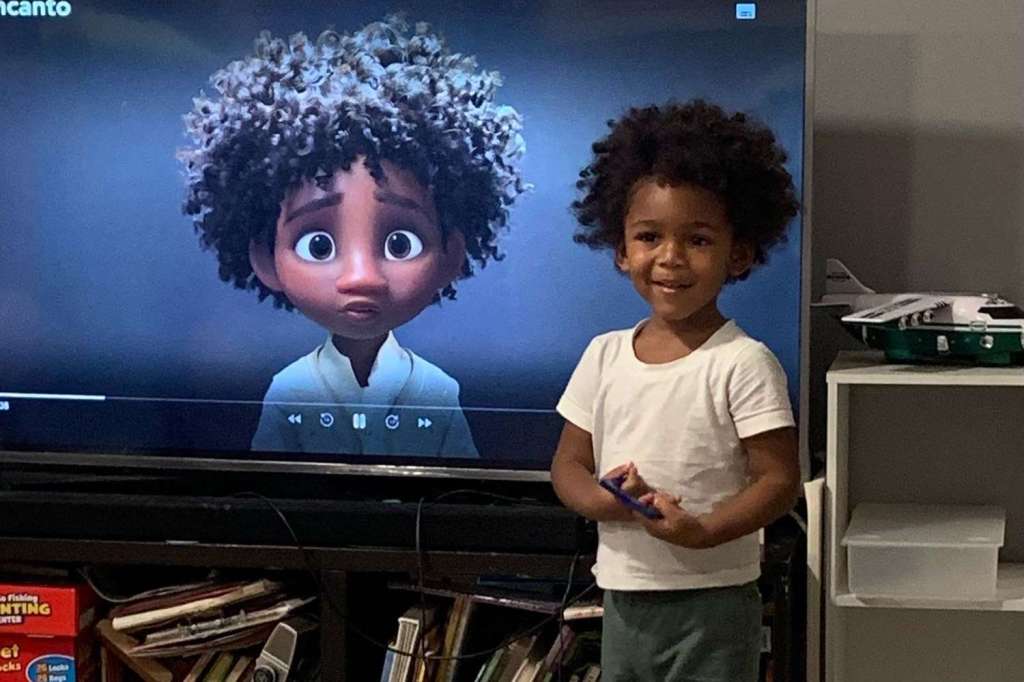
2-year-old Kenzo Brooks is ecstatic to see his lookalike on TV Something powerful happens when a child sees themselves on TV and says to their parents, “Hey! They look like me!”
This heavily ties into my last post about representation. Simply being able to see yourself in a TV show or in a movie can change the way you see yourself and what you think you are capable of.
Bukhari and I discussed the usual stereotypes that come with being South-Asian. The nerdy Indian boy or girl, “the model minority” as he put it, and how neither of us fit into this box that many have put us into.
He has struggled with this conflict of identity a lot. He is not the typical STEM or South-Asian student, he strays far from what the stereotypes portray. He is perhaps the most outgoing person I have met during my time at CSU, but he has battled with what people expect him to be as an Indian student, and what he truly is.
Expectations
Bukhari grew up with two older, high achieving siblings, his sister is attending Cornell and his brother is at Berkley.
There is naturally a lot of pressure South-Asians kids are under, but when you already have golden standards to follow in your own family, that pressure is heightened.
He did well in school, but he really used his athletic and social expertise to help him stand out from his siblings. He is the most outgoing in his family and this has helped him come far in his extracurriculars outside of school, things that he does to just help and give back to the community.
He was naturally drawn to education and learning and saw a lot of value in it, which explains why he wanted to be a teacher. But rather than being pushed to excel in academics because of his passion for education, there was rather a level of disappointment he was running from.
“If you didn’t meet that standard (the South-Asian standard), there was disappointment,” Bukhari said. “I think the fear of disappointment is what has carried me this far.”
Circling back to Bukhari’s decision to pursue a STEM field, a big part of it has to do with the unsaid expectations that are put onto South-Asian kids to chase after a job in STEM.
His decision to choose a job in STEM was not solely for him, but for his parents as well.
I have talked much about the importance of status in South-Asian cultures, as well as how parents are looking out for their children when they push them to pursue STEM fields. However, something that I did not fully understand until recently is the mindset behind the collective and how that affects South-Asians in their decision-making ability, and in practically every other aspect of their life.
The Collective
What I learned from my conversation with Bukhari about my own culture was how much value we put on the collective. Every decision that is made is not for an individual, but rather for the benefit of the whole family.
Bukhari is someone that loves to help people. He sees merit in people and believes that everyone has a story to tell, and if he is able to, he would like to be a part of that story.
His intense care for other people can be tied to how he was brought up. He was taught to think about other people’s needs and what would be best for them. There was not much space for individualism, which is something that he has struggled with.
“In our culture there is a lot of focus on the collective rather than the individual,” Bukhari said. “When you pursue things that are related to your own happiness that’s seen as selfish, but I get why it exists. It’s the same reason behind arranged marriages.”
Arranged marriages are common occurrences in our culture that happen to help tie two families together in order to keep the culture going. It’s seen as less of an individual choice, and as more of a decision for the family.
There are two sides within Bukhari that battle everyday, the side of him that knows he needs to take care of himself, and the side that wants to help and care for everyone. He is learning to step aside from helping others and to think more about himself, something I know many South-Asians have had to learn to do.
“Am I doing this because I want to do it? Or am I doing this for others? Are there certain things that I do just because I’m a brown son?” Bukhari continued. “How do I navigate these expectations when I don’t even know what my own are? The emphasis has never been on me.”
A Difference in Culture
Growing up a child of immigrants in the United States is a unique experience. These children must learn to navigate the culture they are growing up in that is much different than the one they live in at home.
It’s common to see children being told stories from their parents about their time growing up, anecdotes that give advice and at the same time build the bond between parent and child.
These interactions are few and far between in our culture.
“The only time I can get stories from my parents is if I dig and ask,” Bukhari said. “They don’t really talk about themselves or about their past.”
There has to be a direct correlation in this lack of communication in South-Asian cultures to how our culture sees individualism and the humanities. There’s a storytelling aspect of the humanities that is crucial for people to learn and grow that is usually not as valued.
Bukhari had asked earlier why people in our culture don’t write more, and I believe it has to do with how our culture views emotions. We have been taught to prioritize the collective, to put our emotions and feelings on the backburner in order to make sure everyone else is okay.
South-Asian parents don’t show love in a typical way that is expected from parents in the west. How they show love is by pushing their kids to be the best they can be in a field that will guarantee them a job, to ensure that they won’t face the hardships that come with poverty.
There is a lack of expression in the culture that can be related to our lack of vulnerability, our lack of shared emotions. Love is shown differently, and sometimes that love can be harder to understand. And as I have come to learn through my interviews and own reflection, it’s not usually understood until much later.
But this expression is important for our culture to grow. We need to see stories being told of our culture on our TVs and in our books. We need to see that South-Asians are more than doctors and engineers.
There is change coming, I can feel it. I am patiently awaiting for a picture to emerge online of a happy little Indian kid smiling because they see someone on their TV that looks exactly like them.
-
The Cost of Being Overlooked
FORT COLLINS, Colo.
Pulling at the heart and evoking tears, Colorado State University’s production of Larry Kramer’s, “The Normal Heart,” revealed the humanity behind the classic play and its lasting impact on audiences.
Based on the life-story of the playwright himself, the show revolved around the outbreak of the AIDS epidemic in the 1980s. From the U.S. government’s lack of interest in preventing the disease to the tensions that boiled within society, “The Normal Heart” highlighted the human connections during one of the largest epidemics in recent history.
The play follows a group of gay men as they urge the American society to heed the danger of AIDS, some going as far as to proclaim that men should stop having sex in order to prevent the disease from further spreading. Despite their united interest in the cause, not every man is eager to publicly identify his sexuality, leading to betrayal and loss within the group of friends.
“There really were a lot of heroes depicted in the story,” said Dr. Wesley Longacre, the show’s director. “The amount of discrimination, the harassment and marginalization that this community faced at the time, it is representative of the now.”
With the reality of the play at the forefront of the production team’s mind, CSU decided to not only showcase the AIDS epidemic, but to do so in a manner that caused a greater impact on the audience.
Rather than transpiring in a proscenium theater, the show was set in a black-box theater. Without a raised stage, the close proximity between actor and audience revealed the intensity of each moment, increased the emotion of each scene and landed a powerful blow by the play’s heart wrenching end.
Between the initiation of each scene, members of the cast came on stage, each clutching a piece of white chalk in their hand. With a sound akin to glass scraping upon glass, the cast scrawled the names of the AIDS victims on the black stage floor.
By the show’s conclusion, there was barely a spot that remained bare.
As audience members filtered out of the theater, many paused to read the names. Tears filled the eyes of some, while others stood with their mouths gaping open as they gazed at a stage littered with the names of the dead.
An uncomfortable hum vibrated through the audience as they gathered in the theater’s lobby. “The Normal Heart[’s]” message was all too real for members of the LGBTQ+ community.
“I’m a bisexual individual and knowing that people whom I care about, people near me and a world that I’m close to are being affected by things like this, it’s hard,” said CSU performance major, Ethan Bowen, after the performance. “Things are difficult.”
Despite the weight of the play and its connection to reality, Bowen was reminded of how important it is to keep fighting to not be overlooked.
“When tempers are high and everything is tough because everyone feels so strongly about something, it’s okay to keep fighting and it’s okay to keep loving,” Bowen said.
-
Where the Business Community Stands
When it comes to the Land Use Code debate, Fort Collins Chamber of Commerce and the Northern Colorado Board of Realtors and the are some of the more salient groups. The business community is generally acceptive of the Land Development Code for a number of reasons.
The Land Development Code, in general, gives property owners more flexibility in regards to what they can do with their properties. With more flexibility to add additional dwelling units and increase density, the hope is that while supply will increase, prices will decrease.
The Chamber of Commerce is an association that is composed of small and large businesses that advocate for business issues on behalf of their member businesses.
The Northern Colorado Board of Realtors is a group that represents real estate agents who have joined their group. A realtor is a higher level of a real estate agent, meaning that they paid a fee to join the Board and have sworn to uphold a code of ethics.
Both groups were supportive of the Land Development Code and took an active public stance to their support.
Fort Collins Chamber of Commerce
“One of our top issues is housing,” said Joe Rowan, policy consultant and housing specialist for the Chamber.
The Chamber advocates on behalf of its member businesses and one of the recurring issues that they hear from their members is about housing.
“With our member businesses, one of the number one issues that they face is being able to attract and retain employees,” said Rowan. “ An issue that is brought up over and over again with their employees is that the difficulty in finding not only appropriate housing but housing that they can comfortably afford.”
The Land Use Code created barriers to development which was limiting the supply of housing in Fort Collins. The Chamber sees housing as a supply and demand issue so breaking down those barriers to development in the Land Development Code would allow for an increase in housing supply.
Advocacy on behalf of business is one of the pillars of the Chamber of Commerce and that is what they did with the Land Development Code.
Fort Collins Board of Realtors
Similar to the Chamber of Commerce, the Fort Collins Board of Realtors took a similar position in regards to the Land Development Code.
“All real estate has local and national issues that have to do with government,” said Marcus Valdez, director of Governmental Affairs for the Fort Collins Board of Realtors.
“When you really look at it [The Land Development Code], what it does is it increases the density,” Valdez said.
“ So if someone wants to build a duplex or sixplex and they have that much land for the property, this allows them to build on that land and to use it for the highest and best use for that particular property.”
The Land Development Code would take away barriers to denser development that will increase the supply of housing in Fort Collins.
The Board of Realtors met with the City to talk about parts of the Land Development Code that they had questions about.
“As the government affairs committee we had meetings specifically with the City about it and there were just a lot about how the utilities work, who pays for the water and they had answers for them but I’m not sure some of those answers were super thought out,” Valdez said. “When they make a new rule they’re not going to know the unintended consequences of that rule.”
A complex part of making policy is not knowing the unintended consequences. This is what the Board was worried about but overall the Land Development Code was better in their eyes than the Land Use Code.
Valdez has been involved with real estate for over 30 years now. He sees groups like the Board as a part of the process of the Land Development Code because they hold the industry knowledge that the City might not.
Conclusion
Both groups support the Land Development Code but there are nuances to why they support it and those nuances come from what their group stands for.
The Chamber of Commerce supports the Land Development Code because their members need employees that can find appropriate and affordable housing near their place of work. To the Chamber, the supply side of housing is too low and that is why prices have increased.
The Chamber also supports it because it would create more appropriate types of housing. While Fort Collins has lots of student housing for CSU, that is not the type of housing people outside of college are looking for.
The Board of Realtors supports the Land Development Code because they want everyone who owns property to have more flexibility over their property.
More flexibility will allow property owners to develop their properties to the best purpose of that property. This will allow for more housing which will increase density. It also means that more variety of housing is likely to be developed.
In case you were wondering about my last article, I am still working on a couple interviews. More to come on that later. As always, feel free to reach me at michael.stella@colostate.edu or @Michaelstella_.
-
Chapter 4: No Role Models
While interviewing Gaya Sivakumar last week, we stumbled onto a topic that I think deserved its own post. It all started with an anecdote. Sivakumar was explaining to me how her niece wanted to go into graphic design, straying away from the typical South-Asian jobs.
“I hope my sister saved enough money for her,” was the first thought Sivakumar had when she had heard of her niece’s potential career path. Though she herself was not in a typical South-Asian career, she was initially afraid for her niece. This feeling did pass quickly and Sivakumar was able to understand why she felt the way she did.
“I am looking for role models of different people of different ethnicities excelling in different fields and there’s so little. I know there’s a cultural component of succeeding in a non-science job. In this country if you look anything like a South-Asian, they’ll accept you as a doctor or engineer, but to gain respect from peers in a non-scientific sphere, I think there’s a lot more hard work that needs to be done.”
She wanted to know that someone else from our culture made it as a graphic designer, a role model for her niece. That got me thinking about the role models that South-Asians have in jobs that aren’t a part of the typical sought after jobs.
If you take a look at the role models children have, many turn to the fictional heroes and characters that are portrayed in all forms of media. And if you look, you don’t even have to look too hard, you can see that there’s a clear lack of South-Asian role models.
Me and Baljeet
The number of South-Asian representation in media is very limited, and the representation that exists tends to usually be very stereotypical and not at all flattering.
No matter how far from reality tv shows or movies can be, humans still use media to process what their lives should look like. Cartoons and movies have a great impact on children. Little kids want to be dressed in pretty ball gowns like Cinderella, or in a suit of armor like Iron-Man. We like to see ourselves in the characters that we look up to.
As a South-Asian boy, my options were limited. Common stereotypes of South-Asians include the nerd, the convenience store owner, and the taxi driver. Not really characters I wanted to be associated with.
In middle and high school, I was always compared to Baljeet, the nerdy Indian kid on the popular Disney show, Phineas and Ferb.
Granted, I did have a similar skin tone and similar hair to Baljeet, that was really where our similarities started and ended. Baljeet is a likable character. He is smart and dorky. There is nothing inherently wrong with a nerdy character, but because there is a lack of representation of South-Asian characters, especially South-Asians kids, there is an idea that is formed that this is the only way that Indian kids can exist, as nerds.
It is nice to see someone that looks like you on screen, but when there is only one or two characters like you that exist in this medium, you’re forced to relate to these characters, even if you don’t.
I accepted the comparison to Baljeet, though we were not really similar at all. I let myself believe that I was the same as this character though deep down I knew I wasn’t. This reinforced the idea that maybe South-Asians are supposed to be nerdy. That’s what the TV says at least.
A Changing Culture
For a long time, South-Asian representation has been something that has been lacking in the west, but there are people that are pushing for a change.
Mindy Chokalingam, known professionally as Mindy Kaling, is a second generation Indian-American who has become very successful in Hollywood. She works to show her own personal experience as an Indian-American in the United States.
She gained popularity when she played Kelly Kapoor on the smash hit mockumentary series, The Office. She was the sole recurring women of color in the series, and the only woman in the writers room.
She was able to develop and progress the boundaries of what South-Asians and women of color can do on TV. Her character diverged from any normal stereotype that followed Indian women. She portrayed a unique character that was funny, but not for any of the typical reasons Indians are found to be funny.
After her time on The Office, she was able to work on her very own show, The Mindy Project. Her show is about a young Gynecologist, played by her, that is navigating life and love in New York City.
This show was big for South-Asian representation to say the least.
In her Vanity Fair article published in 2019, “Mindy Kaling in Full Bloom,” Samhita Mukhopadhyay spoke about the importance of the tv show after an interview with Kaling.
“The Mindy Project was also revolutionary. Viewers, including, importantly, women like myself, had never seen a character like Lahiri (the main character of The Mindy Project) before, never mind in a leading role. Kaling turned one of the most common tropes about Indian-Americans on its head: the aspiring, straight-A student who becomes a physician.” Mukhopadhyay said. “Lahiri is a doctor, but she is not quiet or particularly geeky. She takes up space (sometimes to the point of narcissism), dresses in bright colors, subsists on rom-coms. She dates, and she likes sex. She is also sometimes offensive–this was no ‘good Indian girl.’”
Kaling has worked on breaking the bounds Indian stereotypes have. She continues doing this with her other shows The Sex Lives of College Girls, and Never Have I Ever. Though there has been critiques on her shows only showcasing the love interests of the main characters as white males, she defends these claims by saying that she is using her platform to speak from her own experience.
“White guys were the ones who hit on me,” Kaling said in her Vanity Fair interview. “Indian men didn’t.”
Even if there isn’t a whole lot of representation in the love interest side of things in Kaling’s shows, by telling her own stories and experiences, she is able to allow for the creation of depth in South-Asians. We are not just nerds who are straight-A students. We are complex individuals who are worthy of representation on all screens, big and small.
Kaling’s work has paved the way for other South-Asians to create representation based on their own experiences. Shows like Aziz Ansari’s Master of None, Priyankra Chopra’s Quantico, and Fatimah Asghar’s Brown Girls, have been able to push the culture forward, welcoming a more rounded, more complex representation of South-Asians. We are more than just doctors and nerds.
Circling Back
We know that the tv shows and movies we consume aren’t real life, but we can’t help but relate to the characters and stories we see. The South-Asian representation, and the lack thereof, has had an impact on the way that South-Asians see themselves and the roles that we let ourselves play in society.
We look for role models, heroes that inspire us to do the things we hope and dream of doing.
For generations, South-Asians have held a very specific niche in society. We have held very specific jobs, and there are powerful forces that reinforce these stereotypes.
As a South-Asian pursuing journalism, I currently stand with no real role models in my field. But I have a feeling that that will be changing. I believe that us South-Asians will be able to break ourselves out of the box, and to explore a world different from the one we have been locked into.
I have faith that we will be seeing more and more South-Asians in different jobs, humanities included amongst them. The change will take time, patience, and vulnerability, like the conversations Sivakumar, Kakumanu, and I have had with our parents.
Progressives like Kaling will continue to humanize South-Asians, to give depth and personality to our culture that is developing in the western world. When South-Asians can see themselves in different careers on TV, when they can find role models that stray from the norm and expand our culture from being stuck in STEM, as it has been for generations, I am sure we will begin to see South-Asians in jobs that we have never seen them in before.
When there are new role models, we can expect new niches to be filled by the South-Asian population. Whether that niche is Cinderella, Iron-Man, or a journalist.
-
An Explanation
You may have noticed that my weekly action report for this week was delayed. I want to provide an explanation why.
Through the course of last week and this week, I conducted multiple interviews in which comments and accusations were made about other groups of people. It is unethical as a journalist to publish these comments without giving the accused the opportunity to respond.
Until then, I am hoping to get an article out for this week where I talk to another stakeholder about the Land Development Code.
I want to be as transparent as possible about the journalistic decisions I am making. It was tough to conduct such interesting interviews and have to wait to share that information with you but it is the right thing to do in the long run.
Until then, feel free to reach at michael.stella@colostate.edu or @Michaelstella_.
-
Chapter 3: The Singer Who Studied Economics
I’m not sure how many South-Asian journalists there are in the United States. So far in my journalism classes, I’ve only ever seen one other South-Asian student. One. I had never even interacted with a South-Asian professor. That is, until now.
Gayathri Sivakumar is a South-Asian associate professor in the journalism department here at Colorado State University. She grew up in South India and had a lot to say about the struggles and challenges that she had to overcome in order to be where she is now.
The Fight for Her Career
From early on Sivakumar knew that math and sciences weren’t her thing, despite those subjects being deemed as so important in Indian culture.
“By class eight (grade eight) I knew science was not my thing,” Sivakumar said. “By then I understood that my everyday life would be terrible because I wasn’t going to enjoy what I would be doing.”
Though for the most part she knew what she wanted to do, there was a lot of pushback from her mother about her career choice and what she would study in college.
She had originally wanted to study English Literature and go into journalism. She was curious about the world around her and was ardent about storytelling.
Her mother, however, was unwilling to let her pursue this unfamiliar path, creating a familiar tension that we had seen in my initial post, and in my post from last week.
Sivakumar applied to only schools that specialized in the humanities, getting into top schools without her mother knowing that was all she applied for.
When her mother found out, she was furious and tracked down a university that was still accepting applicants for a math program, but Sivakumar refused.
“My mother was crying and she was trying to explain to me that she was doing this for my own good,” Sivakumar said. “We compromised, I let go of my obsession with doing literature, and she decided to stop forcing me to do math. We decided that I would study Business Administration.”
This is not a conflict that we are new to. I faced the same tension, and so did Akash Kakumanu. Kakumanu and I would probably describe that period of tension we had with our parents the same way Sivakumar would.
“That was one traumatic summer.”
So…Why STEM?
The pressure for South-Asian students to pursue STEM has been a constant. But why?
In Hindu culture, math is seen as very important and prestigious.
“In Hinduism math is a glorified thing…there’s always an obsession with math,” Sivakumar said. “It is a measurement of how intelligent you are in some ways.”
Sivakumar’s decision to pursue a non-STEM field was emotional for both her and her family. In India, the status of the family is something that is important and always considered.
When someone strays from the norm, there’s a lot of emotional turmoil. The stakes are really high. It’s not always just about a job, it’s about how you and your family are perceived.
The other side to this, is that Indian parents just want their children to be living a good life.
“In India it’s always a joke, when you’re young they always ask, ‘What do you want to be? A doctor or engineer?’ Those are the only two options they want to give you.” Sivakumar said. “I realize it comes from a place of wanting to be protective and a lot of it has to do with the economic situation back home in India at the time.”
There was a high demand for STEM related jobs in India, but nothing really that diverged from these fields. The only jobs that were available were government jobs, which were highly competitive, and positions as a school or university instructor.
“You have to realize that the salary that you get for these professions were minuscule. My parents were aware of the fact that if I did not fall under the category where it would be easy to find employment, the chances that I would be economically underprivileged would be pretty high.” Sivakumar said. “The difference in lifestyle between middle class and lower middle class were pretty huge.”
The relationship that South-Asian cultures have with STEM is complex. It’s a symbol of status, but it is also a sign that you have a good life that comes with a sustainable job.
However, in India, they are beginning to realize how detrimental the lack of humanities has become in the workforce.
People are now trying to humanize STEM because they were producing individuals that were very proficient in their fields, but lacked the necessary skills to be a good employee and communicator.
Sivakumar & The Humanities
Sivakumar loved reading when she was a child, but her family did not have much money to buy reading material.
Her and her siblings would be able to buy a comic book once a month and they would treasure this purchase. They would read and reread these books over and over again.
Sivakumar’s mother was actually an avid reader as well. She was an expert in Tamil literature and had impressive control of the language. She was also able to sing beautifully and improvise songs on the fly.
She was a natural poet and artist.
Her brother suggested she study Tamil in university because of her expertise in the language, but she was highly offended. She decided to study economics in college and was married by the time she finished her studies so she never did anything with it. She kept up with the housework and took care of the kids.
She took a more respected route, but she told Sivakumar that she always regrets not pursuing Tamil. A regret that Sivakumar will likely not face, because she was able to chase her dream, the thing that called out to her.
Still, if her mother had studied Tamil and kept singing, maybe she would have been the first thing I’d hear when I turned on a radio in India.
-
Stakeholders in the Land Use Code Debate
In the last few weeks we have gone over who I am, the timeline of the Land Use Code rewrite and one of the most important aspects of Land Development in Fort Collins, the Growth Management Area.
Given what we know now, it’s time to meet the stakeholders.
Citizen Groups
The most prominent stakeholder in this debate are Fort Collins residents. Decisions that are made in the Land Use Code affect citizens the most and arguably they have the most power here, considering one group was able to petition the repeal of the Land Development Code.
The two citizen groups of interest are Preserve Fort Collins, the opposition group to the Land Use Code and Foco Housing now, the group supporting the Land Development Code.Preserve Fort Collins came in response to what they thought was a lack of communication and outreach by the city in regards to the Land Use Code rewrite. According to their website, their mission is to preserve Fort Collins’ high quality of life for all residents.
Preserve Fort Collins led a citizen petition drive to overturn the Land Development Code. They collected 6,447 valid signatures while they only needed 4,228. The petition requires the City of Fort Collins to repeal Ordinance No. 114, 2022, also known as the Land Development Code.
The other citizen group is FoCo Forward, the group that is supportive of the Land Development Code.
FoCo Forward supports the Land Use Code and the group was created to educate the community in a non-partisan fact based manner, according to their website.
FoCo Forward was founded by city council member Julie Pignataro and Mayor Pro Tem Emily Francis.
An interesting difference between the two groups is the endorsements that they have. Foco Forward has the endorsements of groups like Fort Collins Habitat for Humanity, Poudre Education Association and Fort Collins Chamber of Commerce.
On the other hand, Preserve Fort Collins has the endorsements of former city council members such as former Mayor Doug Hutchison, former Mayor and City Councilmember Ray Martinez, and former City Councilmember and Mayor Pro Tem, Ross Cunniff, to name a few.
Another group to keep in mind is the Associated Students of Colorado State University. ASCSU is currently lobbying the City to change its U+2 ordinance and while their work does not necessarily relate to the Land Development Code, it relates to housing and thus they need to be included in this group.
Housing Industry
The housing industry is an umbrella group for many different groups here. I consider the housing industry to be groups like the Northern Colorado’s Home Builders Association, The Fort Collins Board of Realtors and the Noco Rental Housing Association.
Faster permitting for building and more spaces to rent out are definitely something that these groups are interested in.
City of Fort Collins
Ultimately, the City of Fort Collins has to do something in regards to the Land Use Code. Leaving the code as it is likely will not address the affordable housing crisis the City faces, thus they are left to find a solution.
In the end, the City is being forced to go back to the drawing board and try again with the Land Use Code. The stakeholders are the Fort Collins residents who need places to live, the industries that relate to housing and the City of Fort Collins.
As always, feel free to reach me at michael.stella@colostate.edu or @Michaelstella_.
-
Chapter 2: The Soul That STEM Lacks
I nervously tapped my foot on the glistening tiled floor of the student center. A few tables across, sat a young South-Asian student eating lunch with his girlfriend. This was the perspective I needed. I had trouble finding someone with a point of view that would prove to be beneficial to my story, as there were no clubs on campus dedicated to the culture I was investigating, so I had to scout out my own interviewee.
I worked up the nerve to approach him and asked him, “Hey man, are you South-Asian by any chance?”
He smiled warmly, welcoming me, another individual of South-Asian descent.
“Yes I am,” he said as he reached out for a handshake, “I’m Akash.”
Akash Kakumanu
Akash Kakumanu is a freshman studying computer science here at CSU. We had a very enticing conversation about what it’s like to grow up as a South-Asian in the United States and the challenges that came with that.
Though Kakumanu is studying computer science, a popular major in the STEM field, he had his fair share of arguments and tensions with his parents about what his future would look like.
In many South-Asian and Asian cultures, a holy trinity of occupations exists: doctor, lawyer, and engineer. Many South-Asian kids grow up with the notion that if you don’t have a job in this elite group, you wouldn’t be considered successful, and Kakumanu was no exception to this.
Kakumanu’s parents wanted him to be a doctor for the longest time, though he never really had any interest in this career. They were clashing with each other about something that was important to both of them, Kakumanu’s future.
It was really difficult for Kakumanu during this period of tension. He was frustrated that his parents wouldn’t see his side and allow for him to pursue a career path that he wanted.
Though Kakumanu had very intense feelings about the situation, he was able to understand why his parents believed what they did. Many immigrants come to the United States with practically nothing. They leave everything back home in order to start a new life, to pursue the American Dream. They gamble everything for a better living, and their only goal is to make this gamble worth it.
To many immigrants, survival is everything, and survival is directly tied into how much money you make. Kakumanu understood this. He knew his parents just wanted what was best for him, but he knew deep down that he would not be happy with his life, and with himself if he didn’t do something he loved.
“You can see it from both points of view…it took a lot out of me during that time.” Kakumanu said.
After several months of hard conversations, Kakumanu was finally able to get his parents to see his point of view.
“Hey I could be a doctor, but if I grow up and I don’t like it I’m not going to end up blaming me, I’m going to end up blaming you because you’re the ones that made me do it. I’d rather make my own decisions and see where it leads me.” Kakumanu told his parents.
After his parents were able to understand this point, the weight was taken off his shoulders. Kakumanu wanted to take responsibility for his own life, and his parents gave that responsibility back to him.
What STEM Means to South-Asian Communities
Kakumanu brought up an interesting point about how STEM represents so much more to South-Asian cultures than just a field of occupation. Having a job as a doctor doesn’t just mean you make a lot of money and can provide for yourself, but it also represents an idea of success and respect.
Success and how much money you make is very important in South-Asian culture. It was how Kakumanu’s parents grew up and that thought process followed them, and many other South-Asian parents, to the United States.
“It’s really about their idea of success and their idea of respect. Only certain careers usually have respect, and those are usually in STEM.” Kakumanu said.
South-Asian communities, both in South-Asian countries and in the United States, are very tightly knit together. However, this means that gossip is something that you cannot escape in these communities. Everyone talks to everyone about everything, and a popular topic of discussion is what jobs our children grow up to pursue.
People in these communities care a lot about how they are perceived.
You can choose a job in the humanities, but it wouldn’t be as revered as being a doctor or engineer. You probably won’t get much respect at all for wanting to stray away from the norm of the culture, it’s likely you’ll be faced with judgment.
“If you were a doctor you’d be respected in the community…Even if you grow up as an actor and become successful, they (South-Asian parents) would still be like ‘Oh what would other people think?’” Kakumanu said.
Those that have grown up in the South-Asian culture know the prestige and respect that comes with having a job in the STEM field, and the immense pressure that comes to chase this symbol of esteem.
Kakumanu & The Humanities
There was pressure on Kakumanu to become a doctor, but the presence of compassion in his household allowed him to develop an appreciation for the humanities.
“Don’t do anything if your soul isn’t in it.” Kakumanu’s parents would say.
Compassion was important in his home, he was taught to put his heart and soul into everything he did. But that prioritization of STEM was still inescapable.
“They (his parents) would be like ‘Arts and humanities is cool, but go back to focusing on STEM’” Kakumanu said. STEM still represented that idea of success that was so heavily ingrained into them.
As a computer science major, Kakumanu’s studies revolve around STEM, but he acknowledges the importance of being on both sides of academia in order to be a well-rounded individual.
“I think having that mix of arts and STEM really just brightened my whole life. If your life just revolved around STEM, that would be soulless.” Kakumanu said.
Similarly to my conversation last week with Professor Campbell, the topic of the humanities being undervalued came up. Campbell and Kakumanu both agreed that there needs to be more of a balance between STEM and the humanities.
“STEM is so prevalent in everything we do, but I don’t think that STEM can exist without the arts and humanities…I do think they are underappreciated. I’m sure that if given the same amount of respect, the arts and humanities would do more than STEM.” Kakumanu said.
The importance for STEM was showcased in this conversation, but the need for balance was here again too. The need to understand that the humanities are necessary for us to be human, for us to be happy.
Kakumanu said it better than I ever could’ve.
“The arts and humanities have the soul that STEM lacks.”
-
Designing tomorrow today
When we talk about Land Development in Fort Collins, we have to talk about the Growth Management Area. It determines how geographically large the city can become. When anyone mentions that Fort Collins only has so much land left to develop, they are in part talking about the Growth Management Area.
To learn more about the GMA, I reached out to the folks at the City of Fort Collins and I was directed to Planning Manager Rebecca Everette.
A quick journalistic note here: This interview was conducted over email. In person interviews are the standard for interviews and are always preferable to email interviews. However, this is the nature of journalism: I am a busy college student who is on a deadline and I had to make due with an email interview.
Nonetheless, Rebecca was really helpful in getting a better understanding of the GMA and the role it plays in our bigger discussion about the Land Development Code.
- What is the Growth Management Area? Can you provide a brief synopsis of what it is and what it does?
“The GMA provides a fixed boundary for urban growth and development,” Everett said.
This is a great way to start our understanding of what the GMA is. Fort Collins has drawn a line in the sand in how far out they will develop.
Everett went on to say, “ The GMA has been an effective tool for intentional, orderly, and responsible growth over time. It also establishes the boundary for City Plan and other long-range plans.”

Image: Fort Collins GMA, adopted in 2005. Courtesy of Fort Collins. - When was the GMA created? Who was involved in creating it?
“The GMA was originally established in 1980 as “The Urban Growth Area,” following a Service Area analysis that evaluated where the city could reasonably provide urban level services as the community grows over time,” Everett said.
The city has to be able to provide services to its residents and that is what the Service Analysis does. In case you were looking for the original resolution that created the Urban Growth Area, Everett provided it here.
- What factors were decided when the GMA was formed?
“My understanding is that there were growing concerns in the community, and with planning staff and elected officials, that the community was growing and expanding quickly, and a desire to ensure that growth happened in an intentional and responsible way,” Everett explained.
From 1960 to 1980, Fort Collins experienced a large influx of residents, especially students at the University.
Fort Collins’ population has grown considerably since before the Urban Growth Area was first developed. In my research I came across this great article by the Fort Collins Museum of Discovery. One statistic stood out to me in particular. During the 1962-1963 academic year, student enrollment at CSU was 7,304 students. During the 1968-1969 school year the student population had grown to 15,361.
The population of students at CSU basically doubled in 6 years. By 1970, the University set out to build accommodations for 25,000 students which included the Morgan Library, Moby Gym and Hughes stadium.
CSU had 7,304 students in 1963-64 and during the 1970’s, the University was making infrastructure plans for 25,000 students. If there is a housing shortage now, it seems likely there could have been one during this time of immense growth.
This student population growth led me down another rabbit hole and I found another great resource for Northern Colorado history. In the article, written by Meg Dunn, she points to “a row of quonset huts” that had been built to accommodate the growing number of GI bill students.
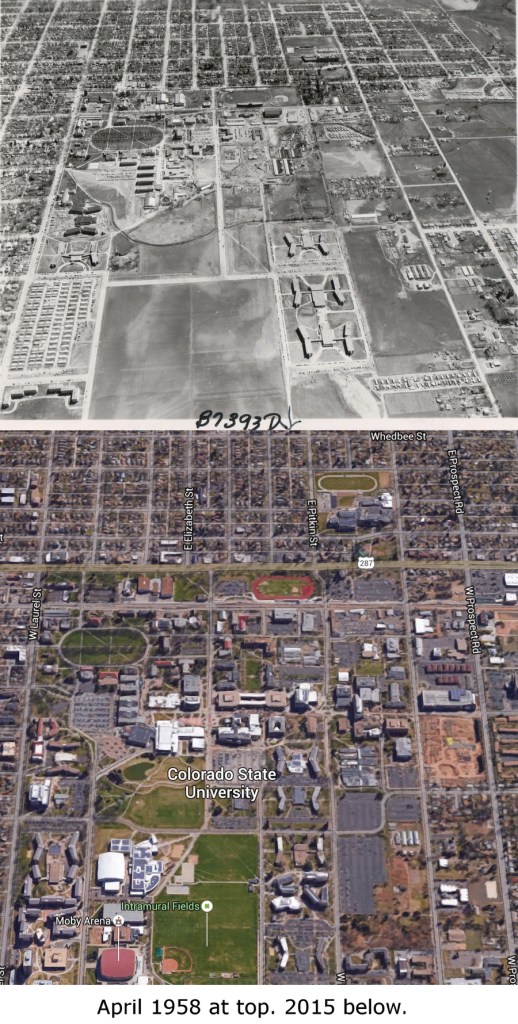
Image: Colorado State University over the years. Photo Courtesy of Meg Dunn, Northern Colorado History. The City grew so fast that in 1970 an organization called “Planning Development for Quality” later changed to “Design tomorrow Today” to help Fort Collins residents cope with the rapid changes.
In 1980, the City of Fort Collins would go on to adopt their Urban Growth Area plan.
- Often we see GMA’s expanded once infill is no longer an option or even before it reaches that point. Will the Fort Collins GMA be expanded at some point?
As someone who grew up in a city where the boundary to development was constantly expanded and kicked down the road, I had a particular interest in this.
“It is highly unlikely that the GMA will be expanded in the future,” Everett said. “The growth area has remained relatively fixed over the past 40 years, and at times Councilmembers and community members have expressed more interest in reducing the size of the GMA in certain areas, rather than expanding it.”
If you are someone who prefers to see land stay the way it is and not be developed, this is great to hear. However, there is a constant push and pull between conserving land and housing. Inherently, if we conserve more land we will have less land to develop for housing, which means we will have less housing unless we can develop policies that allow for denser housing infrastructure. In essence, we have to do more with less.
“ Our GMA also shares boundaries with the GMA’s of other communities in certain areas-including Timanth, Loveland and Windsor- which limits any expansion in those directions.”
- Was this a type of policy that was influenced by public input? Or was it strictly governmental?
This question felt particularly pertinent because of the situation revolving around the Land Development code. Some in the Land Development Code discussion felt that there was not enough public input while others thought that there was a sufficient amount.
Everett said that, “Yes, growth and development have long been major topics of public discussion in Fort Collins. How a community grows over time is critically important, and it feels like a very personal issue to many community members.”
I also asked Everett about the GMA map. If you look at the map, you’ll notice parts of city limits extend past the GMA. The bottom Southwest corner is a good example of this. This area is the Coyote Ridge Natural Area. The other area is the City’s water treatment area along Laporte Avenue. Everett provided this interactive map which is easier to digest.
Final Thoughts
The Growth Management Area is crucial to the land development conversation in Fort Collins. With an understanding of what it is and what it does, we are able to get a clearer idea of the Land Development Code.
If you’ve stuck with me this far, I appreciate it. Also, something to keep an eye from the Coloradoan: The Land Use Code outreach by the City is going to start soon.
Feel free to reach out to me at michael.stella@colostate.edu or @Michaelstella_.
-
Subscribe
Subscribed
Already have a WordPress.com account? Log in now.
 NoCo Convos