-
The Unique and Special City of Fort Collins
by Zachary Beilman
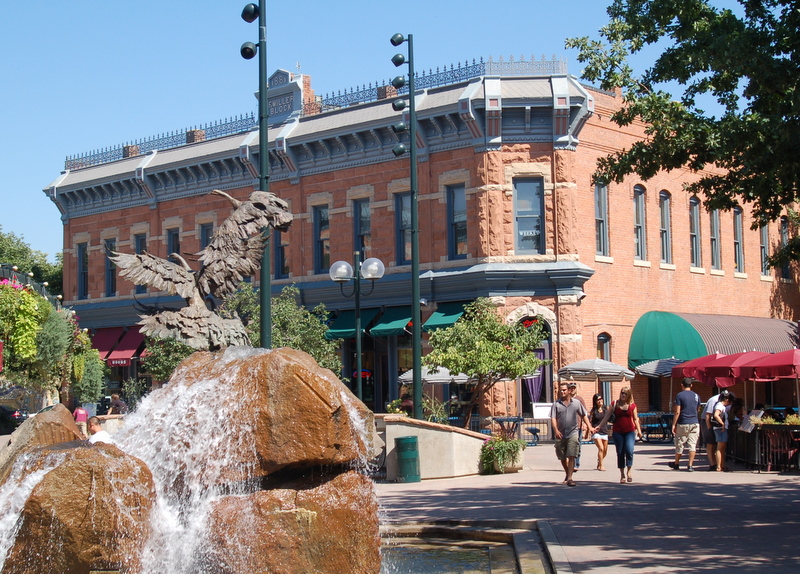
Fort Collins’ popularity continues to rise because of the community’s efforts to sustain a healthy and safe city. It truly stands out, partially due to its commitment to supporting the environment and its efforts to contain a diverse set of individuals.
Fort Collins provides a wide variety of events that are hosted weekly, whether they are hosted on the Colorado State University’s campus or in Old Town.
One element that separates Fort Collins from other cities is its feeling of belonging. The downtown area of Fort Collins, called Old Town, is considered a gathering place for residents and visitors.
Fort Collins provides a variety of restaurants, shops, and events in Old Town. The array of activities in Fort Collins provides a sense of inclusion and joy.
While talking with a woman named Sabrina Richardson, the topic of healthy living, along with inclusion, was discussed as another reason for Fort Collins’ popularity. Richardson, who has lived in Fort Collins for over 25 years, is a Technology Business Consultant at Black Knight Inc.
The conversation began by asking Richardson how well she thought Fort Collins had performed in creating opportunities to improve the well-being of its citizens. “There’s a lot of diversity in the businesses that are around, and they do a really good job with keeping open spaces,” she says. “Creating opportunities for recreation and just meeting everybody’s interests is something I think they do a really good job of.”
Richardson attended Colorado State University in the late ’90s and hasn’t left since. She states that she and her family attend Colorado State sporting events, theater events in the Lincoln Center, and a variety of events hosted in Old Town.
Richardson was then asked if she had had any issues with the city of Fort Collins. “Fort Collins isn’t super diverse in the people that are here,” she says. “I grew up outside of Denver and the diversity was much greater down there than it is up here. I don’t know if that’s anything the city itself can control, but that is one thing that I wish we had more of – diversity.”
Richardson says living in Fort Collins makes her happy because of how close the city is to the mountains and how Fort Collins doesn’t bring off a big city vibe. She also says Fort Collins has been a great place to raise her kids.
In addition to the events hosted in Fort Collins, the city is also known for its involvement in sustainability. According to the City of Fort Collins website, the city has greenhouse gas reduction goals for the near future.
The City of Fort Collins website states that as of 2022, the city’s municipal inventory has dropped by 24% compared to 2005. The primary causes of this reduction are cleaner electricity and increased energy efficiency.
Fort Collins contains three departments within the City’s Sustainability Services Area: Environmental Services, Economic Health, and Social Sustainability. The City of Fort Collins website states that the city was one of the first to structure all three of these components under one service area.
The long-term goal of the effort, aimed towards sustainability, is to reduce its carbon footprint and promote renewable energy. These efforts can only be effective with the help of Fort Collins residents.
Furthermore, an article titled “Recipe for Urban Happiness,” written by Charles Montgomery, discusses the foundation of what makes a happier city. Montgomery is a writer and speaker that studies the science of cities and how they are built on happiness and trust.
Montgomery discusses a variety of steps and categories that help lead to a happy city, such as subjective well-being, psychological well-being, social relationships, and core needs.
The article “Recipe for Urban Happiness” relates the importance of community opinion to the overall well-being of a city. For example, the article mentions how the more people participate in economic and cultural life, the stronger a community is.
Montgomery states that previous studies have found that societies with a narrow gap between rich and poor are both happier and healthier than less equal societies. He relates all these contributions towards a healthy city and relates them to Fort Collins.
According to Montgomery, cities thrive the most when community members are active in city problems, especially in the local government. Fort Collins is a successful example of this.
The community discussed projects, such as the future of the Hughes Stadium site and the city-wide contracts for trash, all while creating local stories of resilience in Fort Collins.
In short, Fort Collins is a very healthy and joyful city to live in due to the rise in sustainability efforts and the wide variety of opportunities it provides to improve the well-being of its citizens.
“In a world where people feel increasingly disconnected from one another, we need to use all the tools at our disposal to create communities worth caring about,” Montgomery says. “The good news is that in an interconnected world, actions to boost urban happiness are also actions for sustainability, equity, and resilience.”
-
Fort Collins and it’s Unexpected World of Skateboarding
by Jonah Climp

Fort Collins isn’t known for its skateboarding. However, a Market Skateshop employee, Connor Rose, explains how the shop supports the Fort Collins skateboarding scene and why he loves the city.
Rose lives in Fort Collins, Colorado, and works at Market Skateshop on 640 South College Ave. He praises the weather, the mountains, and Horsetooth Reservoir as his favorite aspects of Fort Collins.
“The shop is rad,” Rose added.
According to the article, “A Recipe for Urban Happiness”, by Charles Montgomery, two of the ingredients that drive happiness in a city include physical health and social relationships.
With so many great options for outdoor activities such as hiking, swimming, and biking, Fort Collins promotes a healthy lifestyle for residents that can increase overall happiness.
Social relationships are another key contributor to the happiness that Rose connects to skateboarding. Having a skateboarding scene fostered by a local skate shop that is core skater owned creates a sense of community and builds social relationships.
“It becomes more intimate and so it nurtures a scene,” Rose says, “The scene is self-supporting but it’s about having the right backing and access.”
Maintaining core skater values is an important aspect of why Market Skateshop has remained successful over time.
Rose says, “at the end of the day we’re retail. It’s supply and demand. What do the kids want? What are people looking for? If people are always coming in here asking for something then why not carry it. What we carry. How we do our stuff is somewhat defined by the consumer themselves.”
For Rose and many other skaters, skateboarding is so much more than an activity, it is a way of thinking. Market Skateshop aims to maintain the core values that make it that way. This outlook helps build up social relationships within the community, which in turn contributes to the happiness of the community.
Rose says that Market tries to stock and provide local and skater-owned products to support the scene and keep skateboarding unique.
Rose says Market Skateshop isn’t “just another corporation or conglomerate pushing stuff out with a dollar sign on it, without any actual feeling backing it.”
This was made evident when a customer asked Rose for a gift recommendation for their son. He recommended two t-shirt options from local Colorado skateboarding companies.
Equity is another ingredient in the recipe for urban happiness. According to Colorado demographics, Fort Collins has the fourth highest population in Colorado at 166,788 people.
The population is 78.1% white. The city undoubtedly lacks diversity, which could negatively affect the population’s happiness.
“I don’t know if I’m in a position to speak for the skate shop as a whole,” Rose says “There are issues everywhere. Anywhere there’s humanity involved there’s bound to be something. There’s always progress to be made.”
At the end of the day, what is so cool about skateboarding is that it’s all-inclusive and it hasn’t changed much since its inception.
“It’s pretty much a piece of wood, some metal, and some rubber,” Rose says.
Diversity is growing within the skateboarding scene and there is more acceptance and awareness of current social issues but there is still room for improvement. Market Skateshop carries products that support all genders, nationalities, and races in order to keep the scene inclusive.
“Skateboarding regulates itself. I mean skateboarding in and of itself is an outcast thing. It’s illegal to a degree,” Rose says.
By supporting the skateboarding scene and sticking to core values Market Skateshop has seen success.
Rose says, “We are rewarded. We are rewarded in that we are still here. We’ve been here for 27 years, at three different locations. And I think that says a lot especially for not having much of an internet presence. We don’t have a massive internet presence really at all.” He continues, “Yet we still maintain and thrive. We are just consistent in our goal and approach to skateboarding.”
While Fort Collins may not be a diverse city, there are communities in it that promote diversity and inclusion. The skateboarding scene is one such community that does so with physical activity and social relationships.
“The scene is sick and there are tons of parks,” Rose says, referencing skateboarding in Fort Collins. Speakeasy Colorado Skatepark Directory lists 6 skateparks in the Fort Collins area which is a high number for a city of its size.
Due to the fact that skateboarding provides so much joy, it is noteworthy that Fort Collins provides so many places for skateboarding.
-
ASCSU Rally at City Hall
The Associated Students of Colorado State University held a student rally at City Hall on April 4 filling the council chamber so full the Fort Collins Fire Chief had to ask people to leave the building. The student rally was to put pressure on the council to make a motion to put a U+2 repeal on the ballot.
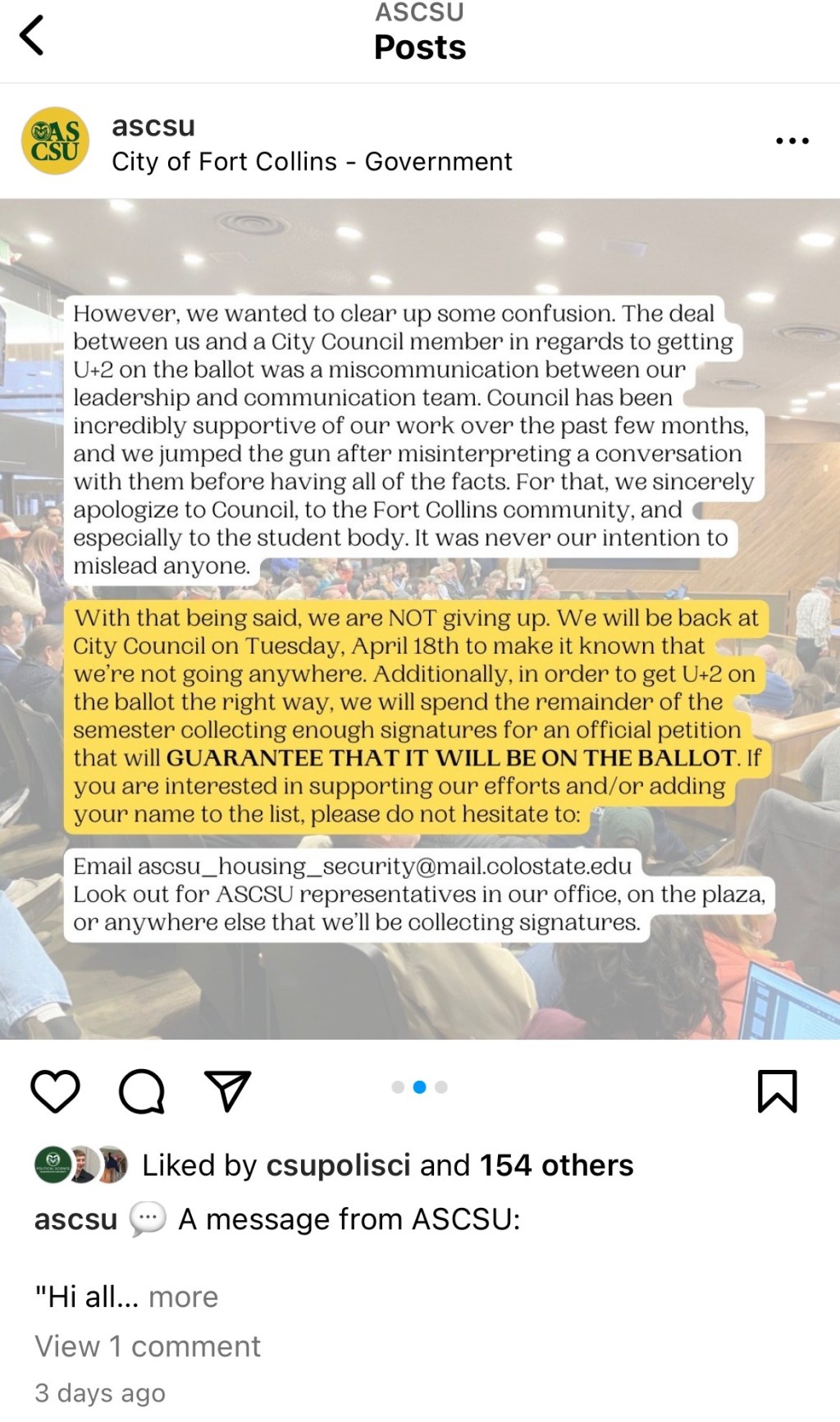
ASCSU posted to their Instagram that a member of City Council had promised that if 200 Colorado State University students showed up to the city council meeting, they would make a motion to put U+2 repeal “on the ballot,” presumably referring to the next city election, in November.
Explanation of deal between unnamed Fort Collins City Council member and ASCSU, courtesy ASCSU Instagram. Evan Welch, Director of State Law and Policy for ASCSU, started the public testimony portion of the night with an explanation of why he thinks that U+2 should be overturned.
Public testimony on U+2 included ASCSU staff members, ASCSU Student Body President Rob Long and even the John Straayer Center for Public Service Leadership Director Sam Houghteling, testified in support of overturning U+2.
The city council meeting came at an interesting time in the housing debate in Fort Collins. The City has set dates for community engagement that the city has said will guide updates to their Land Use Code. Engagement will begin on the April 24 with an informational session.
It also comes as the Land Use Bill starts its journey through committees at the state capital. The Land Use Bill is extremely similar to Fort Collins proposed Land Development Code and would repeal U+2.
Despite a strong turnout from students that likely exceeded 200 no such motion was made.
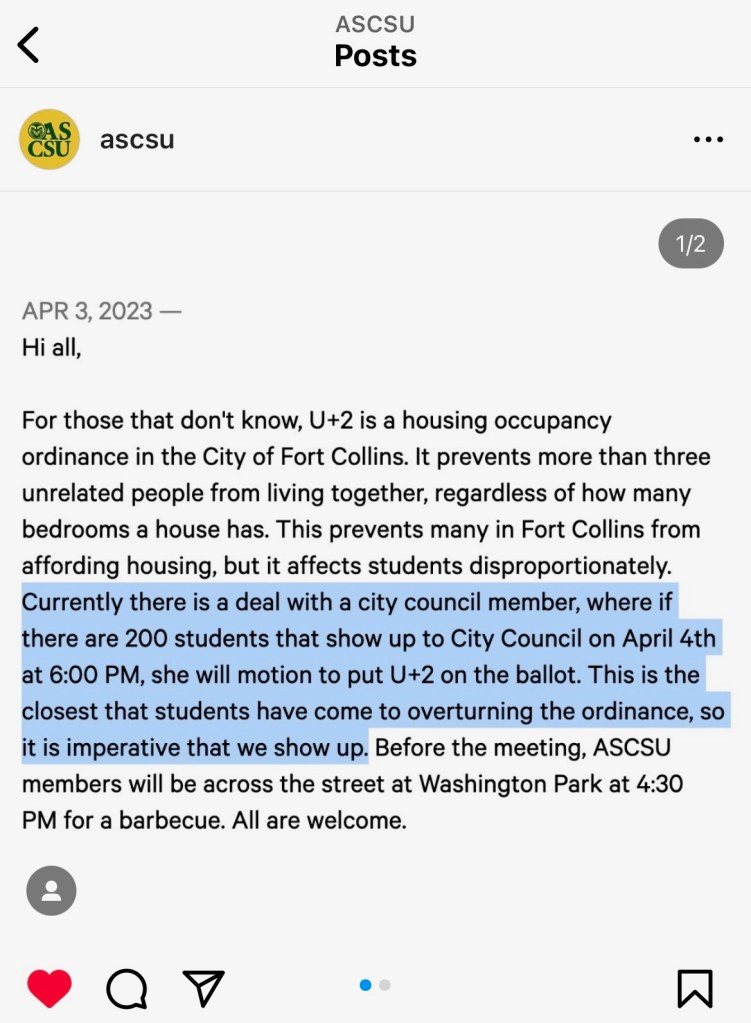
ASCSU posted to their Instagram that there was an internal miscommunication between their leadership and communication team and there was in fact no deal like that on the table.
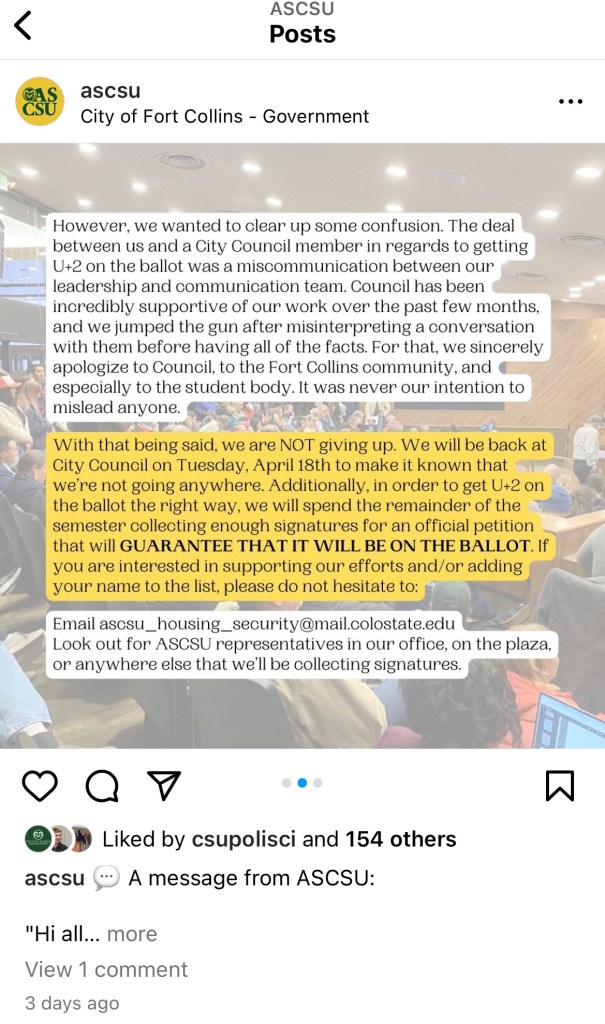
Explanation of why a motion to put U+2 on the ballot was not introduced, courtesy of ASCSU Instagram. They are now calling for students to show up on May 9, for a city council work session on occupancy regulations.
It is important to note that May 9 is three days after the state legislature comes to an end and it is possible that the Land Use Bill will have passed both chambers by then and will just be awaiting Governor Polis’ signature.
Fort Collins would not be the only city affected by repealing occupancy limits at the state level. Cities such as Boulder and Greeley would be affected by the repeal of occupancy regulations as they also have occupancy limits in place.
There are different rules about how long a governor can take to sign a bill into law after it passes, dependent on when it passes during the session. Governor Polis may delay signing the bill into law until later in the summer in order to have a bill signing ceremony of one of his signature bills.
Nonetheless, it is likely to still be the law before Fort Collins does anything significant with U+2.
The Land Use Bill went through an extensive committee hearing on April 6. The committee hearing was only for testimony, meaning that no amendments to the bill could be given.
During the committee hearing, opponents of the bill said that taking away control from local municipalities was not the answer. Many proponents argued that the state would not have to take control if local municipalities had done a better job with housing.
As always, feel free to reach me at michael.stella@colostate.edu or @Michaelstella_.
-
Fort Collins’ Music Scene Blasts Off: Nonprofit Organization Giving Back
by Erin Fuller

Art in Fort Collins posted by Flickr under the creative commons license. When it comes to the local music scene, Fort Collins is bustling with artists, venues, and organizations looking to help further the growth of art in the community. One organization in particular has been helping youth break into the theater, music, and art world.
This is Blast N Scrap.
Michael Gormley, aka Blasti, is the founder and executive director of this nonprofit. He describes it as a “mutual aid meets music showcase”, the major component of Blast N Scrap being donation-suggested concerts and fundraising events. Gormley is also in the band GB & the G Jeez, playing country bluegrass renditions of punk songs.
“Mutual aid meets music showcase”
Michael GormleyBefore Blast N Scrap came to be, Gormley created Cape Pals, a charity where kids make capes and create awareness for good causes. Cape Pals organized an event for children with leukemia and solicited multiple businesses to donate from their earnings, including Who Gives A Scrap, a nonprofit arts and crafts store. His band, GB & the G Jeez, were asked to play kids music at Who Gives A Scrap, and thus, Blast N Scrap was born.
Blast N Scrap is made up of multiple programs and efforts to bring arts into the community of Fort Collins. Scrapyard Garb takes gently used clothing and uses it for screen-printing, making cheap and accessible merch to make for local bands or organizations.
Scrappy Tracking teaches people how to record, edit, and produce their own music single with a real producer.
Grrrls Scrap Back welcomes femme, trans, and non-binary identities to participate in workshops of all art mediums and holds monthly showcases.
New Galaxy Audio Productions teaches new sound engineers sound design and allows them to get their hands on a soundboard for actual live events.
Crafty Community Theatre shows children how to write, cast, direct, and act in a play using repurposed materials for the sets and costumes.
Band Blast Off helps students launch their music career. Even more projects are underway.
Gormley’s endeavors add passion, charity, and empathy to the Fort Collins area. As part of the sober community, he strives to implement safe spaces into Blast N Scrap’s events. One of his major missions is to have harm reduction supplies at all major music venues, making concerts a lower-risk place to be.
“People use drugs, regardless of whether they go to a concert or not, but they use them at a higher percentage when they do go to concerts,” Gormley said. “This is our way of keeping the community safe. Narcan saved my life, so it’s the least I can do to push it further.”
“Narcan saved my life, so it’s the least I can do to push it further.”
Michael GormleyBut what does it mean to be in a leadership position? Gormley has had years of experience being involved in clubs and music scenes along the upper East Coast. During that time he was actively drinking, so he says these experiences were thrown away.
“Nothing stops me from my problematic behaviors with alcohol,” Gormley said. “About a year after I plugged the jug, I wanted to do something with the skill set I had. I entered the music industry on my own terms, building my own project as I [saw] fit.”
Back on his feet, he asked Mishawaka Amphitheatre for a job, admiring the hospitality of the staff.
“I didn’t go in [the industry] to be a leader,” Gormely said. “I thought, I need to fill my time or I’m gonna drink, and I’m gonna treat everyone else fairly because I don’t care about the money. And then it started working.”
Fort Collins has a lot of potential for upcoming artists, and Gormley decided to stick around to get more involved.
“Having a university is certainly essential because there’s an influx of 18-year-olds that move here every semester that need access to all-ages music,” Gormley said. “We are all ages under all circumstances.”
He understands that arts exposure doesn’t have to have an age limit and emphasizes that it shouldn’t be limited by economic standing either. “I put a suggested donation [at our events], but people weren’t showing up,” Gormley said. “It’s just donations. You don’t have to pay for it. That’s how I came up with the sentence ‘no one turned away’.”
By keeping the doors open for events, workshops, and concerts, Gormley was able to create a space to celebrate music and art and found a way to pay for the artists and bands along the way.
Blast N Scrap aims to teach kids how to enter the music business and become successful, building a structure for them to step into.
“When I talk to young artists, I often share the terrible experiences that were my own fault, and how I stepped into the business world,” Gormley said. “A lot of Blast N Scrap is what I think would’ve helped me as a kid. So if I have a hand in helping somebody take their project to a different level, then we’ve done our job.”
For more information on Blast N Scrap and how you can get involved, you can visit blastnscrap.org -
Community Leadership in Fort Collins and CSU
By: Tyler Weatherwax
Fort Collins, Colo. — Durward Hall towers houses more than 500 students who attend Colorado State University. This twelve-story tower is one of the biggest structures in Fort Collins.
Having a good community in a city or on a college campus is one of the most essential things that creates a welcoming space for people.
Some of the most important people are those who help the community and bring people together. They solve issues within the community, helping it grow and prosper.
Only some know the work and effort that goes into keeping a community connected and happy. Even fewer may realize how incredible the people who help these communities are.
Colorado State University houses first-year students who are new to the area and to living on their own. Many of these students are not from Fort Collins and are often below the age of 21. Residential assistants help these young adults to stay safe, be responsible, and have a new community.
Riley Budzien, 20, is one of these residential assistants and lives on the twelfth floor of Durward Hall. She is responsible for not only her floor but the entire building during nights duty.
Fort Collins and Colorado State University are in the same community, but they both have smaller communities outside of each other, each with its positives and negatives.
“I think Fort Collins is really good at having a small-town feel in a big town,” Budzien said when asked about her thoughts on what’s good about the Fort Collins community. “A lot of people come here for that very reason.”
Fort Collins has a population of over 168,000 people, with Colorado State University having over 32,000 students. The downtown area of Fort Collins is home to a large portion of that population. This is one of the issues Budzien saw with Fort Collins, saying, “if you’re outside of the downtown area, it’s really hard to make connections.”
So how do a city and college with such large populations create community and a small town feel?
“Some of the ways I help the community in Fort Collins is by creating a safe haven, especially for first-year students,” Budzien said. “When they come in, they don’t have a lot of familiarity with the school, the buildings, and so by giving them a space to build community and get to know one another initially and creating that environment, that allows them to thrive before classes.”
Budzien continued, “it allows them to be more comfortable and work through challenges before certain classes so that they’re already comfortable.”
Budzien also works for the Student Disability Center at CSU, which helps students in need get the resources available to them.
“I also work with students who need accommodations; I make sure they get what they need in order to be successful in the community,” Budzien said.
With the help of people like Riley Budzien, Fort Collins and CSU, can create welcoming and safe communities to help everyone live happier lives.
-
What is Great About Fort Collins?
By: Holden Matthews
Fort Collins, Colo. – Fort Collins has a bustling downtown, great outdoor recreational activities, and is home to Colorado State University. It was ranked the fourth-most populated city in Colorado by the U.S. Census Bureau.
However, some may wonder: What is so great about Fort Collins, and how is it continuing to improve its citizens’ well-being?
Charles Montgomery, in the article “A Recipe for Urban Happiness,” outlines nine key principles for urban well-being: core needs, social relationships, health, ease, joy, meaning, belonging, and resilience.
Core needs are at the center of the principles of urban well-being. It consists of food, water, shelter, sanitation and safety.
Fort Collins satisfies the core needs of most of its residents with safe bike lanes and a clean water supply contributing to an overall sense of security. However, there is an ongoing struggle to combat homelessness in the city.
“We are never going to ‘end’ homelessness. However, the goal is to put systems in place so that when a person does experience homelessness, it is rare, brief and non-recurring.”
A quote from the City of Fort CollinsThe City of Fort Collins’ proposed solutions to combat homelessness include rapid housing, homeless sheltering, and mental and behavioral health services.
Fort Collins, as of 2022, has also leveraged around $2.28 million in American Rescue Plan Act funds to combat homelessness in the city. Moreover, social relationships are another very important principle of urban well-being that can deeply affect a person’s mood and health.
Montgomery describes that even superficial interactions, such as passing someone on the street, can have an impact on someone’s mood, creativity and productivity.
“Unfortunately, loneliness and social disconnection [are] reaching epidemic levels in many countries,” Montgomery stated. “It’s not obvious to many that the solution to isolation is in the physical design of our communities.”
Fort Collins, as a college town, is a walkable and bikeable location. It has a bustling downtown with several places to spend time.
As a result of the walkable city environment, Fort Collins is a healthy city, ranking among the nation’s least obese cities in 2014.
Jonathan Paul, a student at Colorado State University, weighed in on his health in Fort Collins.
“I feel pretty healthy in Fort Collins. There are plenty of options for food and exercise for physical health, in the mountains in particular,” Paul said. “I think the city is small enough to not feel oppressive, and the weather is often clear, which helps my mood.”
The fourth principle of urban well-being is equity. A city with a higher level of inequity resulted in unhappiness, leading to an overall worse economy, Montgomery stated.
To measure equity, Fort Collins uses equity indicator reports. These reports detail the level of inequity people experience based on race.
The most recent report, released in 2021, found that, in 54% of the categories measured, racial and ethnic disparities were found.
“[The Institute for State and Local Governance] also found differences by income, gender, sexual orientation, disability status, educational attainment, household composition, and neighborhood.”
From Fort Collins’s Equity Indicator ReportsThe city of Fort Collins will use the information provided by the report to influence policy changes and decisions regarding equity, the report stated.
The fifth principle of urban well-being, ease, is an important part of urban design.
“Well-designed places offer people a sense of ease and freedom,” Montgomery stated. “Rather than making us feel stuck or frustrated, they empower us to move as we please.”
This principle relates closely to the sixth, seventh, eighth and ninth principles: joy, meaning, belonging and resilience, as they all relate to the concept of friendship and community.
Paul stated that, as a studen, he feels at ease most of the time but gets bogged down at times from stress.
“The groups I have fallen in with I felt I had to work to be a part of, such as extracurricular groups,” Paul stated. “That being said, I do feel like I have support structures should I need them.”Paul described how, despite not feeling part of a larger Fort Collins community, he feels supported by smaller support groups within the Fort Collins community.
“I have never felt unwelcome in Fort Collins–The groups I have joined have made me feel included and appreciated.”
Jonathan Paul, a Student at Colorado State UniversityFort Collins is a city with a deep community that cares about one another despite everyone’s differing circumstances.
Like many cities, Fort Collins is not perfect. What makes it great, however, is how it works to solve these issues and works to consistently makes its citizens happy.
For more information on the city of Fort Collins’ upcoming projects, visit www.fcgov.com
-
Where We Are and Where We’re Going
When we started this journey to learn more about Fort Collins’ Land Use Code, I was not really sure what to expect. I presumed it would be pretty straightforward; we would learn about the story of the Land Development Code, what had happened and what was to come next.
I never expected that a Land Development Code in a mid-sized town in Northern Colorado could get so political and controversial but that is what I have discovered.
I have unearthed much more about the Land Development Code, the players involved, and everything that has happened than I expected I would. I am still working on securing some interviews with relevant parties and in the meantime I wanted to give an update on everything that has happened so far and to also give an update on what I am watching in the coming weeks.
First, we started with an introduction of the Land Use Code, then we moved to a timeline of the code, and we talked about the Growth Management Area.
From there we went to the stakeholders in the Land Development Code, we talked to members of the business community and got their perspective, and most recently we took a look at the Land Use Bill, the latest twist in this story.
The City of Fort Collins has made minor updates to the Land Use Code throughout the years but they re-wrote the code to what they believed would meet housing needs and the new code was named the Land Development Code.
The Land Development Code, like many government documents, is extremely long and complicated, filled with technical jargon. With documents this large and complex, it is easy to see how public opinion can be swayed one way or the other, if the city does not provide simpler ways to digest it.
There is never one side to a story. Some groups of people, such as FoCo Forward said that from the beginning, the city had conducted plenty of outreach and civil participation when forming the code.
Other groups, such as the Fort Collins Chamber of Commerce, said that the city did a good job at the beginning when they were forming the code, but could have done a better job explaining what the document was at the end of the process. Even further, some said that at no point in the process was the city transparent.
Once the city of Fort Collins released the new code, a citizen group was formed to overturn it and overturn it they did.
But now it all might be for naught because Governor Polis and state Democrats have introduced a Land Use Bill that is extremely similar to the Land Development Code and it will be much harder to stop this legislation than it was to stop the Land Development Code.
If the Land Use Bill gets signed into law, a more likely than not scenario, housing in Fort Collins would look like it would under the Land Development Code but perhaps even differently, because the Land Use Bill would eliminate U+2 in Fort Collins.
So we had a nearly two year long process to rewrite the Land Use Code into the Land Development Code in which a citizen group was formed to overturn the code and a citizen group was formed to support the Land Development Code and while the City has recently announced that they will start conversations around the Land Use Code again, the state has essentially said they will take care of it through their action.
All the while, ASCSU is going full steam ahead to try to get the city to overturn U+2, seemingly before the state does. ASCSU elections also ended today, with every candidate promising to overturn U+2.
It is important to remember that in the Land Development Code, there was no mention of U+2, despite its effect on housing supply.
ASCSU also hosted a student rally at Fort Collins City Hall last night to speak in support of overturning U+2. More on that soon.
There is a lot going on these days with the Land Development Code and housing, not just in Fort Collins, but in Colorado.
I’ll do my best to keep you updated on everything that happens and what to watch for. Until then, feel free to reach me at michael.stella@colostate.edu or @Michaelstella_.
-
Chapter 6: The Girl with The Hand-Drawn Tattoos
I was strolling through the library, intent on getting some work done before class, when someone caught my eye. My journey to tell this story has required the perspectives of unique South-Asians, something that I have struggled to find. I have become attuned to noticing South-Asians whenever I’m on campus, always in search of someone that I think will give me a good point-of-view on the story I’m chasing, and this specific person was no exception.
This individual I saw in the corner of my eye was a South-Asian girl sitting at a table with her friend. Her outfit was cool to say the least, and her arms were spotted with tattoos, something that I rarely see people with in my culture.
I had immediately begun to think about her perspective and the stories she would be able to tell me about her tattoos and her identity as a South-Asian woman.
I switched into journalist mode and approached her, excited to learn more about who she was and about femininity in South-Asian culture.
Aryana Banerji
I had met Aryana Banerji, a first-year student from Michigan majoring in Biomedical Sciences and minoring in Chemistry and Philosophy.
During my conversation with her, it was easy to tell that she was very confident, optimistic, and sure of herself and her identity. I learned that her upbringing had had a significant influence on her growing into the person she was today, with two older brothers and parents that were opposites of each other.
Her father was perhaps the one who had the most impact on her. She described her mother as being “the Indian poster child” who was accomplished in her career and never did anything wrong. Her father, on the other hand, was far from what a typical South-Asian father is perceived to be.
“My dad is a little rebellious and I think that’s where I get it from,” Banerji said. “He taught me that concerts are fun, being yourself is fun. It makes everything more exciting and that’s where I kind of got it from. He was that kind of person.”
Banerji is an extremely optimistic individual. She loves to be energetic and even after just one conversation with her, I can tell she’s the kind of friend to have your back and encourage you to do things that you may be doubtful about doing yourself. Her confidence was contagious.
“I like to be enthusiastic with people, I like people to be excited and to uplift the room,” Banerji said. “I like to be surrounded by people and things that are really happy and make me feel that enthusiasm.”
Though her father is an accomplished radiologist and is very much so an academic, he still strays from a traditional Indian father. He enjoys music, films, and art. Banerji had even described him as a “player,” even if he still wears the infamous traditional Indian dad sandals.
The well-roundedness of her father, the duality of his artistic expression and of his magnetism towards academia had rubbed off on his daughter, creating an individual that values both. This balance became an important part of her identity and how she lives her life.
Mental Health
Banerji and I went through the same topics that I had discussed with every interview prior to her, and she had a lot to say about why South-Asian culture treats the humanities the way it does.
“I feel like Indian people are very closed off with their emotions,” Banerji said. “I feel in Indian culture mental health is not necessarily looked at. So things regarding mental health–therapists or anything regarding the arts and humanities sociology or psychology…they aren’t real. ‘Just brush it off, you’ve gone through much worse. Just use your brain, you’ll be good.’”
The lack of importance put on mental health in both South-Asian and Asian cultures has been prevalent for generations, with the newest generation of kids trying to fight the stigma against hesitant parents.
These jobs are oftentimes disregarded, as what they are dealing with is not seen as something worth even mentioning.
“They don’t believe that there’s an importance to these jobs because they feel like it’s a very American way of life,” Banerji said. “‘Paying attention to this and making problems out of this shouldn’t be a big deal, just relax.’”
Apart From The Majority
What drew me to Banerji was just how strong her personality and self expression was. She is so unapologetically herself, and though her parents encouraged her to be herself, she was still faced with some pressures to follow a certain standard of South-Asian woman. Standards that were not effective in putting Banerji into any category of identity other than the one she formed herself.
“Why do I have to conform to that idea of the brown woman from every family?” Banerji questioned. “I still have that liberty to be my own person, white or brown. Through the eyes of brown parents, they have that traditional mindset of a woman…it’s not ideal.”
She’s very expressive, all of her tattoos are her own drawings. Her two nose piercings are a reflection of her and so is the way that she dresses, talks, and acts, and it does not exactly fit into how most people would perceive her if they just judged her by the color of her skin.
“There’s always a social construct of someone’s identity,” Banerji said. “It’s in your full control whether you follow that and occupy that generalization of a group of people.”
As I had mentioned before, her confidence was contagious. I told her my own hesitance with getting a tattoo myself, somewhat due to the permanence of such a decision, and somewhat due to me believing that I shouldn’t simply because I am South-Asian, and she was quick to brush away my doubts.
“If you want one and genuinely have a cool idea, get it,” she said. “Don’t even look at the color of your skin, just do it because you like it and it’s for you, not for anyone else.”
Banerji is a STEM major with one of her minors being in the humanities. Her ideology of balance, of being a well-rounded person, flows into her academic life.
She enjoys philosophical conversations and being aware of the people around her. Their feelings, their lives, what makes them who they are, are all things that she values.
Banerji chose a field in STEM because it was what she enjoyed. She’s on the path to become a vet, something that she’s always wanted to do, and she’s been able to do it on her own terms.
Her parents let her be who she was, someone that didn’t fit into any typical stereotype of a South-Asian woman, she was herself.
She dresses the way she wants and she acts the way she wants. Her tattoos can be seen as her connection to art and to her father, but they are also representations of who she is. The kind of friend to encourage you, with all the enthusiasm in the world, to go get that tattoo you’re so afraid of getting.
-
Fort Collins Heating and Air Conditioning Owner proudly serves his hometown community
By Jack Larson
Lightning-fast installations, friendly service and affordable pricing are the names of the game for Fort Collins Heating and Air. It’s a pillar in the Fort Collins community.
Fort Collins Heating and Air was founded in 1996, over 25 years ago, by one man named Glenn Frank.
“It’s a very hard thing to build an entire business from the ground up, maintain that business and become successful enough to support your employees and their futures,” Frank said.
Frank, did not only wants to continue the legacy of his late grandfather’s company, the Fort Collins Sheet and Metal Company. He also wants to make a difference in the lives of those in his local community using his company’s resources.
“What we’ve built this company into over the years has been incredible,” Frank said. “I’m so grateful for my partners and employees that helped me build Fort Collins Heating and Air into what it is and I think we have really done some awesome things for Fort Collins.”
Frank’s company provides heating installations and services, air conditioning installation and services, air duct maintenance, plumbing services, sheet metal fabrications and extensive community outreach. The company’s slogan is easily recognizable to Fort Collins’ natives. “Big enough to serve, small enough to care,” Fort Collins Heating and Air Conditioning.
“It takes tireless effort and persistent determination which nobody seems to teach people anymore,” Frank said. “You will fail in the beginning when you are trying to run your own business but you have to keep going with it no matter what if you ever want to become successful.”
To give back, Frank talked about one program in particular where Fort Collins Heating and Air gives away one furnace annually to a Northern Colorado resident through a lottery selection.
The goal of the program is to establish a good relationship between the company and members of the Fort Collins community. It is also meant to serve people in need who can’t afford furnaces or other heating and cooling appliances.
Frank talked about a recent 2021 winner. Her name is Colleen C; She has lived in Fort Collins for nearly 50 years and won the appliance that she needed as the 2021 Furnace Program Winner.
“My house was built in 1969, and it has the original furnace. I’m not sure how the furnace continues to work, except that I ask God to keep it working every winter,” Colleen said. “I am a widow and retired. I’ve lived in my home for 41 years. Although it should be paid for by now, my husband had an extended terminal illness, and we had to refinance the house to help pay medical expenses.”
Colleen explained why she needs a new furnace. “The house needs lots of upgrades/remodeling, and I am trying to do a little each year, said Colleen. “Although my furnace is working so far this year, it doesn’t heat efficiently, and I’m not sure about whether it is leaking dangerous gasses.”
Frank said he is most proud of this program and how it has helped people in need across the Fort Collins Community.
“Colleen’s story is incredible but heartbreaking to hear at the same time,” Frank said. “It’s the things like this program that I love so much about our company.”
Colleen expanded on her condition. She said, “I do not have the money to replace my furnace, but it would be such a gift to have a new furnace that I knew would be reliable and safe.”
Frank, realizing the need in the community, said, “I know it still may seem like a small thing to us or to people that can afford it but it can mean the world to someone who really does need it and I’ve definitely seen that over the years.”
Through hard work and dedication, Frank has achieved and continues to achieve his goals and aspirations of continuing his family’s legacy and giving back to his hometown community of Fort Collins.
Fort Collins always has been and will be home for Frank along with his employees that work alongside him. There is no other community he would rather be working in than Fort Collins.
Through Frank’s hard work, he has built a successful business in Fort Collins for over 25 years and counting.
Glenn Frank is a person that will be recognized in the Fort Collins community. The blue, yellow and orange flames on company fleet trucks in Fort Collins will always be synonymous with Frank’s life and work.
-
The Land Use Bill: How it applies to Fort Collins
Fort Collins might just get its Land Development Code afterall. Just not their exact version of it.
A sweeping Land Use Bill was recently introduced by Governor Jared Polis and state Democrats that would affect most cities in Colorado. The bill would direct local governments on how land can be used for housing.
This major legislative development out of Denver comes at a time when Colorado is facing extraordinary high home prices and a housing shortage.
SB23-213, also being referred to as More Housing Now, directly mentions the housing issues Colorado faces in the bill.
Section 1A says, “ Colorado housing is currently among the most expensive in the nation. In 2021, Colorado had the sixth highest median home values and the fourth highest median gross rent.”
Similar to most stakeholders, such as the Fort Collins Chamber of Commerce and the Northern Colorado Board of Realtors, Governor Polis has said that housing is a supply and demand issue.
Polis’s Land Use Bill, which is sponsored by Majority Leader Senator Dominick Moreno and State Representatives Iman Jodeh and Steven Woodrow, aims to increase the supply of housing not just now but for the future growth Colorado is expected to face in coming years.
Colorado faces a shortage of housing especially when it comes to mountain towns where the ski resorts are located. Ski resort employees are often seasonal workers but their pay is not commensurate with rent prices, making it hard to make ends meet. This is also problematic for the ski industry because it makes it difficult to attract employees.
The bill is similar to the Fort Collins Land Development Code in that it encourages more variety of housing that will increase density. It allows for development such as additional dwelling units on single family plots of land. It also allows for duplexes and triplexes to be built in single family neighborhoods.
The most far reaching aspect of the Land Use Bill when it comes to Fort Collins is blocking limits of how many unrelated people can live in a house.
In other words, this would be the end of U+2, the housing rule in Fort Collins that says only three unrelated persons can live in most houses.
Gover Polis’s Land Use Bill will have less than half the legislative session to get debated, amended and passed before the May 6th deadline. With Democratic majorities in both chambers of the state legislature and a large, diverse coalition supporting the bill, it is likely that it will become law.
This may be a blessing in disguise for Fort Collins and supporters of the Land Development Code.
Developing ADU’s, duplexes and triplexes will take time but one stakeholder will almost immediately benefit from the demise of U+2: Colorado State University Students.
ASCSU’s department of Housing Security has been working on overturning U+2 now for a number of years.
“We’ve hosted tie dye events, there was even one year where we were like 200-300 hundred signatures away from like putting it on the ballot,” Jorge Garcia, ASCSU Director of Housing Security, said.
Despite Fort Collins’ reluctancy to change the U+2 rule, Garica said that efforts will be focused on lobbying the city to overturn U+2 instead of the state legislature, before the state legislative session ends on March 6th.
“We honestly thought it was perfect timing to either put more pressure on the city, right, are we going to make the state step in or is the city going to do something good for our people,” Garcia said.
The U+2 policy has been policy in Fort Collins since the 1960’s. The City has considered making changes to the policy on and off throughout the years.
“I feel like for the first time too the city is willing to listen to us,” Gacia said.
Regardless of who overturns U+2, be it the city or the state, the elimination of the policy would go a long way in freeing up additional rooms in Fort Collins, not just for students but for everyone who calls Fort Collins home.
“It’s not only students now that are violating U+2, its community members,” Garcia said.
It is worth noting that U+2 was not included in the Fort Collins Land Development Code. There were no plans to revise the limit or to erase it all together, even though it is a major factor in housing in Fort Collins.
-
Subscribe
Subscribed
Already have a WordPress.com account? Log in now.
 NoCo Convos