-
Hope Farms- Local Food Production and the Economy
By Macy Kramer

Eating green in a college town is notoriously difficult. The domination of the fast food industry over hearty, home cooked meals, from an economic perspective, is inevitable. Fast food tends to be popular amongst college students, causing unhealthy restaurants to amass huge profits.
According to The New York Times, more than 70% of college students influence the economic climate by eating fast food at least once a day. Chains such as Chick-Fil-A, McDonald’s, and Wendy’s benefit massively from this demographic, raking in hundreds of thousands of dollars from college campus locations alone. This positive feedback loop, although beneficial for the economy, can be detrimental to college students’ health.
A New Type of Food
In the midst of the craze for highly-processed, unhealthy foods, there is a steadily-growing counter-movement fighting for the inclusion of healthy foods in Fort Collins residents’ diets.
One organization that contributes to this movement is Hope Farms, a locally-owned community farm and garden in Fort Collins. The farm charges a membership fee of $50 in exchange for access to the gardens and the food they yield.
For those with less disposable income, a sliding scale is offered, so that those who need it (including college students) can pay as little as $1. This money is then reinvested into the farm, funding the production of more produce, more public outreach, and workshops on healthy eating.
Economic Outreach
Although Hope Farm’s economic benefits are certainly on a smaller scale than those of chain fast-food restaurants, the resulting public outreach compensates for that. By profiting from their business in a manner that still allows it to be accessible to everyone, Hope Farms promotes the importance of healthy eating as well as a prosperous economy.
Fresh produce is typically expensive in grocery stores. By making their produce accessible to everyone, Hope Farms is better able to spread their message, resulting in more financial success. By spending money on mindfully-produced, less-processed foods, Fort Collins residents can make an economic statement about the importance of local food and help encourage healthy eating habits.
-
Locally Grown Produce: What Are The Benefits?
By Emma Recker
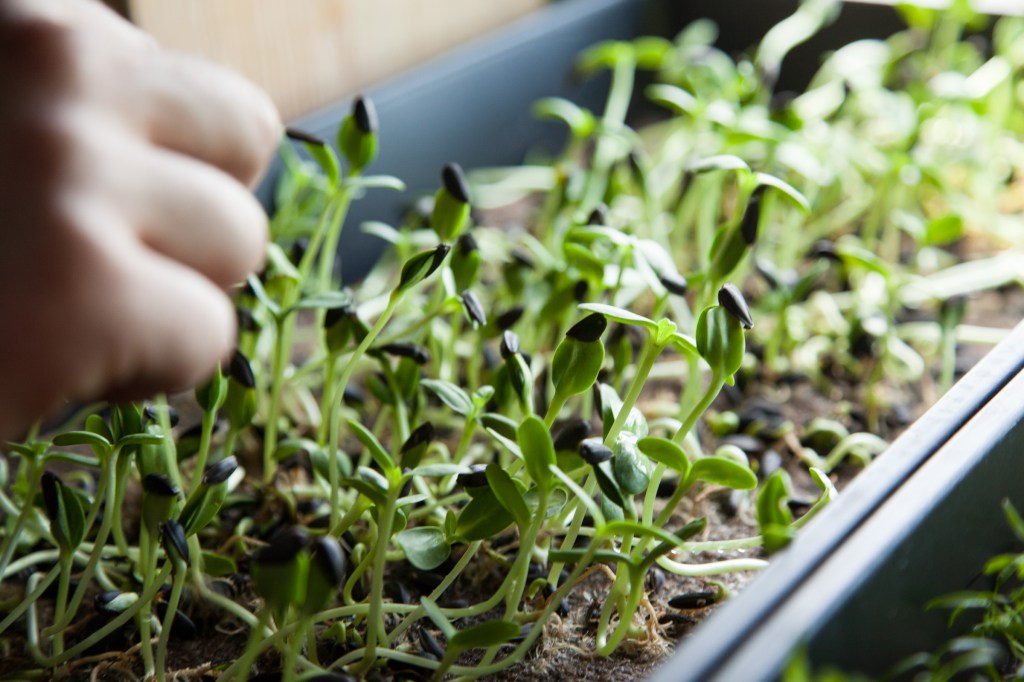
Locally Grown, Limiting Carbon Footprint
A refrigerated truck is vital for transporting and guaranteeing freshness; however, this is more energy costly than any typical truck, therefore more pollutants are being emitted, contributing to diminished air quality.
A possible solution to this is localizing the production of food, so energy is not being used for unnecessary transportation. In addition, localized food is not mass cultivated, so the crops are grown with minimal pesticides and fossil fuels.
Food that is locally grown is fresher, contains fewer carbon emissions, utilizes less energy, and typically fosters better working and wage conditions.
Americans typically spend a low portion of their annual income on food, which may explain why they are more likely to have a poor diet consisting of processed foods filled with unwanted preservatives. These habits may contribute to the overall lower quality of American foods.
Purchase Locally Grown and Raised Food Products
Larimer county offers a myriad of farmers markets all year round. Fort Collins offers a winter market that provides locals with fresh, in-season, and locally grown crops.
Local businesses, such as EP Green and Peace Country Microgreens, grow microgreens, herbs, and lettuce year-round to sell at the Winter Farmers Market in Fort Collins.
Unnecessary energy is not being used to transport this product to Fort Collins because it’s grown locally and sold directly to them. Despite Fort Collins’ cold winters, these small businesses will operate year-round with indoor hydroponic farms.
Fresh Meat and Ethical Agriculture
At the Fort Collins Winter Market, animal products such as: eggs, milk, and meat are common items sold because of their ability to be produced year-round.
Jodar Farms is a locally owned farm in Fort Collins, and raises chickens and pigs with free-range and pasture-based methods. They provide a community support agriculture, so locals can purchase products at the beginning of an agriculture season.
Their business has a goal of ethically raising animals, harvesting products with care, and providing consumers with the highest quality and freshest animal products. Unwanted preservatives are not in their products, so they must be consumed quickly and sold locally. Their business provides hog orders by the whole or half, so consumers will be able to use everything from the hog.
-
Consumption in Fast Fashion and How to Tackle It
By: Emmalee Krieg
Fort Collins, Colo — “The Story of Stuff” by Annie Leonard focuses on consumption. She points out the ideals of consumerism and how as consumers, this is where we play an active role in our addiction.
Consumption is fast-paced, especially in richer countries where we are able to “nourish” our consumer selves and “drown” out our other identities. Leonard ties buying stuff to social pressure and status which reinforces the cycle of replacing products and buying many new ones.
Leonard then carries into a conversation about planned obsolescence and advertising. This encourages people to replace products much sooner than is necessary by designing products that are “designed for the dump”, consumers will throw away more and buy more.
This directly contributes to not just over-consumerism, but the environment as well. With more consumerism, comes more production, which means more extraction. This results in depleting ecosystems with a loss of biodiversity.
Truthfully, it’s the most logical thing that comes to mind when thinking of over-consumption. The more stuff bought, the more stuff made, and the more stuff taken away from our natural world.
Human consumption can be seen in many ways from food and plasticware to clothes and shopping products.
With clothes specifically, we know that fast fashion plays a big role in consumption. What isn’t talked about enough is what happens to clothes after society is done with them.
While trends are in and out, that means clothes come and go as well. Even if we consider a decent amount of people avid thrifters, most clothes just go- they never come back.
A Bloomberg article said, “few are aware that old clothes are rarely recycled into new ones because the technology and infrastructure don’t exist to do that at scale.”
This means that tens of millions of garments are tossed out every day without the promise of being recycled. In fact, “Globally, less than 1% of used clothing is actually remade into new garments,” the Bloomberg article continued.
Unfortunately, we feed into this cycle of fast fashion which affects the environment. With a majority of our clothes never being recycled, it just contributes to waste and requires the extraction of more resources and materials to make more textiles.
Overall, our consumption is reinforced by the promise of new and trendy clothes at the snap of a finger.
Not only does overconsumption affect our rate of recycling, but it also affects our sustainability rates. According to a peer-reviewed article done by Xiang Ji, Jiasen Sun, Qunwei Wang & Qianqian Yuan, a study of nearly 10 years in regions of mainland China found a link between sustainability and consumption. They found that in certain regions, sustainability was extremely low.
“The primary driver of these two phenomena is pollutant over-emission and resource over-consumption respectively,” stated Ji and colleagues.
As consumption increases, so do all our energy sources used to create products. Our pollutants increase as well.
Since a lot of our consumption is built on planned obsolescence, we continue to overconsume. With the advertising strategy of needing “new” things all the time, we then create a lot of waste with our products.
With all this waste lying around, it does so much harm to our environment. An interesting way to get rid of this waste and actually use it for good, is to convert it into energy.
A front runner on this initiative is Project Drawdown. They have a project for “Waste to Energy.” Project Drawdown stated, “converting waste to energy could avoid 6.27–5.24 gigatons of greenhouse gas emissions by 2050 due to reduced methane emissions from landfills and reduced demand for fossil fuels.”
Waste to Energy is being adopted more and more throughout the U.S. As of now, it’s not seen as a long-term solution. Ideally, there wouldn’t be all this waste to make energy out of it.
“We consider waste-to-energy a ‘transition solution.’ It can reduce greenhouse gas emissions, but social and environmental costs are high. It can help move us away from fossil fuels in the near term, but is not part of a clean energy future, ”Project Drawdown stated on their website.
Even with a cool solution of Waste to energy, it still has its drawbacks, “Converting waste to energy through incineration, gasification, or pyrolysis is a trash management strategy that can also reduce greenhouse gas emissions by reducing methane generation from landfills and releasing energy that can substitute for that generated by fossil fuels. However, it also can contaminate air, water, and land with toxic pollutants.”
With all this consumption, comes a lot of waste. Society is often too eager to get rid of its “old” stuff. We encourage the buying of new goods at basically an unsustainable rate.
At the end of the day, over-consumerism is very unhealthy for the environment. It’s really the root of a lot of sustainability issues.
-
An Energy Scandal
By Macy Kramer
Introduction
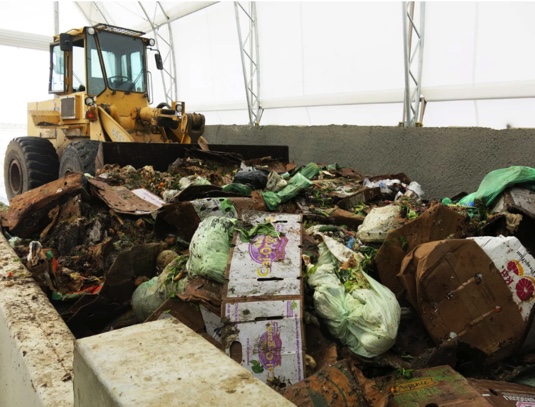
Food is one of the biggest components of life. It is needed to survive for every person on this planet. But, that necessity of food has turned into a harmful and intensive industry that overproduces and contributes to waste in massive quantities.
Energy Consumption
One of the many important issues with food production is energy consumption. According to the Save on Energy Team, in the United States, in 2018, 10.1 quadrillion British thermal units (BTU) were expended on food production alone.
In Colorado, there have been several missions to reduce the energy waste caused by food production. In an NPR article from 2016, Luke Runyon talks about the Heartland Biogas Project, a Northern Colorado initiative that takes food waste and turns it into electricity. This project helps decrease energy waste from food itself, but another problem is the process of actually growing the foods.
Food Production
When it comes to the production of produce, like meat, eggs, and different plants, the energy provided by the food is minuscule in comparison to the energy that is used to grow them.
According to Webber, the U.S. of America uses roughly 10 units of fossil energy to produce one unit of food energy.
In Denver, the Denver Food Vision is an elaborate plan of action for how the city can better its food production practices by 2030.
One of their main goals is to reduce the energy used in food production and transportation. This includes: focusing on buying from local and state farmers, using electric vehicles for transport, and include neighborhood retail locations to encourage less driving to stores like Walmart or Target.
According to Hancock, it also outlines how they will promote more natural farming techniques that would exclude chemicals commonly used in agriculture. It also wants to decrease the amount of wasted energy in water use, farm equipment and land use.
The U.S. undoubtedly has work to do to reduce the amount of energy that’s used. Food is crucial to life but there are better ways to grow produce that can dramatically reduce energy use.
Places, such as Colorado, are ahead of the game, with hundreds of initiatives and proposals that will not only decrease energy usage, but also food waste, and even turn wasted food into more energy!
-
WaterSense: An Invaluable Partnership for Fort Collins Communities
By: Darcy Keown
Fort Collins, Colo — What is WaterSense?
WaterSense is a U.S. Environmental Protection Agency (EPA) program that promotes and enhances water-efficient products and services. The city of Fort Collins became a partner of the WaterSense program to decrease indoor and outdoor water use by opening communities’ eyes to alternative plumbing systems, landscaping ideas, and various other products that work well and save water.
In addition to conserving water for future generations, the WaterSense partnership also helps Fort Collins residents save money on their water bills. As part of Senate Bill 14-103, only WaterSense products are sold in Colorado.
Why is it important?
When it comes to lawns, most people think of the American dream: a lush, green lawn with flowers of choice and other yard decorations. However, this isn’t environmentally sustainable, and living in an arid desert like Colorado, it’s going to cost a lot of water (and money) to maintain.
In terms of production, WaterSense provides an ethical consumer option that supports the environment while helping FoCo residents save money. Under current water rates, the average Colorado resident pays anywhere from $85 to $112 per month. For Fort Collins WatersSense customers, similar bills would be about $30 to $47 (The Coloradoan)
WaterSense-labeled products and services are certified to use at least 20 percent less water, save energy, and perform as well as or better than regular models (EPA). Ethical consumerism is the social phenomenon where consumers take account of wider issues in their purchasing decisions (Buying For Good).
In the past, the idea of the American dream fueled Americans to buy whatever they wanted, forgoing what they needed (The Story of Stuff). This still stands today, although there has been a lot of growth. In recent decades, consumers have been increasingly attuned to social and ethical considerations when it comes to buying products for themselves or their homes.
According to “Buying For Good: Altruism, ethical consumerism, and social policy,” such ethical considerations may potentially be building more bridges across social groups, bringing like-minded individuals together in the manner of social movements. As a Fort Collins resident, you can contribute to this particular social movement by starting (and continuing) to buy WaterSense products and utilize their water-saving tips for the rest of your home.
-
Art from the Heart Podcast: Scott Leneway and Werner Schreiber | Part 1
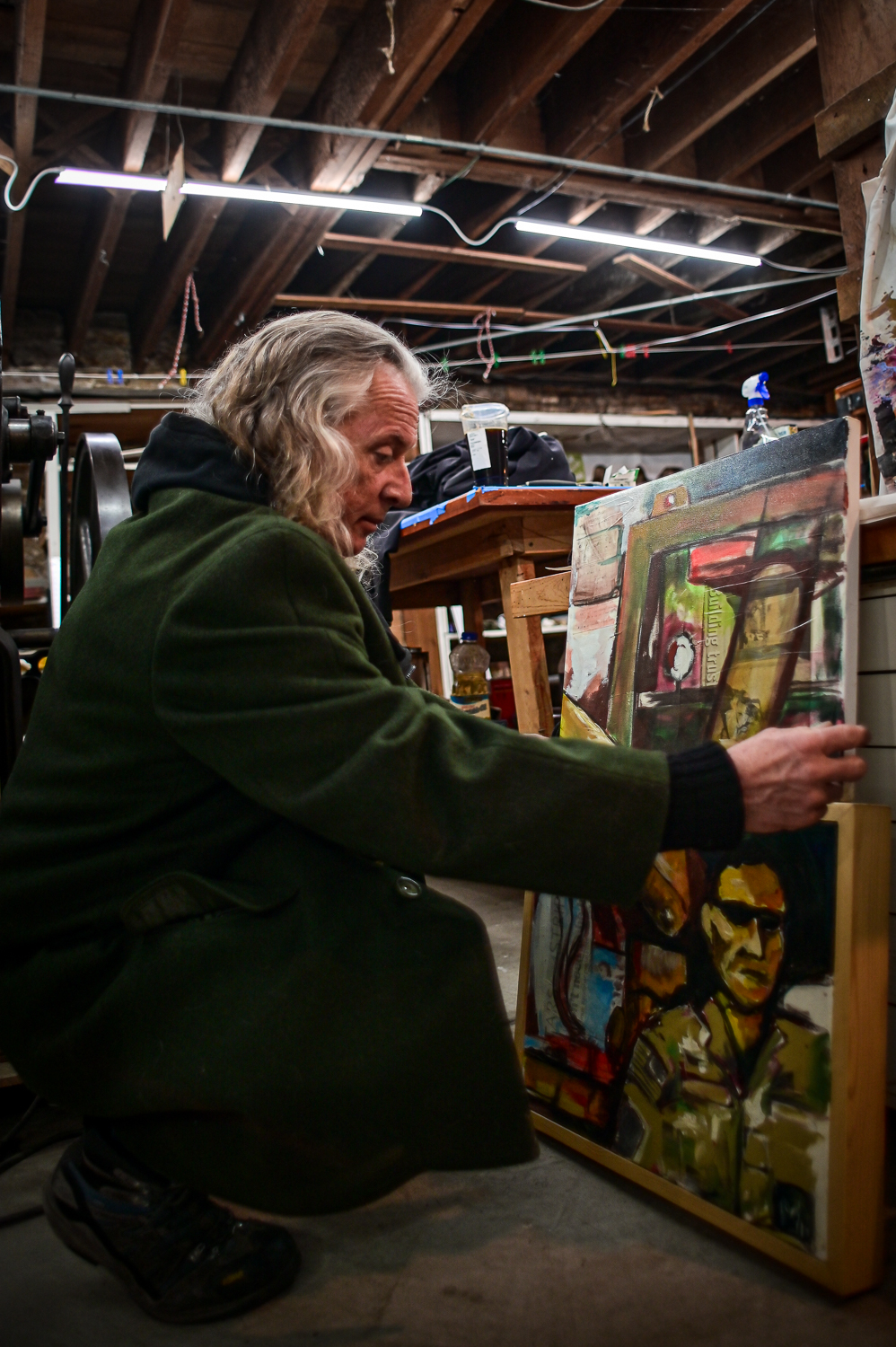
In this segment, I take the audience through an experience with Scott Lenaway, who has served two tours in the Iraq War, he will tell us about the connection of turning to art in the aftermath of his life spend overseas. Werner Schrieber lived through the second world war as a child.
Scott Lenaway’s printmaking studio
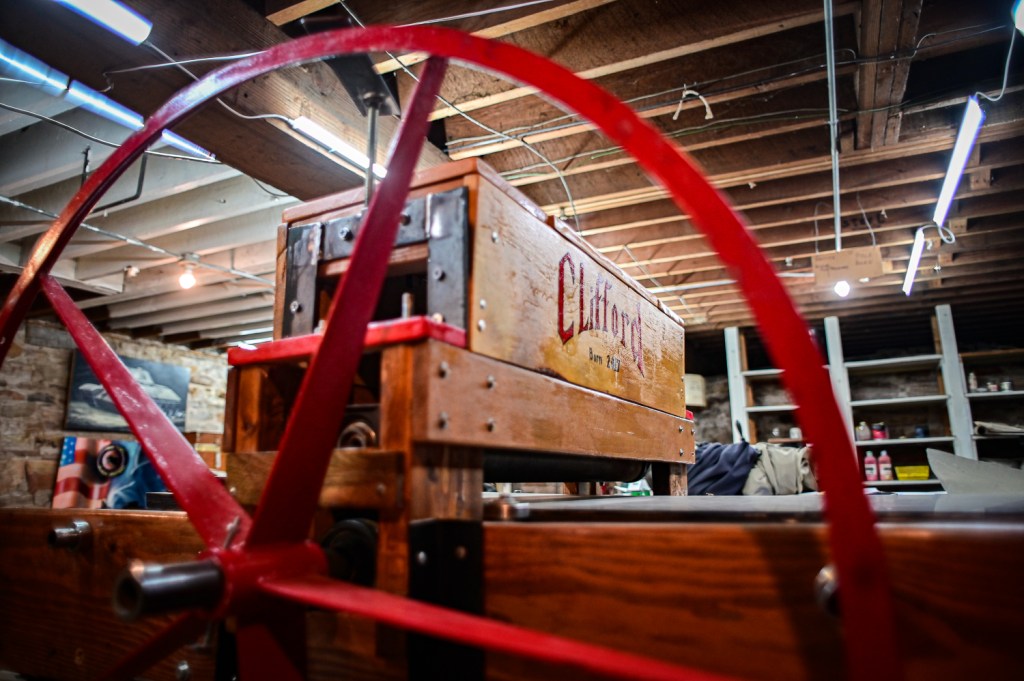
The Clifford machine, handmade by Scott Lenaway, a printmaking artist at the Walnut Creek basement studio in Old Town Fort Collins, Mar. 10. 
Scott Lenaway, printmaking artist in deep thought while looking at his favorite print machine at the Walnut Creek basement studio in Old Town Fort Collins, Mar. 10. 
Scott Lenaway, printmaking artist, showcase organize letters for use on the letterpress at the Walnut Creek basement studio in Old Town Fort Collins, Mar. 10. 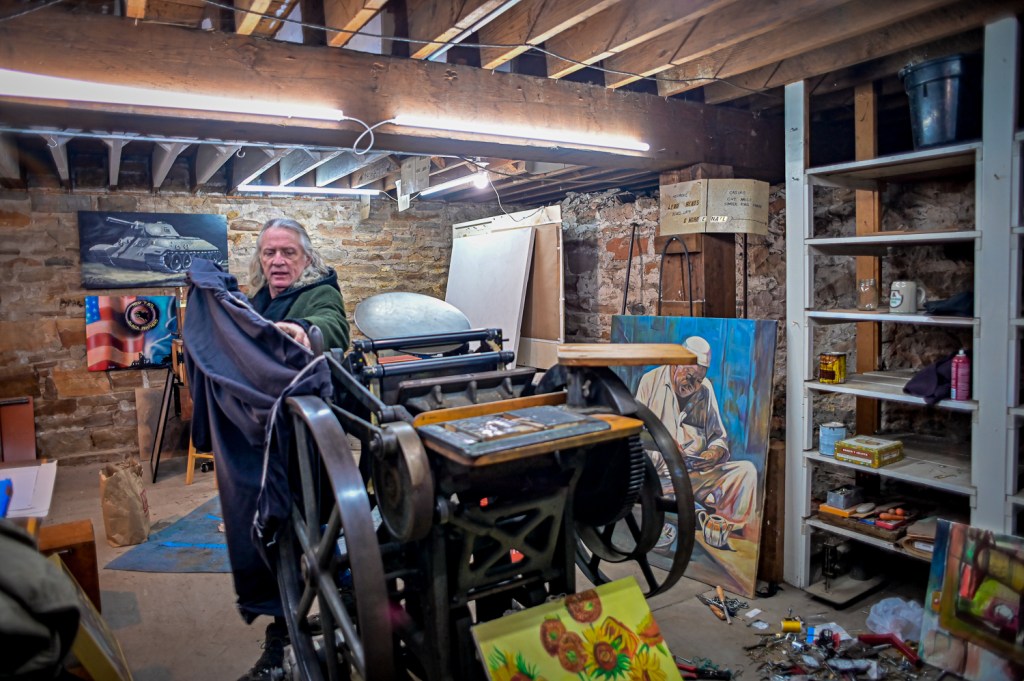
Scott Lenaway, printmaking artist, showcase one of the three letter presses at the Walnut Creek basement studio in Old Town Fort Collins, Mar. 10. 
Scott Lenaway, printmaking artist, uncovers a letterpress printer to display its operation at the Walnut Creek basement studio in Old Town Fort Collins, Mar. 10. 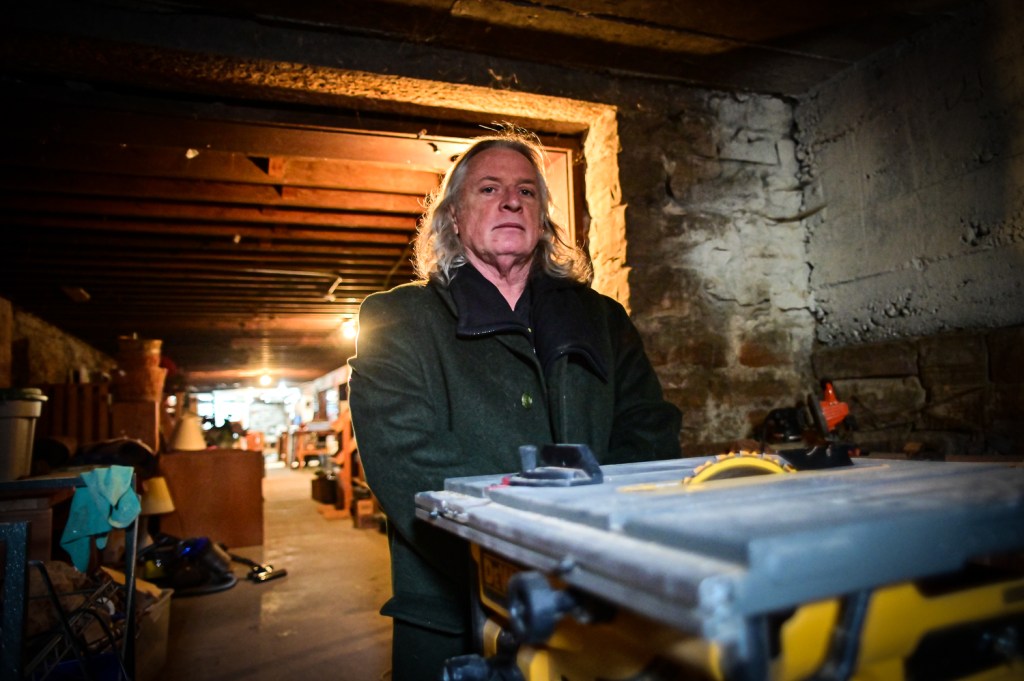
Scott Lenaway, printmaking artist at the Walnut Creek basement studio in Old Town Fort Collins, Mar. 10. 
Scott Lenaway, printmaking artist, features one of his on-going projects of the violin light at the Walnut Creek basement studio in Old Town Fort Collins, Mar. 10. 
at the Walnut Creek basement studio in Old Town Fort Collins, Mar. 10. 
at the Walnut Creek basement studio in Old Town Fort Collins, Mar. 10. 
at the Walnut Creek basement studio in Old Town Fort Collins, Mar. 10. 
Scott Lenaway, printmaking artist has a special connection to his workspace every time passing the red door at the Walnut Creek basement studio in Old Town Fort Collins, Mar. 10. 
Scott Lenaway, printmaking artist, display an old hand drill from his father and grandfather’s toolbox at the Walnut Creek basement studio in Old Town Fort Collins, Mar. 10. 
Painting of a Russian T-34 from Werner Schreiber, a mural artist , given to Scott Lenaway at the Walnut Creek basement studio in Old Town Fort Collins, Mar. 10. Werner Schreiber’s Oak Street Mall murals
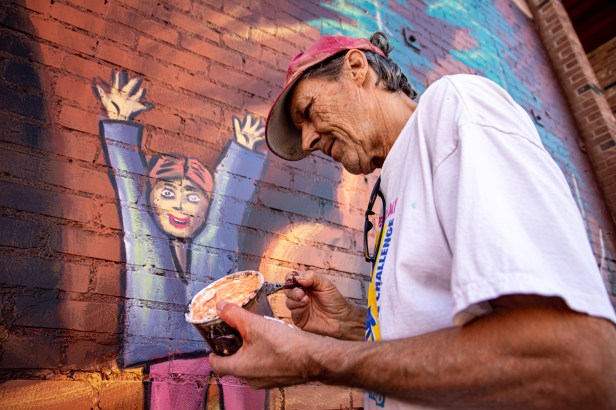
Werner Schreiber paints a mural as a donation towards the care of children in danger of abuse, neglect and abandonment near the Mason Street Parking Lot of Fort Collins, Colorado Nov. 2, 2022. 
Werner Schreiber in his natural way of excitement as he describes the meaning of the mural near the Mason Street Parking Lot in Fort Collins, Colorado Nov. 2, 2022. He was born in Songpa, Germany and came to the United States of America in 1974. 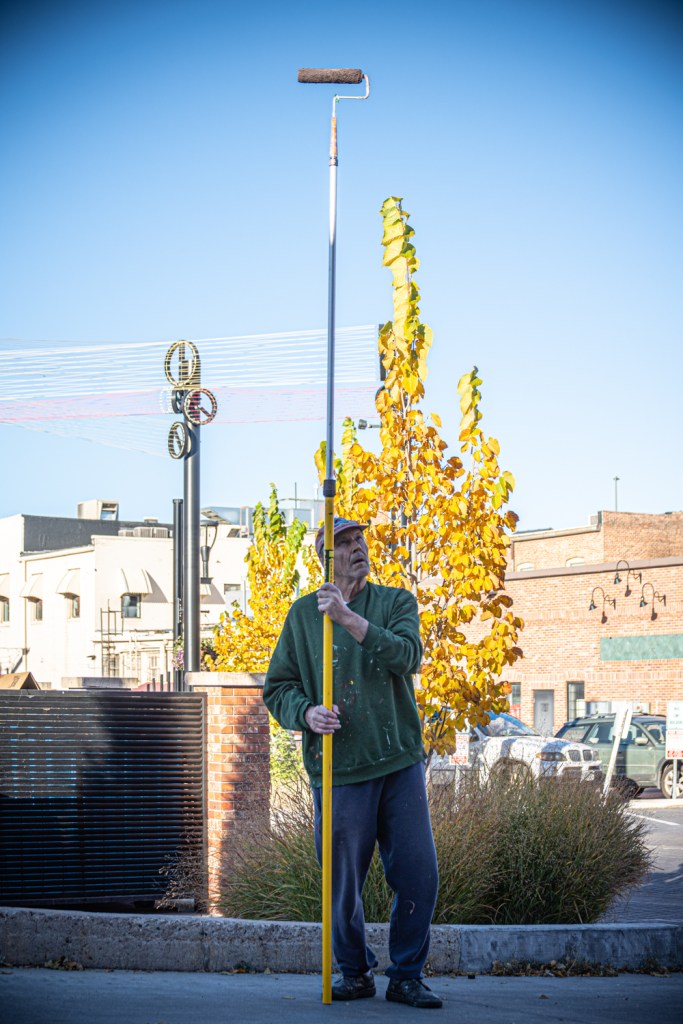
Werner Schreiber reaches for the top with a high extension air brush to fill in the clouds of a donation mural for Realities For Children near the Mason Street Parking Lot in Fort Collins, Colorado Nov. 2, 2022. 

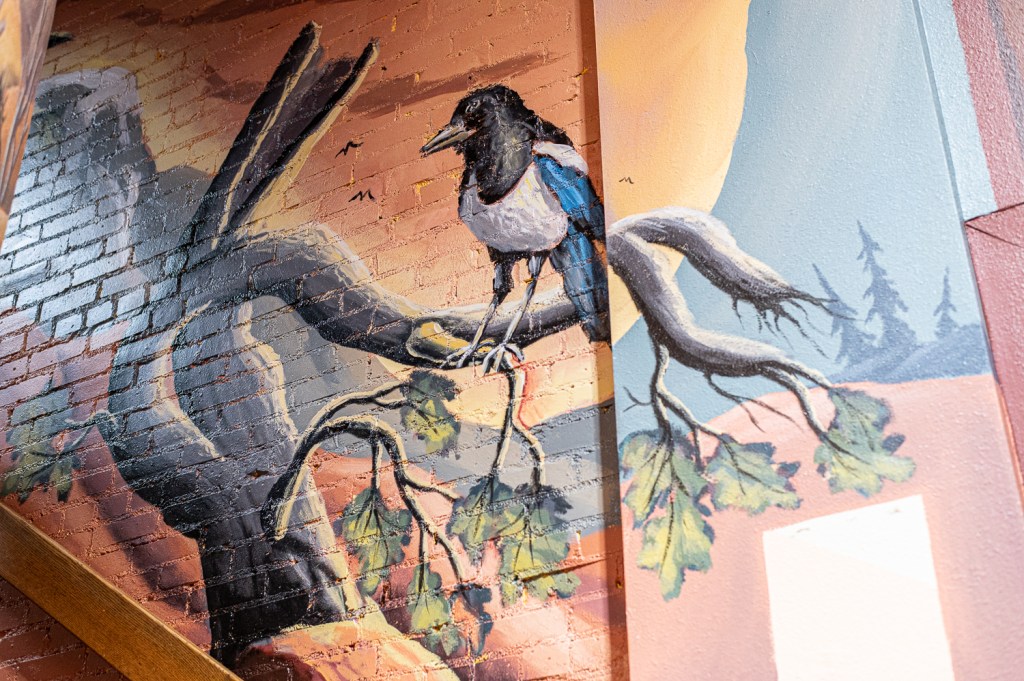
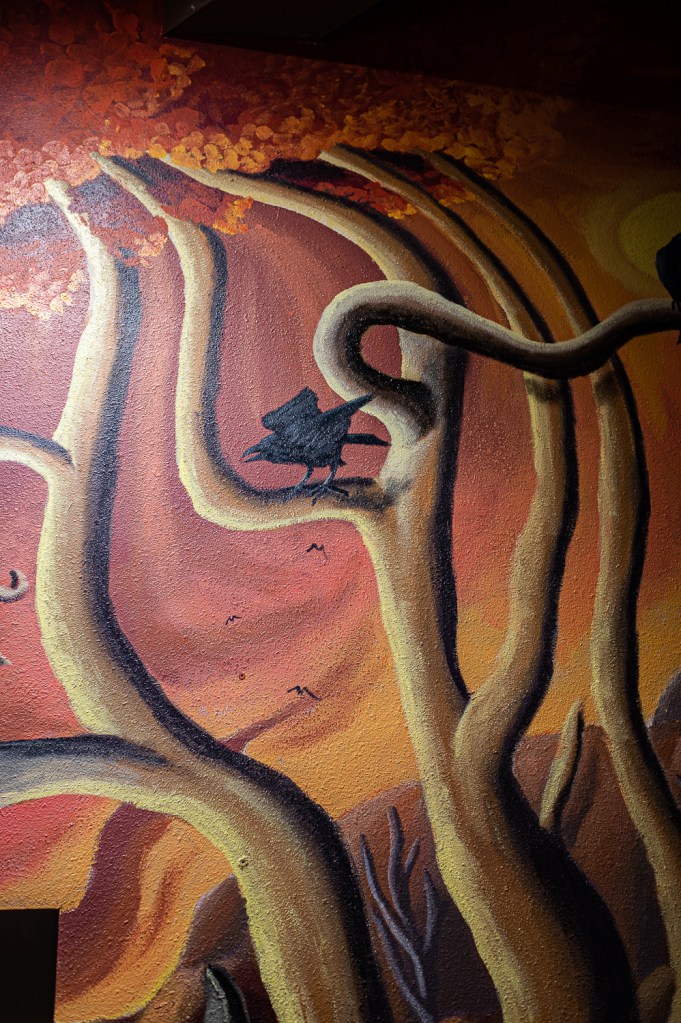
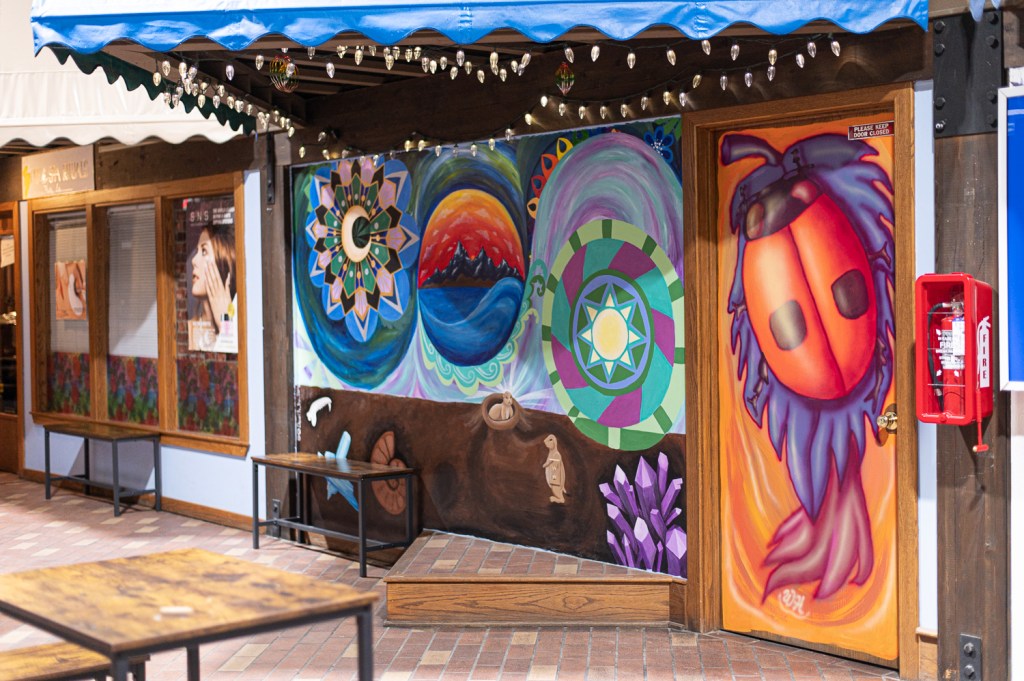

Werner Schreiber, mural artist, works on his pieces at Oak Street Mall in Old Town Mar. 8. 

-
Solar and Consumption
By: Aidan Eure
Fort Collins, Colo. — While Fort Collins is relatively small compared to other urban environments like Denver, energy consumption is still a significant concern. As a result, new programs have been initiated by the city that gives people financial incentives to switch to rentable energy sources such as solar.
In our nation’s current state, energy consumption is a big concern. We consume over two and a half times as much energy as India, whose population dwarfs our own. While the US has recently generated more electricity from renewables than fossil fuels for the first time, there is still a lot of progress to be made.
A peer-reviewed article published by Elsevier states that “there is no question that cutting energy consumption in the United States (and elsewhere in the world) can contribute to substantial reductions in GHG emissions.”
Many people have been switching to sustainable energy sources such as solar to combat the overconsumption of fossil fuel power. Solar is much cleaner than fossil fuels and consistently generates more than adequate power for those who own it.
Resources such as Project Drawdown rank rooftop solar as the 10th most crucial sustainable resource humans can use. Drawdown further states that “solar is replacing electricity generated from coal as well as from natural gas.”
One of the barriers that people encounter to switching to solar is the upfront cost. To amend this concern, cities such as Fort Collins is offering rebates for citizens who produce solar energy. Currently, Fort Collins is offering a maximum of a $1,000 rebate depending on how much energy a household produces.
Fort Collins advertises other incentives, such as solar battery storage, that save energy and reduces the need to generate more power constantly. As of now, over 3000 Fort Collins residents have solar energy, but as more rebate programs and other incentives are brought forward, solar energy should rise in popularity.
-
Chapter 7: Lilacs at Little League
When I first came to Colorado State University, I was initially studying just English Literature, with the goal of going on to become a professor of English. I had never known another individual in my South-Asian community or just any other South-Asian in general with the same goals as me.
But that changed last week.
I was emailing Dr. Aparna Gollapudi in regard to an education abroad program, and I saw that she was an English Professor.
Knowing that she was South-Asian, I reached out to her, explained my project, and asked her for an interview that she excitedly agreed to.
I was thrilled as well to explore the depths of her journey as a South-Asian in academia, where I hope to find myself at some point in the future.
Not only did I learn about my culture and how it relates to Gollapudi’s unique perspective, but I was able to go deeper into the very origins of the STEM and humanities relationship in South Asia, and its roots that go all the way to the British rule of South Asia.
Dr. Aparna Gollapudi
Gollapudi was born and raised in India. She was always drawn to English, but she wasn’t able to study this without her parents attempting to push her into STEM.
She took a lot of medical school entry exams, but didn’t get into one, something she is actually very proud of not accomplishing. She was then able to study English on her own terms.
However, this passion and drive to pursue this side of academia was seen by her father as her giving up on education entirely.
“As soon as I told people I wanted to study English people thought ‘Oh so you’re basically not interested in education anymore,’” Gollapudi said. “‘Is it because you want to get married and be a housewife? What else is an English degree good for?’”
Her parents, who were typically very supportive, had their reservations about her studying English, and the situations in which they had butt heads on the topic were very traumatic for her.
“I think I might have erased some memory of that simply because of how unpleasant and traumatic it was.” She said.
These reservations were somewhat ironic. Gollapudi is a storyteller, a trait she got from her father, and for a period of time, her mother was an actress
Storytelling was in her genetics, yet she was still criticized for it.
The Exclusive Power of the Humanities
Gollapudi brought forth a new perspective of English that I hadn’t really explored before: the very origins of why South-Asian cultures seemed to be STEM-centric.
When India was colonized by the English, the only way for South-Asians to move up socially and economically was by knowing English and being a part of the established British government.
“The humanities, more than STEM, has been a tool of historical oppression and the colonization of the mind.” Gollapudi said. “The British wanted the best and the brightest to be admitted to English speaking schools. The only avenue for people to gain upward mobility was to be a part of the British government.”
English was seen as powerful, but inequitable. There is a cultural value that is placed on the language due to its oppressive history.
Alongside people seeing Gollapudi’s decision to study English as her giving up on education, it was also, seemingly paradoxically, seen as her attempting to be better than others.
“There was also the ‘You’re doing a degree that raises you above other people that are not good speakers of English.’” Gollapudi said. “That fact that I wanted to do English made me aware that I am constructed by a history that is less than equitable.”
It is impossible to say that the relationship between South Asia and the humanities was not shaped by the colonization and oppression that happened during the development of the country.
When India was colonized, British rule changed the educational curriculum to be more centered around the English language.
Their goal was to produce South-Asians that were infused with British culture. English became a priority, as opposed to the study of any of the other 300+ languages spoken in India.
Gollapudi’s relationship to her mother tongue is limited to speaking, she is not able to read or write it. In school she was taught English and Hindi, but was never really taught Hindi literature, the focus was on English Literature.
The South-Asian sense of the humanities was colonized. It wasn’t their own literature and stories, it was that of the people that had taken over their country and changed everything.
“There’s a loss in the humanities that we have been taught to appreciate.” Gollapudi said.
The Importance of Humanities in South-Asian Culture
A common experience South-Asians have on campus here at CSU is being the only student of color in a classroom. I was intrigued to find that this was not just the case for students, but also for professors on campus as well.
Gollapudi has often been the only person of color in many of the classrooms she has taught in, the classes mostly being focused on British literature as well.
She had only recently started to teach a literature class focused on Indian literature and she has loved it.
“Knowing the South-Asian culture they are reading and writing about has a different kind of weight to it,” Gollapudi said. “I hope to do more of it.”
She had pointed out how STEM is seen as something that is typically more masculine, and how there are gender roles present in academia that contribute to the devaluation of the humanities.
South-Asian boys are pushed into STEM because it is seen as more powerful. The culture makes it so that it is more of a letdown for boys to do something not in STEM, as boys are often seen as the men that they will become, with the weight of providing for their future families on their backs.
And the lack of humanities in boys can lead to the lack of vulnerability, emotional expression, and empathy in them as well, which is destructive to the bigger picture of South-Asian relationships as a whole.
The Flowers in Words
“When I first came to the US, I took my son to a little league game,” Gollapudi said. “There was this amazing blooming plant, it was purple and smelled lovely. I asked another parent what it was and it was a lilac. I thought back and I had read poetry about lilacs throughout my entire life, but it wasn’t a part of my everyday life. The kind of literature I read gave me knowledge about parts of the world I had not known.”
The humanities was Gollapudi’s way to travel to different countries, as it is for many people all over the world.
Gollapudi has a cousin in the United States who did not get into the STEM program that he wanted to get into, and he started going to local standup comedy shows without his parents knowing, and he actually discovered that he was a natural talent.
He has become more successful and is able to earn a pretty good living, though it wasn’t what he had initially intended on doing and it’s far from what his parents thought he would be doing with his life.
“And that just makes me so happy,” Gollapudi said. “Not only for him as an individual, but so that he could see he has this other talent in him which he would have never found out about unless there was that shift in his idea of success and the gradual awareness that people could be successful in other ways.”
Gollapudi knew about lilacs through the words she had read. Imagine the spread of South-Asian culture if there were more writers, comedians, and actors. People that spoke about their experiences in India or Bangladesh or Pakistan, about the smells that would fill their homes when their favorite dish is being prepared, or of the flowers that flow in the fields near the villages.
And then, only then, can there be an American on the opposite side of the planet from India, who can experience the scent of an Indian flower in India that they had only read about in a poem.
-
Clean Energy and Quality Living
By: Audrey Brooks
Fort Collins, Colo – One of Fort Collins’ key industries is clean energy. But why should you care? What is clean energy anyway? Sure, it sounds all nice and fancy, I mean it has “clean” in the name. But what does it actually do for us?
So, what is clean energy? Clean energy is any form of energy that uses renewable and sustainable resources and produces a minimal amount of pollution and greenhouse gas emissions– things like Solar, wind, or hydroelectric energy.
The way we consume energy now is not sustainable. However, besides just the environment, clean energy also plays a vital role in economic growth.
Having a strong economy is one of the ways in which clean energy can contribute to the quality of life. Having a strong and thriving economy allows for more financial security for individuals, and more financial security means less stress.
Clean energy can also improve air quality, reduce climate change impact, lower energy costs, and increase energy accessibility. All of these, of course, are nice and in different ways can contribute to the quality of life of individuals and their communities around them.
Have you ever heard the phrase “You are the company you keep?” It’s usually meant as a way to warn people to be wary of who they keep around them. However, part of this saying is based on the fact that attitude is contagious. When people around you are in a good mood it can brighten your mood.
If your friends and neighbors feel good that feeling will often rub off on you. Having a community of people around you who are happy and healthy can have an impact on not only your life outside of the home but your life inside the home because you can get in the habit of being in this good mood.
Overall clean energy is great for the environment, as it not only reduces carbon emissions but is also quite sustainable. On top of this, it can also encourage happy and healthy communities that make for a better quality of life.
-
Importing vs. Growing Produce Locally: Which is Better?
by Audrey Brooks

Introduction
When we think of ways to cut down on pollution to our environment, importing goods may not be the first thing that comes to mind.
After all, vehicles used for transport, such as planes, emit large amounts of carbon dioxide (CO₂) into the atmosphere. But when we dive deeper into the implications of both growing food locally and importing it, we find that importing food might be a solution to reducing the harm to our planet. It is a game of balancing our emissions and reducing them where we can.
Impacts of Locally Grown Produce
With the rise of corporations pushing farmers to produce on a larger scale, they often turn to the use of fertilizers, pesticides, and insecticides. Not only this, but they are incentivized to grow crops that may not be native to their area, which leads to the excessive use of water to sustain those crops. For areas that are arid, such as Colorado, a better alternative may be to import produce that requires a lot of water from more suitable places.
Impacts of Imports
There are many modes of transportation when importing goods; this includes air travel, the use of trucks and railroads, boat travel, and piggyback (trailers). Some modes of transportation can carry more cargo, which means they will not have to make as many trips. When considering what would be best for a community, we have to keep these factors in mind as some modes of transportation produce more CO₂ than others, while others take more trips. Right now, we import most of our produce from other countries, which increases the impact we have on the environment.
How Could Colorado Balance This Better?
As of right now, 86% of Colorado’s water is directed toward agricultural practices because of its semi-arid climate. This is incredibly wasteful as we could be using this water for other activities or storing it for emergency use.
For starters, the water-intensive crops that we produce here could be imported from better suited areas, and our crops could be switched to less water-intensive crops.
Not only would this help us conserve the amount of water we have in our state, but also help the economy by keeping the money in our country instead of buying from outside of the United States of America.
Overall, importing goods from other states in cases where it would be less impactive than growing it in an area that cannot sustain it well, would be better for the environment.
-
Subscribe
Subscribed
Already have a WordPress.com account? Log in now.
 NoCo Convos